Malaria Branch, Division of Parasitic Diseases and Malaria, Center for Global Health, United States Centers for Disease Control and Prevention, Kisumu, Kenya; Malaria Branch, Division of Parasitic Diseases and Malaria, Center for Global Health, Centers for Disease Control and Prevention, Atlanta, GA, USA.
Kwame Nkrumah University of Science and Technology/Agogo Presbyterian Hospital, Agogo, Asante Akyem, Ghana.
Lancet Infect Dis. 2022 Sep;22(9):1329-1342. doi: 10.1016/S1473-3099(22)00273-0. Epub 2022 Jun 23.
Controlled infection studies in malaria-naive adults suggest increased vaccine efficacy for fractional-dose versus full-dose regimens of RTS,S/AS01. We report first results of an ongoing trial assessing different fractional-dose regimens in children, in natural exposure settings.
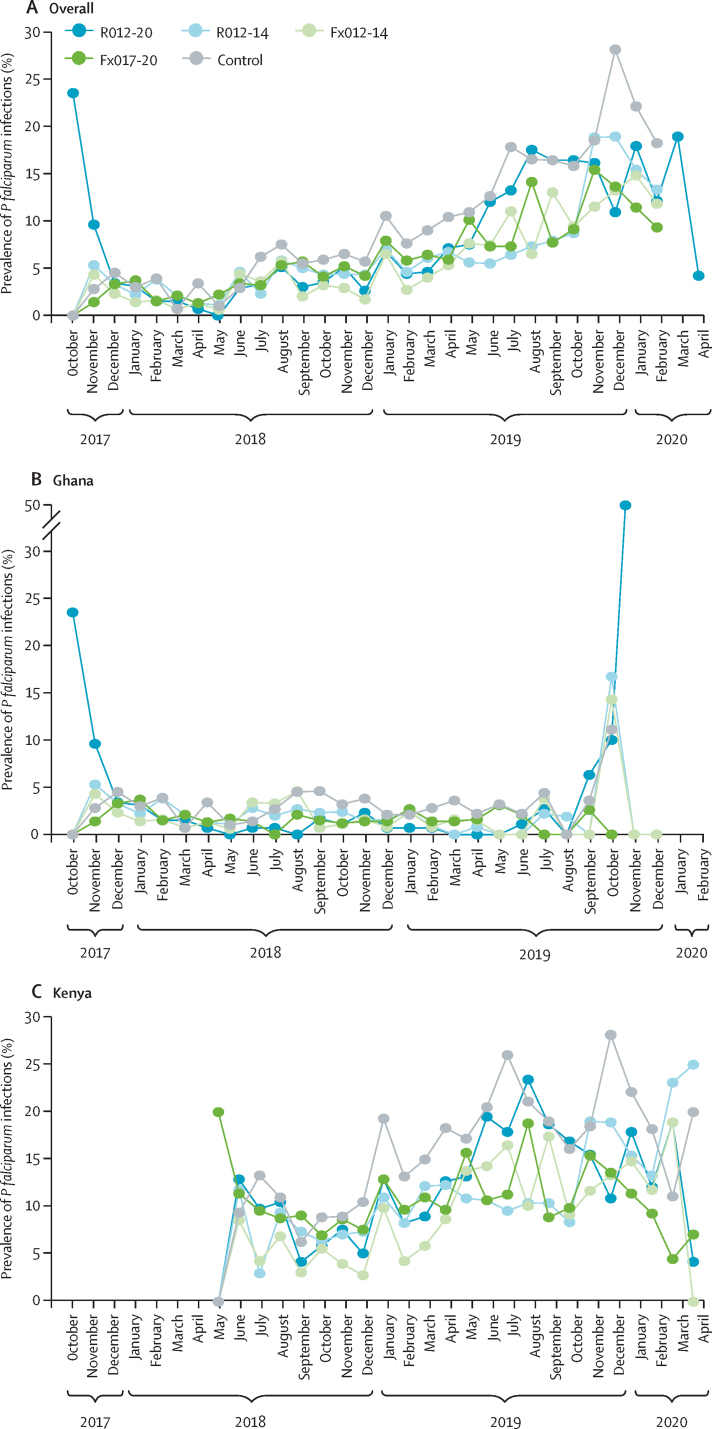
This open-label, phase 2b, randomised controlled trial is conducted at the Malaria Research Center, Agogo, Ashanti Region (Ghana), and the Kenya Medical Research Institute and the US Centers for Disease Control and Prevention site in Siaya County (Kenya). We enrolled children aged 5-17 months without serious acute or chronic illness who had previously received three doses of diphtheria, tetanus, pertussis, and hepatitis B vaccine and at least three doses of oral polio vaccine. Children were randomly assigned (1:1:1:1:1) using a web-based randomisation system with a minimisation procedure accounting for centre to receive rabies control vaccine (M012 schedule) or two full doses of RTS,S/AS01 at month 0 and month 1, followed by either full doses at months 2 and 20 (group R012-20 [standard regimen]), full doses at months 2, 14, 26, and 38 (R012-14), fractional doses at months 2, 14, 26, and 38 (Fx012-14), or fractional doses at months 7, 20, and 32 (Fx017-20). The fractional doses were administered as one fifth (0·1 mL) of the full RTS,S dose (0·5 mL) after reconstitution. All vaccines were administered by intramuscular injection in the left deltoid. The primary outcome was occurrence of clinical malaria cases from month 2·5 until month 14 for the Fx012-14 group versus the pooled R012-14 and R012-20 groups in the per-protocol set. We assessed incremental vaccine efficacy of the Fx012-14 group versus the pooled R012-14 and R012-20 group over 12 months after dose three. Safety was assessed in all children who received at least one vaccine dose. This trial is registered with ClinicalTrials.gov, NCT03276962.
Between Sept 28, 2017, and Sept 25, 2018, 2157 children were enrolled, of whom 1609 were randomly assigned to a treatment group (322 to each RTS,S/AS01 group and 321 to the rabies vaccine control group). 1500 children received at least one study vaccine dose and the per-protocol set comprised 1332 children. Over 12 months after dose three, the incremental vaccine efficacy in the Fx012-14 group versus the pooled R012-14 and R12-20 groups was -21% (95% CI -57 to 7; p=0·15). Up to month 21, serious adverse events occurred in 48 (16%) of 298 children in the R012-20 group, 45 (15%) of 294 in the R012-14 group, 47 (15%) of 304 in the Fx012-14 group, 62 (20%) of 311 in the Fx017-20 group, and 71 (24%) of 293 in the control group, with no safety signals observed.
The Fx012-14 regimen was not superior to the standard regimen over 12 months after dose three. All RTS,S/AS01 regimens provided substantial, similar protection against clinical malaria, suggesting potential flexibility in the recommended dosing regimen and schedule. This, and the effect of annual boosters, will be further evaluated through 50 months of follow-up.
GlaxoSmithKline Biologicals; PATH's Malaria Vaccine Initiative.
在疟疾初发的成年人中进行的受控感染研究表明,RTS,S/AS01 的部分剂量方案比全剂量方案具有更高的疫苗效力。我们报告了一项正在进行的评估儿童不同部分剂量方案的试验的初步结果,该试验在自然暴露环境中进行。
这项开放标签、2b 期、随机对照试验在加纳阿散蒂地区阿戈戈的疟疾研究中心和肯尼亚医学研究所以及美国疾病控制与预防中心在锡亚县的站点进行。我们招募了年龄在 5-17 个月、没有严重急性或慢性疾病、之前已接受过三次白喉、破伤风、百日咳和乙型肝炎疫苗接种和至少三次口服脊髓灰质炎疫苗接种的儿童。儿童使用基于网络的随机系统以 1:1:1:1:1 的比例随机分配,最小化程序考虑到接受狂犬病控制疫苗(M012 时间表)或在 0 月和 1 月接受两次全剂量 RTS,S/AS01,然后在第 2 个月和第 20 个月(标准方案组 R012-20)或在第 2、14、26 和 38 个月(R012-14)接受全剂量、在第 2、14、26 和 38 个月(Fx012-14)接受部分剂量或在第 7、20 和 32 个月(Fx017-20)接受部分剂量。部分剂量在复溶后作为全剂量 RTS,S 剂量(0.5 毫升)的五分之一(0.1 毫升)给予。所有疫苗均通过左三角肌肌内注射给予。主要终点是 Fx012-14 组在第 2.5 个月至第 14 个月期间与 R012-14 和 R012-20 组的临床疟疾病例发生情况,在方案设定中评估。我们评估了 Fx012-14 组相对于 R012-14 和 R012-20 组在接种第三剂后 12 个月的增量疫苗效力。在所有接受至少一剂疫苗的儿童中评估安全性。该试验在 ClinicalTrials.gov 上注册,NCT03276962。
2017 年 9 月 28 日至 2018 年 9 月 25 日期间,共纳入 2157 名儿童,其中 1609 名随机分配至治疗组(每组 RTS,S/AS01 组 322 名,狂犬病疫苗对照组 321 名)。1500 名儿童接受了至少一剂研究疫苗,方案设定包括 1332 名儿童。在接种第三剂后 12 个月,Fx012-14 组相对于 R012-14 和 R12-20 组的增量疫苗效力为-21%(95%CI-57 至 7;p=0.15)。截至第 21 个月,在 R012-20 组中,48 名(16%)298 名儿童、R012-14 组中 45 名(15%)294 名儿童、Fx012-14 组中 47 名(15%)304 名儿童、Fx017-20 组中 62 名(20%)311 名儿童和对照组中 71 名(24%)293 名儿童发生严重不良事件,未观察到安全信号。
在接种第三剂后 12 个月,Fx012-14 方案并不优于标准方案。所有 RTS,S/AS01 方案均对临床疟疾提供了实质性的、相似的保护,这表明推荐的给药方案和时间表可能具有一定的灵活性。这一点,以及每年加强针的效果,将通过 50 个月的随访进一步评估。
葛兰素史克生物制品公司;PATH 的疟疾疫苗倡议。