
改变氯酸钾的物态以改善铝/三氧化钼纳米铝热剂的热性能和燃烧性能。
Changes in the state of matter of KCIO to improve thermal and combustion properties of Al/MoO nanothermite.
作者信息
Chen Jialin, Li Shutao, Dai Mengnan, An Ming, Song Rui, Chen Yeqing, Song Jiaxing, Tian Quanwei, Zhong Xiting, Yan Qiushi
机构信息
Institute of Defense Engineering, AMS, PLA, Beijing, China.
School of Physics, Southeast University, Nanjing, China.
出版信息
BMC Chem. 2024 May 9;18(1):91. doi: 10.1186/s13065-024-01202-6.
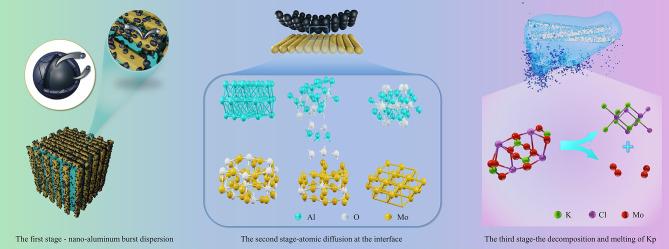
To improve the thermal and combustion properties of nanothermites, a design theory of changing the state of matter and structural state of the reactants during reaction was proposed. The Al/MoO/KClO (Kp) nanothermite was prepared and the Al/MoO nanothermite was used as a control. SEM and XRD were used to characterize the nanothermites; DSC was used to test thermal properties; and constant volume and open combustion tests were performed to examine their combustion performance. Phase and morphology characterization of the combustion products were performed to reveal the mechanism of the aluminothermic reaction. The results show that the Al/MoO/Kp nanothermite exhibited excellent thermal properties, with a total heat release of 1976 J·g, increasing by approximately 33% of 1486 J·g of the Al/MoO nanothermite, and activation energy of 269.66 kJ·mol, which demonstrated higher stability than the Al/MoO nanothermite (205.64 kJ·mol). During the combustion test, the peak pressure of the Al/MoO/Kp nanothermite was 0.751 MPa, and the average pressure rise rate was 25.03 MPa·s, much higher than 0.188 MPa and 6.27 MPa·s of the Al/MoO nanothermite. The combustion products of Al/MoO nanothermite were AlO, MoO, and Mo, indicating insufficient combustion and incomplete reaction, whereas, the combustion products of Al/MoO/Kp nanothermite were AlO, MoO, and KCl, indicating complete reaction. Their "coral-like" morphology was the effect of reactants solidifying after melting during the combustion process. The characterization of reactants and pressure test during combustion reveals the three stages of aluminothermic reaction in thermites. The excellent thermal and combustion performance of Al/MoO/Kp nanothermite is attributed to the melt and decomposition of Kp into O in the third stage. This study provides new ideas and guidance for the design of high-performance nanothermites.
为改善纳米铝热剂的热性能和燃烧性能,提出了一种在反应过程中改变反应物物态和结构状态的设计理论。制备了Al/MoO/KClO(Kp)纳米铝热剂,并将Al/MoO纳米铝热剂用作对照。采用扫描电子显微镜(SEM)和X射线衍射仪(XRD)对纳米铝热剂进行表征;用差示扫描量热法(DSC)测试热性能;进行定容燃烧试验和开放燃烧试验以考察其燃烧性能。对燃烧产物进行相和形貌表征以揭示铝热反应机理。结果表明,Al/MoO/Kp纳米铝热剂表现出优异的热性能,总热释放量为1976 J·g,比Al/MoO纳米铝热剂的1486 J·g增加了约33%,活化能为269.66 kJ·mol,显示出比Al/MoO纳米铝热剂(205.64 kJ·mol)更高的稳定性。在燃烧试验中,Al/MoO/Kp纳米铝热剂的峰值压力为0.751 MPa,平均压力上升速率为25.03 MPa·s,远高于Al/MoO纳米铝热剂的0.188 MPa和6.27 MPa·s。Al/MoO纳米铝热剂的燃烧产物为AlO、MoO和Mo,表明燃烧不充分且反应不完全,而Al/MoO/Kp纳米铝热剂的燃烧产物为AlO、MoO和KCl,表明反应完全。它们“珊瑚状”的形貌是燃烧过程中反应物熔化后凝固的结果。反应物表征和燃烧过程中的压力测试揭示了铝热剂中铝热反应的三个阶段。Al/MoO/Kp纳米铝热剂优异的热性能和燃烧性能归因于Kp在第三阶段熔化并分解为O。本研究为高性能纳米铝热剂的设计提供了新的思路和指导。


 Zotero 插件