Agency for Science, Technology and Research (A*STAR), Singapore Institute of Food and Biotechnology Innovation, 31 Biopolis Way, Singapore, 138869, Singapore.
NUS Graduate School for Integrated Sciences and Engineering, National University of Singapore, 21 Lower Kent Ridge Road, Singapore, 119077, Singapore.
Microb Cell Fact. 2024 May 9;23(1):121. doi: 10.1186/s12934-024-02365-6.
Mycosporine-like amino acids (MAAs) are a class of strongly UV-absorbing compounds produced by cyanobacteria, algae and corals and are promising candidates for natural sunscreen components. Low MAA yields from natural sources, coupled with difficulties in culturing its native producers, have catalyzed synthetic biology-guided approaches to produce MAAs in tractable microbial hosts like Escherichia coli, Saccharomyces cerevisiae and Corynebacterium glutamicum. However, the MAA titres obtained in these hosts are still low, necessitating a thorough understanding of cellular factors regulating MAA production.
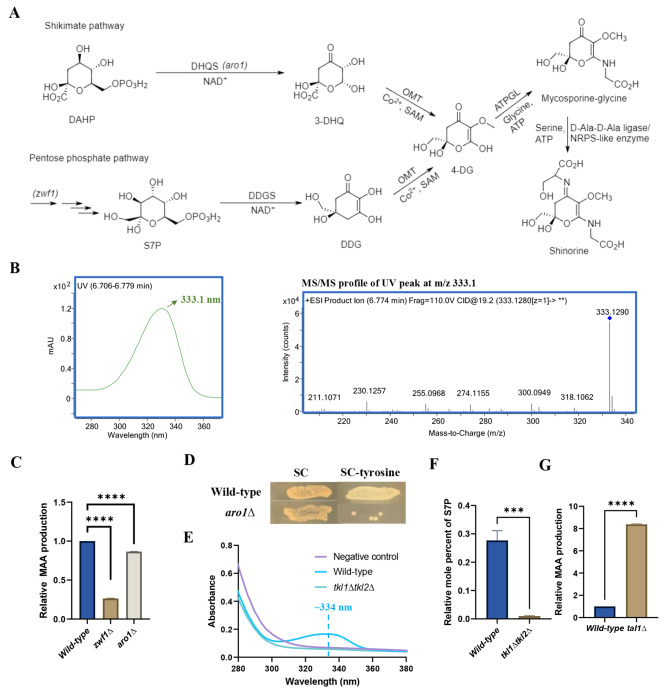
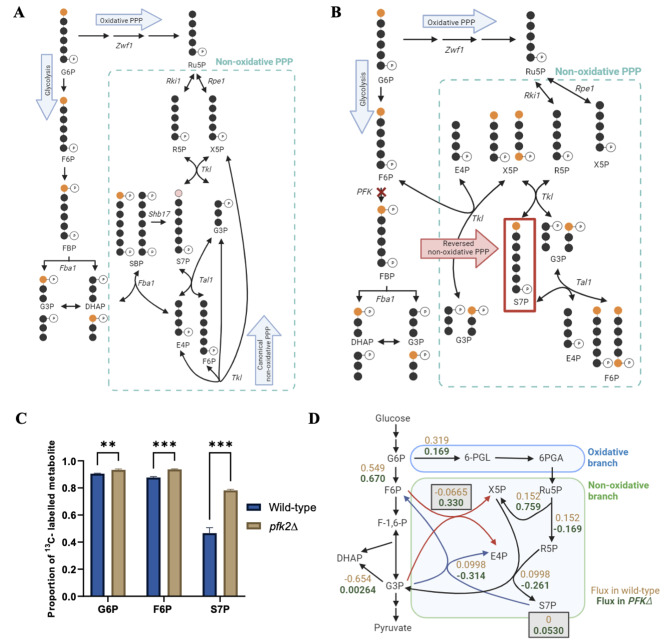
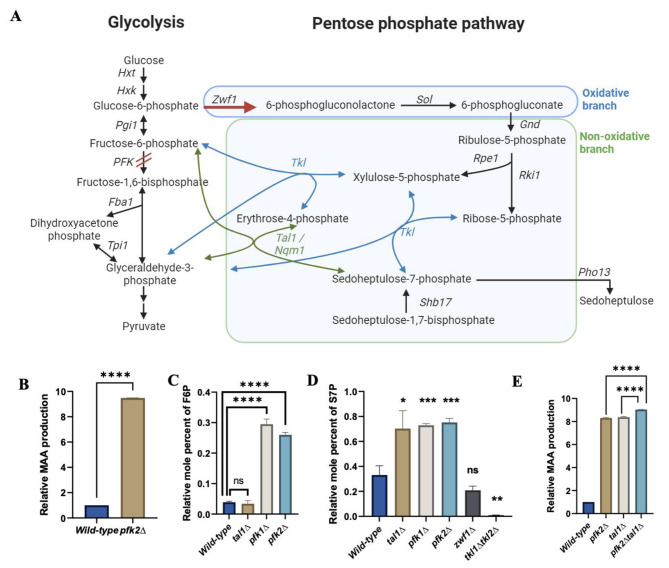
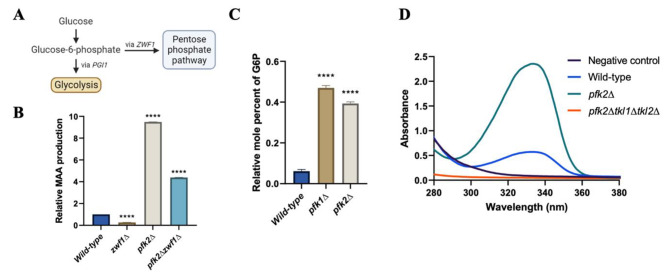
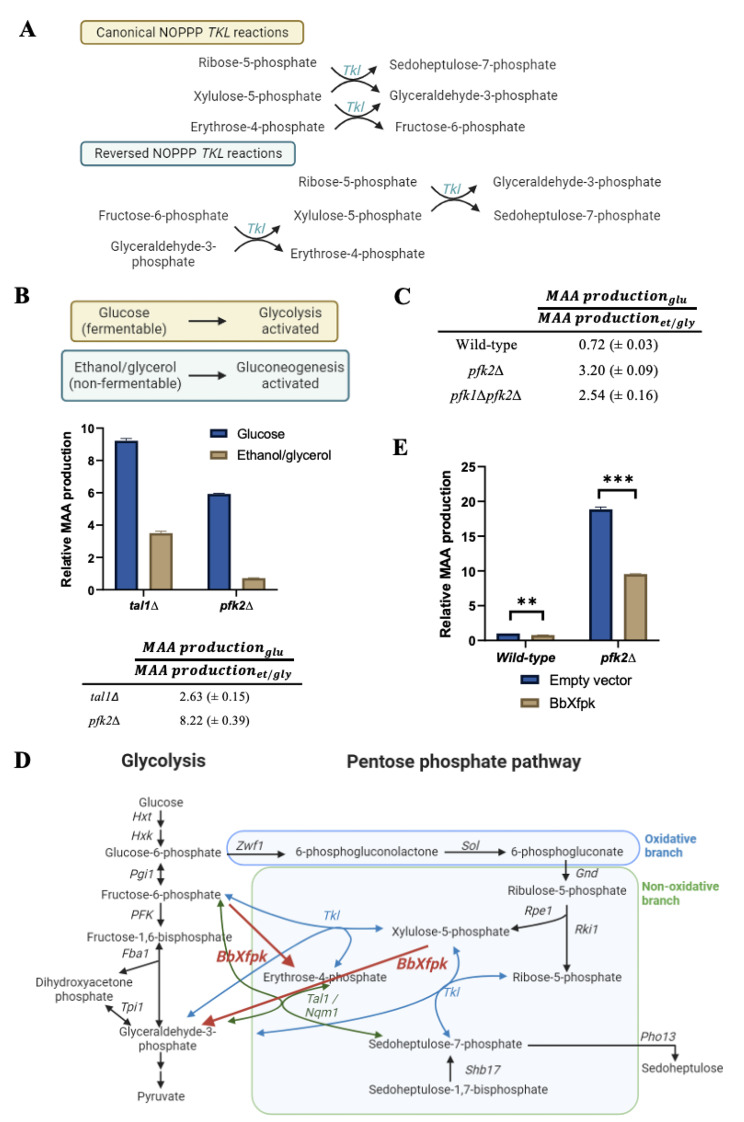
To delineate factors that regulate MAA production, we constructed a shinorine (mycosporine-glycine-serine) producing yeast strain by expressing the four MAA biosynthetic enzymes from Nostoc punctiforme in Saccharomyces cerevisiae. We show that shinorine is produced from the pentose phosphate pathway intermediate sedoheptulose 7-phosphate (S7P), and not from the shikimate pathway intermediate 3-dehydroquinate (3DHQ) as previously suggested. Deletions of transaldolase (TAL1) and phosphofructokinase (PFK1/PFK2) genes boosted S7P/shinorine production via independent mechanisms. Unexpectedly, the enhanced S7P/shinorine production in the PFK mutants was not entirely due to increased flux towards the pentose phosphate pathway. We provide multiple lines of evidence in support of a reversed pathway between glycolysis and the non-oxidative pentose phosphate pathway (NOPPP) that boosts S7P/shinorine production in the phosphofructokinase mutant cells.
Reversing the direction of flux between glycolysis and the NOPPP offers a novel metabolic engineering strategy in Saccharomyces cerevisiae.
肌肽类似氨基酸(MAAs)是一类具有强紫外线吸收能力的化合物,由蓝细菌、藻类和珊瑚产生,是天然防晒霜成分的有前途的候选物。从天然来源获得的 MAAs 产量低,加上培养其天然生产者的困难,促使人们采用合成生物学方法,在易于处理的微生物宿主如大肠杆菌、酿酒酵母和谷氨酸棒杆菌中生产 MAAs。然而,在这些宿主中获得的 MAA 产量仍然很低,这需要对调节 MAA 生产的细胞因素有透彻的了解。
为了描绘调节 MAA 生产的因素,我们通过在酿酒酵母中表达来自聚球藻的四个 MAA 生物合成酶,构建了一种 shinorine(肌肽-甘氨酸-丝氨酸)生产酵母菌株。我们表明 shinorine 是由戊糖磷酸途径中间体 sedoheptulose 7-phosphate(S7P)产生的,而不是如先前所述的由莽草酸途径中间体 3-dehydroquinate(3DHQ)产生的。转醛醇酶(TAL1)和磷酸果糖激酶(PFK1/PFK2)基因的缺失通过独立的机制促进了 S7P/shinorine 的生产。出乎意料的是,PFK 突变体中增强的 S7P/shinorine 生产并非完全归因于戊糖磷酸途径通量的增加。我们提供了多条证据支持糖酵解和非氧化戊糖磷酸途径(NOPPP)之间的反向途径,该途径可促进磷酸果糖激酶突变体细胞中的 S7P/shinorine 生产。
糖酵解和 NOPPP 之间通量方向的逆转为酿酒酵母提供了一种新的代谢工程策略。