CNRS UMR 8003 Paris University, SSPIN, Neuroscience Institute, Team "Mitochondria, Apoptosis and Autophagy Signaling", Campus Saint-Germain, Paris, France.
INSERM U1151, Institut Necker Enfants Malades (INEM), Campus Necker, Université Paris Cité, Paris, France.
PLoS One. 2024 May 10;19(5):e0302701. doi: 10.1371/journal.pone.0302701. eCollection 2024.
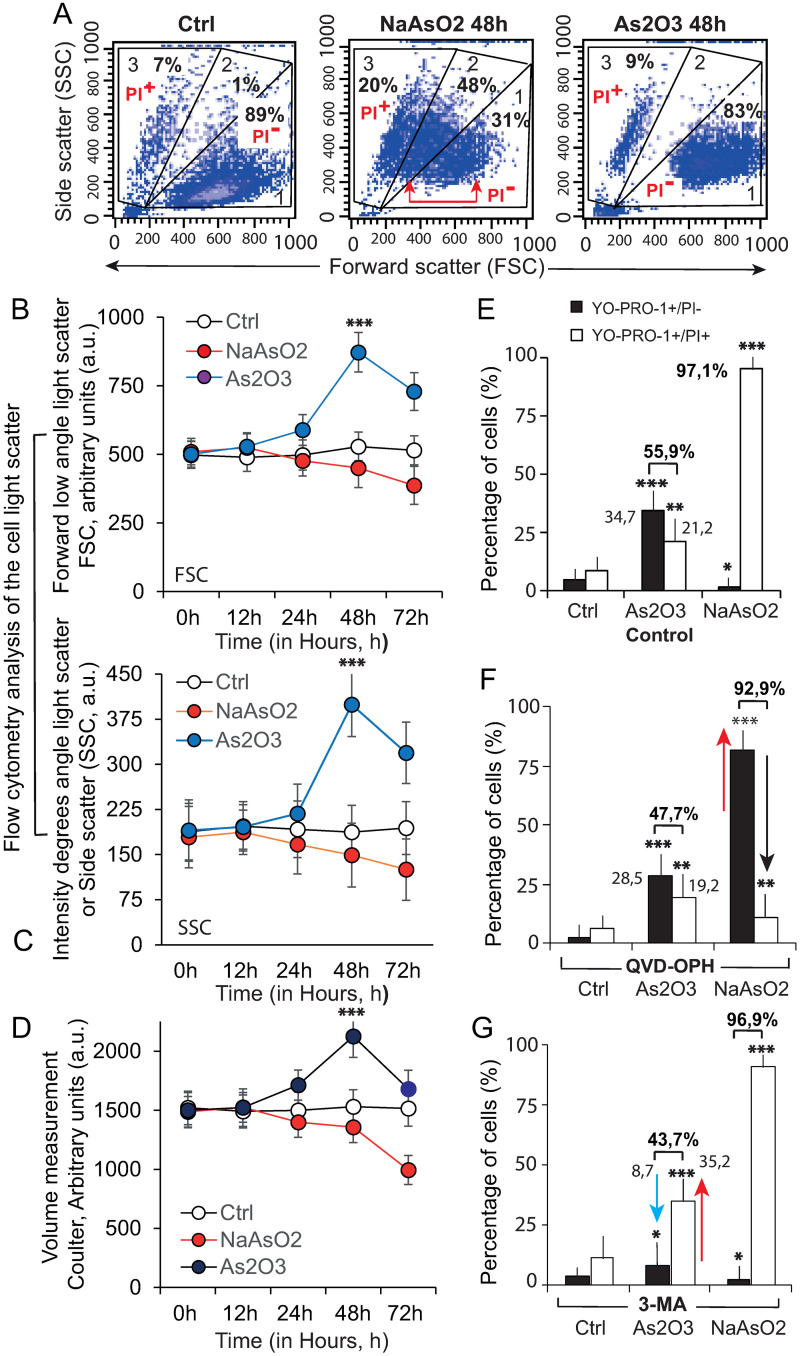
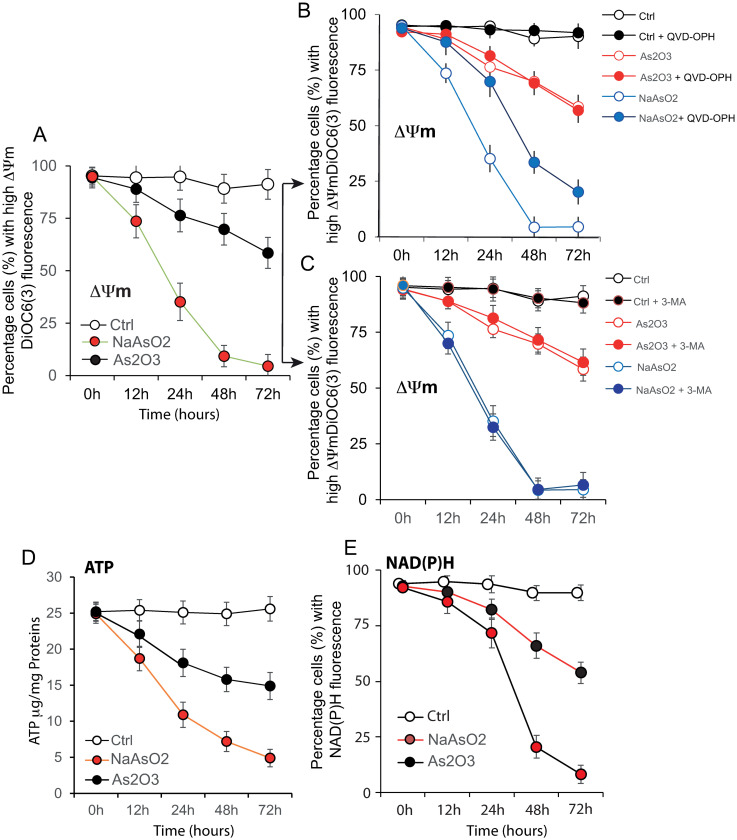
Although the toxicity of arsenic depends on its chemical forms, few studies have taken into account the ambiguous phenomenon that sodium arsenite (NaAsO2) acts as a potent carcinogen while arsenic trioxide (ATO, As2O3) serves as an effective therapeutic agent in lymphoma, suggesting that NaAsO2 and As2O3 may act via paradoxical ways to either promote or inhibit cancer pathogenesis. Here, we compared the cellular response of the two arsenical compounds, NaAsO2 and As2O3, on the Burkitt lymphoma cell model, the Epstein Barr Virus (EBV)-positive P3HR1 cells. Using flow cytometry and biochemistry analyses, we showed that a NaAsO2 treatment induces P3HR1 cell death, combined with drastic drops in ΔΨm, NAD(P)H and ATP levels. In contrast, As2O3-treated cells resist to cell death, with a moderate reduction of ΔΨm, NAD(P)H and ATP. While both compounds block cells in G2/M and affect their protein carbonylation and lipid peroxidation, As2O3 induces a milder increase in superoxide anions and H2O2 than NaAsO2, associated to a milder inhibition of antioxidant defenses. By electron microscopy, RT-qPCR and image cytometry analyses, we showed that As2O3-treated cells display an overall autophagic response, combined with mitophagy and an unfolded protein response, characteristics that were not observed following a NaAsO2 treatment. As previous works showed that As2O3 reactivates EBV in P3HR1 cells, we treated the EBV- Ramos-1 cells and showed that autophagy was not induced in these EBV- cells upon As2O3 treatment suggesting that the boost of autophagy observed in As2O3-treated P3HR1 cells could be due to the presence of EBV in these cells. Overall, our results suggest that As2O3 is an autophagic inducer which action is enhanced when EBV is present in the cells, in contrast to NaAsO2, which induces cell death. That's why As2O3 is combined with other chemicals, as all-trans retinoic acid, to better target cancer cells in therapeutic treatments.
虽然砷的毒性取决于其化学形式,但很少有研究考虑到亚砷酸钠(NaAsO2)作为一种强效致癌剂,而三氧化二砷(ATO,As2O3)在淋巴瘤中作为一种有效的治疗剂的这种模糊现象,这表明 NaAsO2 和 As2O3 可能通过矛盾的方式促进或抑制癌症发生。在这里,我们比较了两种砷化合物,亚砷酸钠(NaAsO2)和三氧化二砷(As2O3)对 Burkitt 淋巴瘤细胞模型,即 Epstein Barr 病毒(EBV)阳性 P3HR1 细胞的细胞反应。通过流式细胞术和生物化学分析,我们表明 NaAsO2 处理会诱导 P3HR1 细胞死亡,并伴有ΔΨm、NAD(P)H 和 ATP 水平的急剧下降。相比之下,As2O3 处理的细胞抵抗细胞死亡,ΔΨm、NAD(P)H 和 ATP 水平适度降低。虽然这两种化合物都能阻止细胞进入 G2/M 期,并影响其蛋白质羰基化和脂质过氧化,但 As2O3 诱导的超氧阴离子和 H2O2 增加比 NaAsO2 温和,同时抗氧化防御的抑制也较温和。通过电子显微镜、RT-qPCR 和图像细胞计数分析,我们表明 As2O3 处理的细胞显示出整体自噬反应,伴有线粒体自噬和未折叠蛋白反应,而 NaAsO2 处理后则没有观察到这些反应。由于先前的工作表明 As2O3 可使 EBV 在 P3HR1 细胞中重新激活,因此我们用 EBV-Ramos-1 细胞进行了处理,并表明在这些 EBV-细胞中,As2O3 处理不会诱导自噬,这表明在 As2O3 处理的 P3HR1 细胞中观察到的自噬增加可能是由于这些细胞中存在 EBV。总的来说,我们的结果表明,As2O3 是一种自噬诱导剂,当 EBV 存在于细胞中时,其作用会增强,而 NaAsO2 则会诱导细胞死亡。这就是为什么 As2O3 与其他化学物质(如全反式维甲酸)联合使用,以在治疗中更好地靶向癌细胞。