Muffly Lori, Liang Emily C, Dolan J Gregory, Pulsipher Michael A
Division of Blood and Marrow Transplantation, Department of Medicine, Stanford University School of Medicine, Stanford, CA.
Division of Hematology and Oncology, Department of Medicine, University of Washington, Seattle, WA.
Blood. 2024 Jul 18;144(3):253-261. doi: 10.1182/blood.2023023699.
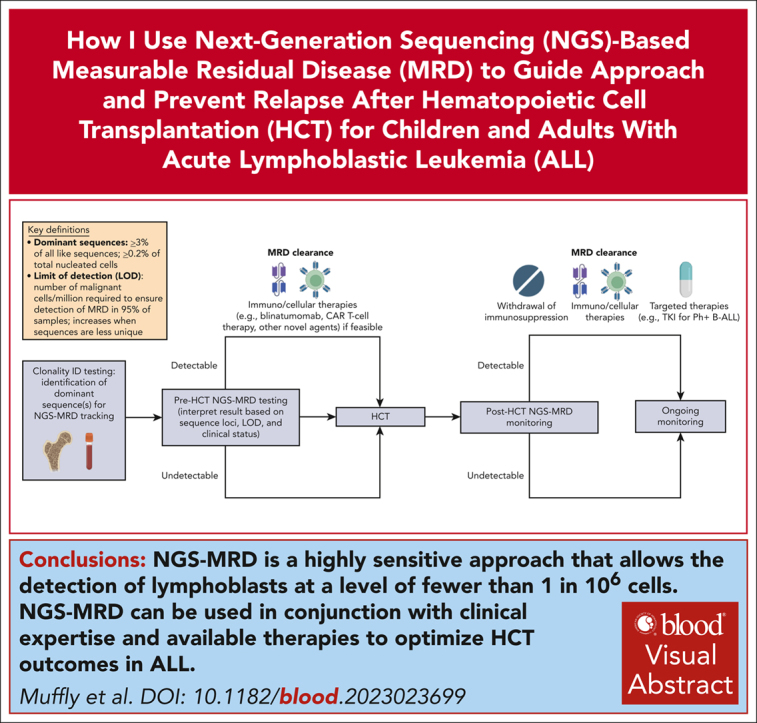
Measurable residual disease (MRD) evaluation by multiparameter flow cytometry (MFC) or quantitative polymerase chain reaction methods is an established standard of care for assessing risk of relapse before or after hematopoietic cell transplantation (HCT) for acute lymphoblastic leukemia (ALL). Next-generation sequencing (NGS)-MRD has emerged as a highly effective approach that allows for the detection of lymphoblasts at a level of <1 in 106 nucleated cells, increasing sensitivity of ALL detection by 2 to 3 logs. Early studies have shown superior results compared with MFC and suggest that NGS-MRD may allow for the determination of patients in whom reduced toxicity transplant preparative approaches could be deployed without sacrificing outcomes. Many centers/study groups have implemented immune modulation approaches based on MRD measurements that have resulted in improved outcomes. Challenges remain with NGS-MRD, because it is not commercially available in many countries, and interpretation of results can be complex. Through patient case review, discussion of relevant studies, and detailed expert opinion, we share our approach to NGS-MRD testing before and after HCT in pediatric and adult ALL. Improved pre-HCT risk classification and post-HCT monitoring for relapse in bone marrow and less invasive peripheral blood monitoring by NGS-MRD may lead to alternative approaches to prevent relapse in patients undergoing this challenging procedure.
通过多参数流式细胞术(MFC)或定量聚合酶链反应方法进行的可测量残留病(MRD)评估,是评估急性淋巴细胞白血病(ALL)造血细胞移植(HCT)前后复发风险的既定标准治疗方法。新一代测序(NGS)-MRD已成为一种高效方法,能够检测出每106个有核细胞中少于1个的淋巴母细胞,将ALL检测的灵敏度提高2至3个对数。早期研究显示,与MFC相比,其结果更优,这表明NGS-MRD可能有助于确定哪些患者可以采用毒性降低的移植预处理方法而不影响疗效。许多中心/研究小组已基于MRD测量实施免疫调节方法,从而改善了治疗结果。NGS-MRD仍面临挑战,因为它在许多国家尚未商业化,且结果解读可能很复杂。通过患者病例回顾、相关研究讨论以及详细的专家意见,我们分享我们在儿科和成人ALL患者HCT前后进行NGS-MRD检测的方法。通过NGS-MRD改善HCT前风险分类以及HCT后骨髓复发监测和侵入性较小的外周血监测,可能会带来预防接受这一具有挑战性手术的患者复发的替代方法。