Migliorini Filippo, Coppola Francesco, D'Addona Alessio, Rosolani Marco, Della Rocca Federico
Department of Orthopaedics and Trauma Surgery, Academic Hospital of Bolzano (SABES-ASDAA), Teaching Hospital of the Paracelsus Medical University, 39100 Bolzano, Italy.
Residency Program, University Federico II of Naples, 80131 Naples, Italy.
J Clin Med. 2024 Apr 23;13(9):2459. doi: 10.3390/jcm13092459.
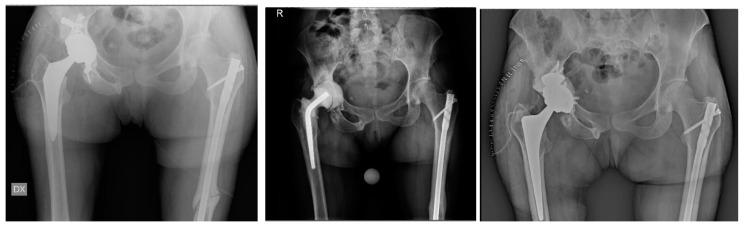
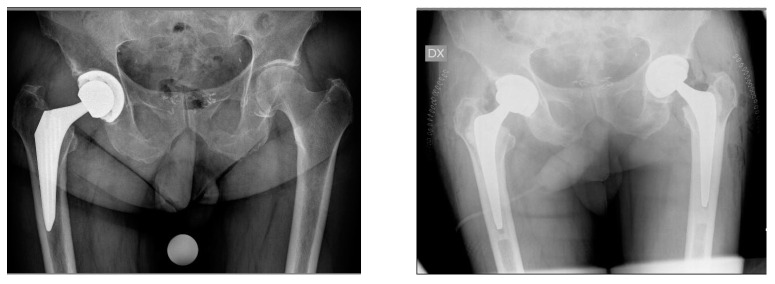
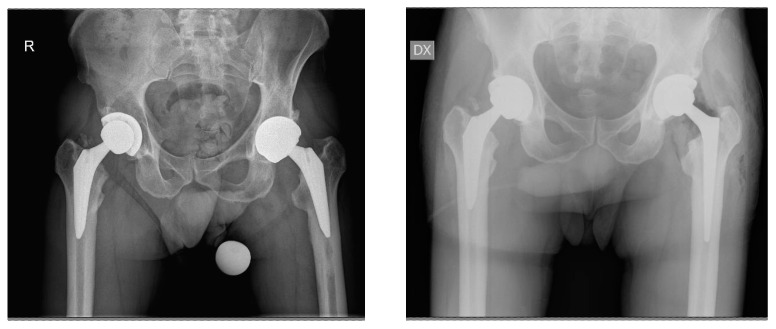
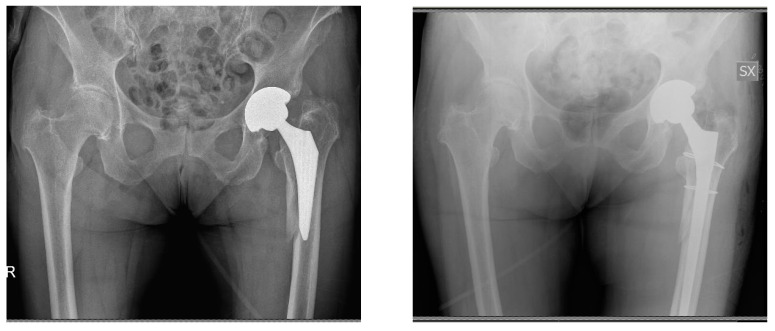
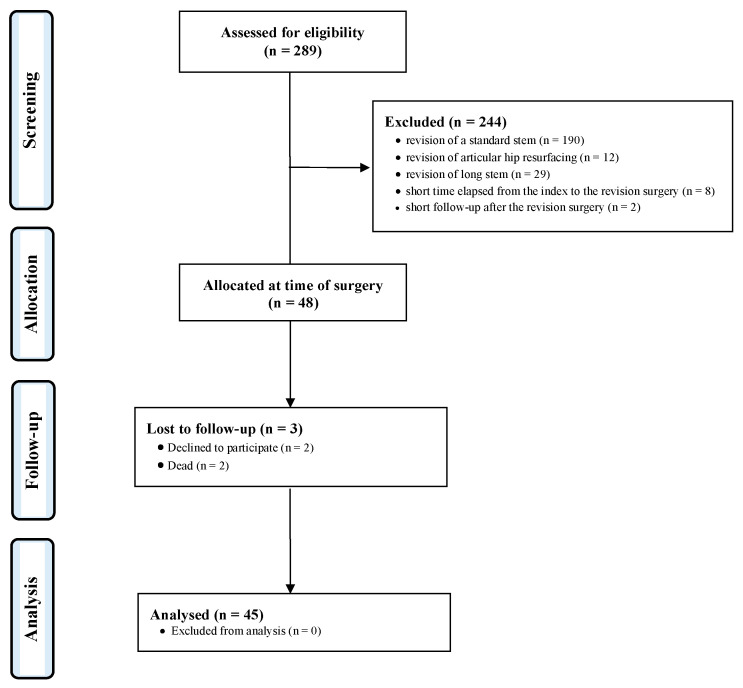
: The current literature lacks studies which evaluate the failure of short stems in total hip arthroplasty (THA). Therefore, the present clinical investigation reported our experience with the failure of short stems in THA, evaluating the causes of failure, survivorship, and the clinical outcomes of revision arthroplasty. : The present study was performed according to the STROBE guidelines. This study was conducted at the Department of Orthopaedic Surgery of the Humanitas Clinical Institute, Milan, Italy, between 2017 and 2022. All patients who underwent revision surgery of a previously implanted THA using a short stem were prospectively included in the present study. Surgeries were performed with patients in lateral position, using a minimally invasive posterolateral approach. The outcomes of interest were to report information on the type and survivorship of implants used for the revision surgery and evaluate the clinical outcomes and the rate of complications. The following patient-reported outcome measures (PROMs) used for the clinical assessment were the Western Ontario McMaster Osteo-Arthritis Index (WOMAC) and related subscales of pain, stiffness, and function, and the visual analogue scale (VAS). : Data from 45 patients were retrieved. Of them, 31% (14 of 45 patients) were women. The mean age was 63.7 ± 13.9 years. The mean length of the implant survivorship was 6.2 ± 5.7 years. In total, 58% (26 of 45 patients) underwent revision of all components, 36% (16 of 45 patients) revised only the stem, and 1% (3 of 45 patients) received a two-stage revision. The mean length of the follow-up was 4.4 ± 1.5 years. The cup was revised in 58% (26 of 45) of patients. At 4.4 ± 1.5 years of follow-up, the WOMAC score was 3.5 ± 1.3 and the VAS was 1.2 ± 1.3. In total, 9% (4 of 45) of patients experienced minor complications. One patient used a walking aid because of reduced function. One patient evidenced muscular hypotrophy. Two patients experienced hip dislocations. All two dislocations were managed conservatively with repositioning in the emergency room under fluoroscopy. No patient needed additional revision surgery or experienced further dislocations. : Revision surgery is effective and safe when a short stem THA fails. At approximately four years of follow-up, all patients were highly satisfied with their clinical outcomes. Despite the relatively high number (9%), complications were of a minor entity and were successfully managed conservatively.
目前的文献缺乏评估全髋关节置换术(THA)中短柄假体失败情况的研究。因此,本临床研究报告了我们在THA中短柄假体失败方面的经验,评估了失败原因、生存率以及翻修关节成形术的临床结果。
本研究是根据STROBE指南进行的。该研究于2017年至2022年在意大利米兰的胡曼itas临床研究所骨科进行。所有接受使用短柄假体对先前植入的THA进行翻修手术的患者均被前瞻性纳入本研究。手术采用侧卧位,使用微创后外侧入路。感兴趣的结果是报告用于翻修手术的植入物类型和生存率信息,并评估临床结果和并发症发生率。用于临床评估的以下患者报告结局指标(PROMs)是西安大略和麦克马斯特大学骨关节炎指数(WOMAC)及其疼痛、僵硬和功能相关子量表,以及视觉模拟量表(VAS)。
检索了45例患者的数据。其中,31%(45例患者中的14例)为女性。平均年龄为63.7±13.9岁。植入物的平均生存时长为6.2±5.7年。总共58%(45例患者中的26例)接受了所有组件的翻修,36%(45例患者中的16例)仅翻修了柄,1%(45例患者中的3例)接受了两阶段翻修。平均随访时长为4.4±1.5年。58%(45例中的26例)的患者进行了髋臼翻修。在4.4±1.5年的随访时,WOMAC评分为3.5±1.3,VAS评分为1.2±1.3。总共9%(45例中的4例)的患者出现了轻微并发症。1例患者因功能减退使用了助行器。1例患者出现肌肉萎缩。2例患者发生髋关节脱位。所有两例脱位均在急诊室通过透视下复位进行保守处理。没有患者需要额外的翻修手术或再次发生脱位。
当THA短柄假体失败时,翻修手术是有效且安全的。在大约四年的随访中,所有患者对其临床结果都非常满意。尽管并发症数量相对较高(9%),但都是轻微的,并且通过保守治疗成功处理。