Baylor University Medical Center (M.P.), Dallas, TX.
Imperial College, London, UK (M.P.).
Circulation. 2024 Jul 9;150(2):151-161. doi: 10.1161/CIRCULATIONAHA.124.068883. Epub 2024 May 11.
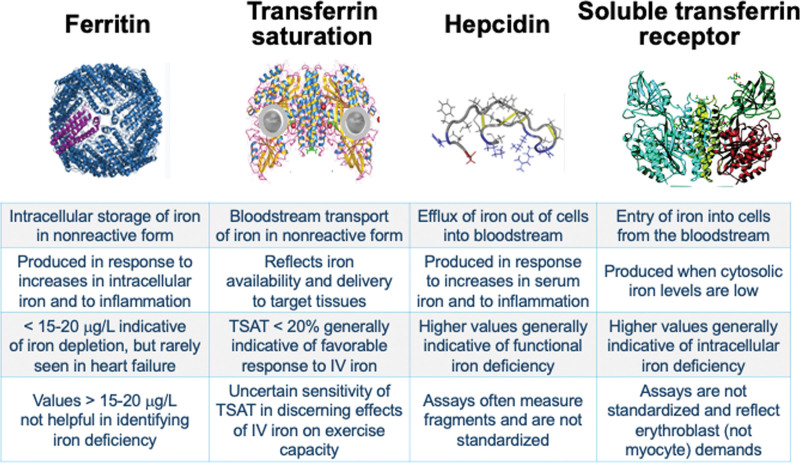
A serum ferritin level <15 to 20 μg/L historically identified patients who had absent bone marrow iron stores, but serum ferritin levels are distorted by the systemic inflammatory states seen in patients with chronic kidney disease or heart failure. As a result, nearly 25 years ago, the diagnostic ferritin threshold was increased 5- to 20-fold in patients with chronic kidney disease (ie, iron deficiency was identified if the serum ferritin level was <100 μg/L, regardless of transferrin saturation [TSAT], or 100 to 299 μg/L if TSAT was <20%). This guidance was motivated not by the findings of studies of total body or tissue iron depletion, but by a desire to encourage the use of iron supplements to potentiate the response to erythropoiesis-stimulating agents in patients with renal anemia. However, in patients with heart failure, this definition does not reliably identify patients with an absolute or functional iron-deficiency state, and it includes individuals with TSATs (≥20%) and serum ferritin levels in the normal range (20-100 mg/L) who are not iron deficient, have an excellent prognosis, and do not respond favorably to iron therapy. Furthermore, serum ferritin levels may be distorted by the use of both neprilysin and sodium-glucose cotransporter 2 inhibitors, both of which may act to mobilize endogenous iron stores. The most evidence-based and trial-tested definition of iron deficiency is the presence of hypoferremia, as reflected by as a TSAT <20%. These hypoferremic patients are generally iron deficient on bone marrow examination, and after intravenous iron therapy, they exhibit an improvement in exercise tolerance and functional capacity (when meaningfully impaired) and show the most marked reduction (ie, 20%-30%) in the risk of cardiovascular death or total heart failure hospitalizations. Therefore, we propose that the current ferritin-driven definition of iron deficiency in heart failure should be abandoned and that a definition based on hypoferremia (TSAT <20%) should be adopted.
血清铁蛋白水平<15 至 20μg/L 曾用于识别骨髓铁储存不足的患者,但在患有慢性肾脏病或心力衰竭的患者中,血清铁蛋白水平会受到全身性炎症状态的影响而出现偏差。因此,大约 25 年前,慢性肾脏病患者的诊断性铁蛋白阈值提高了 5 至 20 倍(即,如果血清铁蛋白水平<100μg/L,则存在铁缺乏,无论转铁蛋白饱和度[TSAT]如何,如果 TSAT<20%,则为 100 至 299μg/L)。这一指导意见并非基于全身或组织铁耗竭研究的结果,而是为了鼓励使用铁补充剂来增强肾性贫血患者对促红细胞生成素刺激剂的反应。然而,在心力衰竭患者中,这种定义并不能可靠地识别出绝对或功能性铁缺乏状态的患者,它包括 TSAT(≥20%)和血清铁蛋白水平在正常范围内(20-100mg/L)的个体,这些个体不缺铁,预后良好,对铁治疗反应不佳。此外,血清铁蛋白水平可能会因使用 Neprilysin 和钠-葡萄糖共转运蛋白 2 抑制剂而受到影响,这两种抑制剂都可能作用于动员内源性铁储存。铁缺乏的最具循证依据和经试验验证的定义是低铁血症的存在,表现为 TSAT<20%。这些低铁血症患者在骨髓检查时通常存在铁缺乏,如果给予静脉铁治疗,他们的运动耐量和功能能力会得到改善(在有意义的受损时),并且心血管死亡或心力衰竭住院的总体风险降低最明显(即 20%-30%)。因此,我们建议放弃目前心力衰竭中铁缺乏的铁蛋白驱动定义,采用基于低铁血症(TSAT<20%)的定义。