Institute of Parasitology and Biomedicine López-Neyra, Consejo Superior de Investigaciones Científicas (CSIC), Granada, Spain.
Institute of Parasitology and Biomedicine López-Neyra, Consejo Superior de Investigaciones Científicas (CSIC), Granada, Spain; Department of Clinical Pharmacy, San Cecilio University Hospital, Instituto de Investigación Biosanitaria de Granada (ibs.Granada), Granada, Spain.
Lancet Rheumatol. 2024 Jun;6(6):e374-e383. doi: 10.1016/S2665-9913(24)00064-X. Epub 2024 May 8.
Giant cell arteritis is an age-related vasculitis that mainly affects the aorta and its branches in individuals aged 50 years and older. Current options for diagnosis and treatment are scarce, highlighting the need to better understand its underlying pathogenesis. Genome-wide association studies (GWAS) have emerged as a powerful tool for unravelling the pathogenic mechanisms involved in complex diseases. We aimed to characterise the genetic basis of giant cell arteritis by performing the largest GWAS of this vasculitis to date and to assess the functional consequences and clinical implications of identified risk loci.
We collected and meta-analysed genomic data from patients with giant cell arteritis and healthy controls of European ancestry from ten cohorts across Europe and North America. Eligible patients required confirmation of giant cell arteritis diagnosis by positive temporal artery biopsy, positive temporal artery doppler ultrasonography, or imaging techniques confirming large-vessel vasculitis. We assessed the functional consequences of loci associated with giant cell arteritis using cell enrichment analysis, fine-mapping, and causal gene prioritisation. We also performed a drug repurposing analysis and developed a polygenic risk score to explore the clinical implications of our findings.
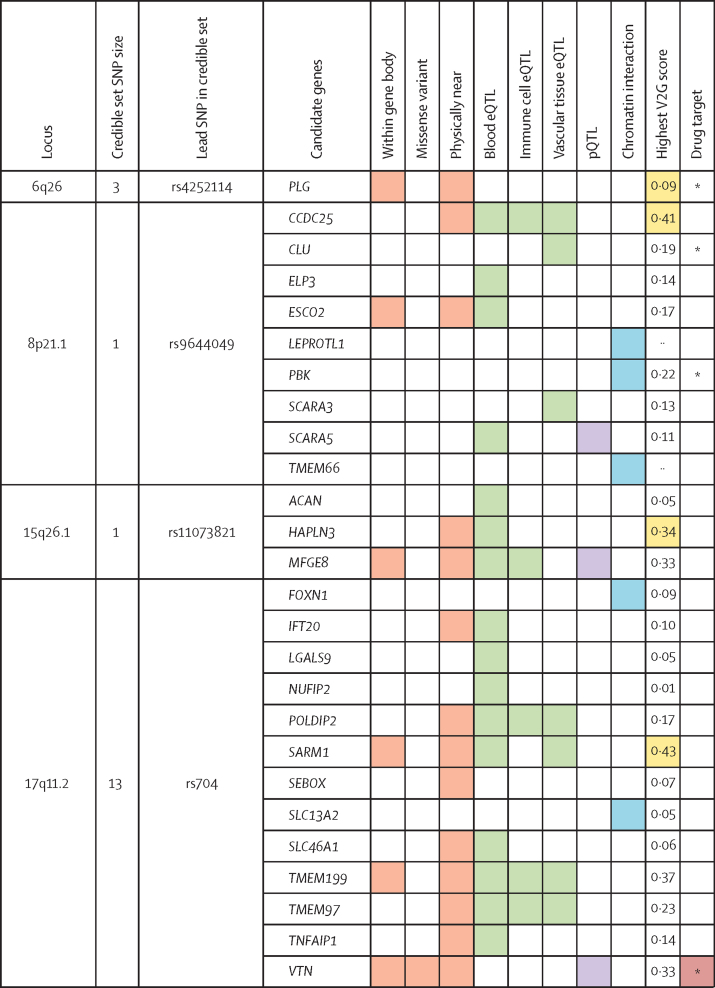
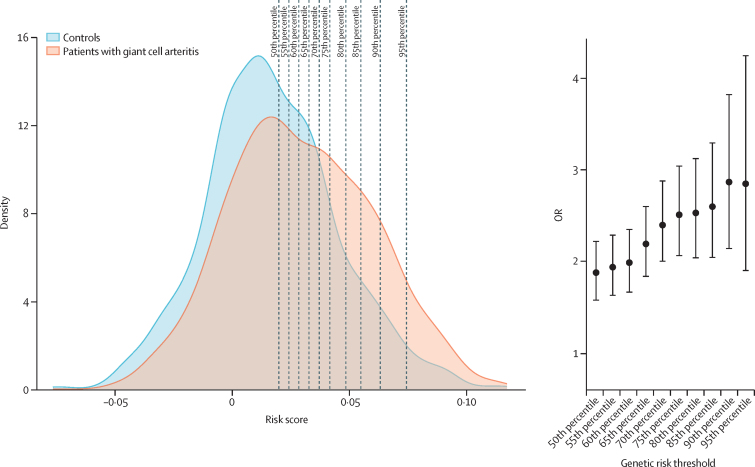
We included a total of 3498 patients with giant cell arteritis and 15 550 controls. We identified three novel loci associated with risk of giant cell arteritis. Two loci, MFGE8 (rs8029053; p=4·96 × 10; OR 1·19 [95% CI 1·12-1·26]) and VTN (rs704; p=2·75 × 10; OR 0·84 [0·79-0·89]), were related to angiogenesis pathways and the third locus, CCDC25 (rs11782624; p=1·28 × 10; OR 1·18 [1·12-1·25]), was related to neutrophil extracellular traps (NETs). We also found an association between this vasculitis and HLA region and PLG. Variants associated with giant cell arteritis seemed to fulfil a specific regulatory role in crucial immune cell types. Furthermore, we identified several drugs that could represent promising candidates for treatment of this disease. The polygenic risk score model was able to identify individuals at increased risk of developing giant cell arteritis (90th percentile OR 2·87 [95% CI 2·15-3·82]; p=1·73 × 10).
We have found several additional loci associated with giant cell arteritis, highlighting the crucial role of angiogenesis in disease susceptibility. Our study represents a step forward in the translation of genomic findings to clinical practice in giant cell arteritis, proposing new treatments and a method to measure genetic predisposition to this vasculitis.
Institute of Health Carlos III, Spanish Ministry of Science and Innovation, UK Medical Research Council, and National Institute for Health and Care Research.
巨细胞动脉炎是一种与年龄相关的血管炎,主要影响 50 岁及以上人群的主动脉及其分支。目前的诊断和治疗选择有限,这突显了我们需要更好地了解其潜在发病机制。全基因组关联研究(GWAS)已成为揭示复杂疾病相关致病机制的有力工具。我们旨在通过进行迄今为止最大的巨细胞动脉炎 GWAS 来描述巨细胞动脉炎的遗传基础,并评估确定的风险位点的功能后果和临床意义。
我们收集并荟萃分析了来自欧洲和北美的十个队列中患有巨细胞动脉炎和健康对照的欧洲血统患者的基因组数据。合格的患者需要通过阳性颞动脉活检、阳性颞动脉多普勒超声或确认大血管血管炎的影像学技术来确认巨细胞动脉炎的诊断。我们使用细胞富集分析、精细映射和因果基因优先级评估与巨细胞动脉炎相关的位点的功能后果。我们还进行了药物重新利用分析,并开发了多基因风险评分,以探讨我们发现的临床意义。
我们共纳入了 3498 名巨细胞动脉炎患者和 15550 名对照。我们确定了三个与巨细胞动脉炎风险相关的新位点。两个位点,MFGE8(rs8029053;p=4.96×10;OR 1.19 [95% CI 1.12-1.26])和 VTN(rs704;p=2.75×10;OR 0.84 [0.79-0.89])与血管生成途径有关,第三个位点,CCDC25(rs11782624;p=1.28×10;OR 1.18 [1.12-1.25])与中性粒细胞胞外陷阱(NETs)有关。我们还发现这种血管炎与 HLA 区域和 PLG 之间存在关联。与巨细胞动脉炎相关的变体似乎在关键免疫细胞类型中发挥了特定的调节作用。此外,我们确定了几种可能成为治疗这种疾病的有前途的候选药物。多基因风险评分模型能够识别出患巨细胞动脉炎风险增加的个体(第 90 个百分位数 OR 2.87 [95% CI 2.15-3.82];p=1.73×10)。
我们发现了几个与巨细胞动脉炎相关的额外位点,突出了血管生成在疾病易感性中的关键作用。我们的研究代表了将基因组发现转化为巨细胞动脉炎临床实践的重要一步,提出了新的治疗方法和衡量这种血管炎遗传易感性的方法。
西班牙卡洛斯三世健康研究所、西班牙科学与创新部、英国医学研究理事会和英国国家卫生与保健研究所。