Department of Orthodontics, Faculty of Dentistry, University of Damascus, Damascus, Syria.
Department of Applied Statistics, Faculty of Economics, University of Damascus, Damascus, Syria.
Prog Orthod. 2024 May 13;25(1):17. doi: 10.1186/s40510-024-00517-3.
Low-intensity electrical stimulation (LIES) is considered a relatively recent technology that has received little attention in orthodontics as a method of acceleration. This study aimed to evaluate patient-reported outcome measures when LIES is used to accelerate the en-masse retraction of the upper anterior teeth.
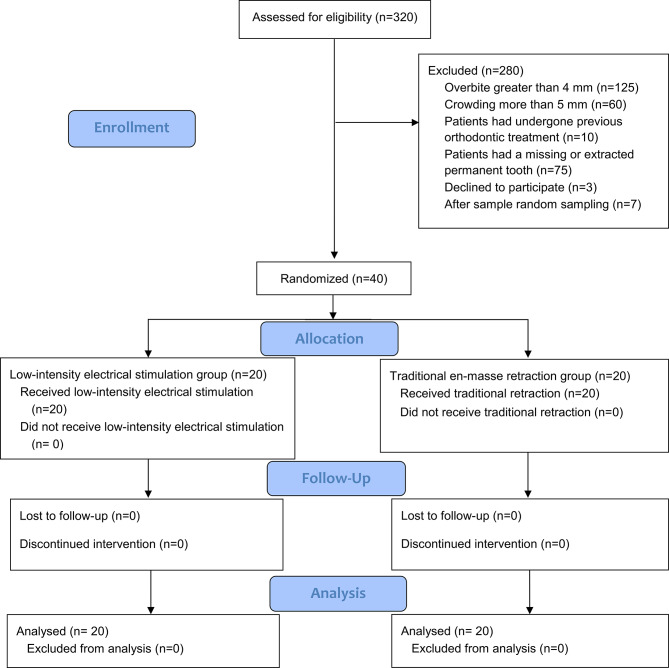
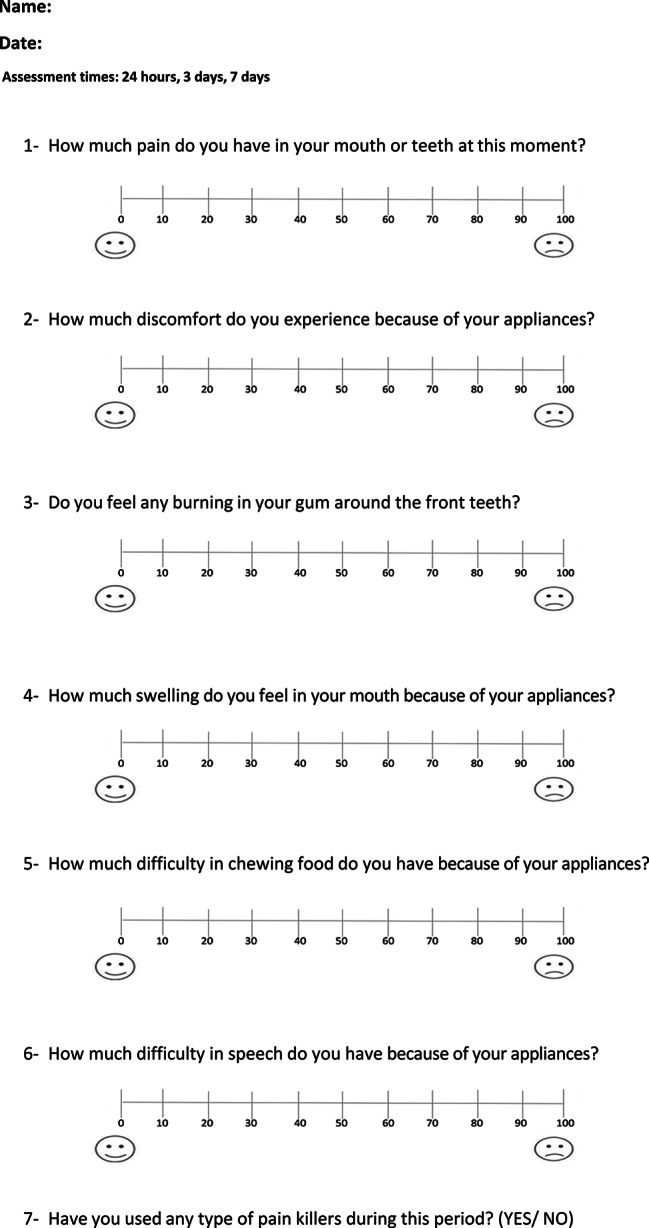
The sample consisted of 40 patients (8 males, 32 females; mean age 21.1 ± 2.3 years), with Class II division I malocclusion who required extraction of the first premolars to retract upper anterior teeth. They were randomly assigned to the LIES group (n = 20) and the conventional en-masse retraction group (CER; n = 20). Patient responses regarding pain, discomfort, burning sensation, swelling, chewing difficulty, speech difficulty, and painkillers' consumption were recorded at these nine assessment times: 24 h (T1), 3 days (T2), and 7 days (T3) after force application, then in the second month after 24 h (T4), 3 days (T5), and 7 days (T6) of force re-activation, and finally after 24 h (T7), 3 days (T8), and 7 days (T9) of force re-activation in the third month.
The mean values of pain perception were smaller in the LIES group than those in the CER group at all assessment times with no statistically significant differences between the two groups except during the second and third months (T5, T6, T8, and T9; P < 0.005). However, discomfort mean values were greater in the LIES group with significant differences compared to CER group during the first week of the follow-up only (T1, T2, and T3; P < 0.005). Burning sensation levels were very mild in the LIES group, with significant differences between the two groups at T1 and T2 only (P < 0.001). Speech difficulty was significantly greater in the LIES group compared to CER group at all studied times (P < 0.001). High levels of satisfaction and acceptance were reported in both groups, without any significant difference.
Both the LIES-based acceleration of en-masse retraction of upper anterior teeth and the conventional retraction were accompanied by mild to moderate pain, discomfort, and chewing difficulty on the first day of retraction. These sensations gradually decreased and almost disappeared over a week after force application or re-activation.
ClinicalTrials.gov, ClinicalTrials.gov, NCT05920525. Registered 17 June 2023 - retrospectively registered, http://clinicaltrials.gov/study/NCT05920525?term=NCT05920525&rank=1 .
低强度电刺激 (LIES) 被认为是一种相对较新的技术,在正畸学中作为一种加速方法,尚未得到广泛关注。本研究旨在评估 LIES 用于加速上颌前牙整体内收时患者的报告结局测量值。
该样本由 40 名患者(8 名男性,32 名女性;平均年龄 21.1±2.3 岁)组成,患有 II 类 1 分类错颌,需要拔除第一前磨牙以内收上颌前牙。他们被随机分配到 LIES 组(n=20)和传统整体内收组(CER;n=20)。在力应用后 24 小时(T1)、3 天(T2)和 7 天(T3),以及力重新激活后的第 2 个月的 24 小时(T4)、3 天(T5)和 7 天(T6),以及第 3 个月的力重新激活后的 24 小时(T7)、3 天(T8)和 7 天(T9)时,记录患者对疼痛、不适、烧灼感、肿胀、咀嚼困难、言语困难和止痛药消耗的反应。
在所有评估时间点,LIES 组的疼痛感知均值均小于 CER 组,但两组间无统计学差异,仅在第 2 个月和第 3 个月时存在差异(T5、T6、T8 和 T9;P<0.005)。然而,在随访的第一周,LIES 组的不适均值更大,与 CER 组相比差异具有统计学意义(T1、T2 和 T3;P<0.005)。LIES 组的烧灼感程度非常轻微,两组间仅在 T1 和 T2 时存在差异(P<0.001)。在所有研究时间点,LIES 组的言语困难均显著大于 CER 组(P<0.001)。两组患者均报告高度满意和接受,无显著差异。
无论是基于 LIES 的上颌前牙整体内收加速,还是传统的内收,在回缩的第一天都会伴有轻度到中度的疼痛、不适和咀嚼困难。这些感觉在力应用或重新激活后一周左右逐渐减轻并几乎消失。
ClinicalTrials.gov,ClinicalTrials.gov,NCT05920525。2023 年 6 月 17 日注册-回顾性注册,http://clinicaltrials.gov/study/NCT05920525?term=NCT05920525&rank=1。