Xinhua Hospital affiliated to Shanghai Jiao tong University School of Medicine, Shanghai, China.
J Orthop Surg Res. 2024 May 12;19(1):293. doi: 10.1186/s13018-024-04789-7.
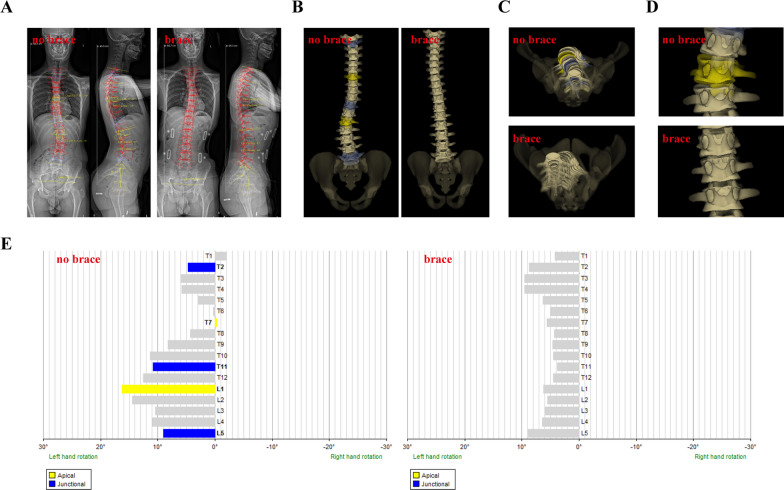
To investigate the effects of bracing on apical vertebral derotation and explore the factors that influence in-brace derotation effects in adolescent idiopathic scoliosis (AIS) patients. For patients with AIS, vertebral rotation causes cosmetic appearance abnormalities and acts as an indicator for curve progression. However, there have been few studies investigating the precise derotation effects of bracing for apical vertebra. The application of EOS imaging system enables quantitative evaluation of vertebral rotation in the axial plane in a standing position.
There were 82 eligible patients enrolled in current study, who underwent EOS imaging evaluation before and immediately after bracing. The clinical demographic data (age, gender, Risser sign and menstrual status) were recorded. The correlation analyses between derotation effects and key parameters (age, pre-brace Cobb angle, thoracic kyphosis, lumbar lordosis, vertebral rotation, pelvis axial rotation and apical vertebral level) were performed. The in-brace derotation effects stratified by gender, Risser sign, apical vertebral level, menarche status, coronal balance and sagittal balance were also analyzed.
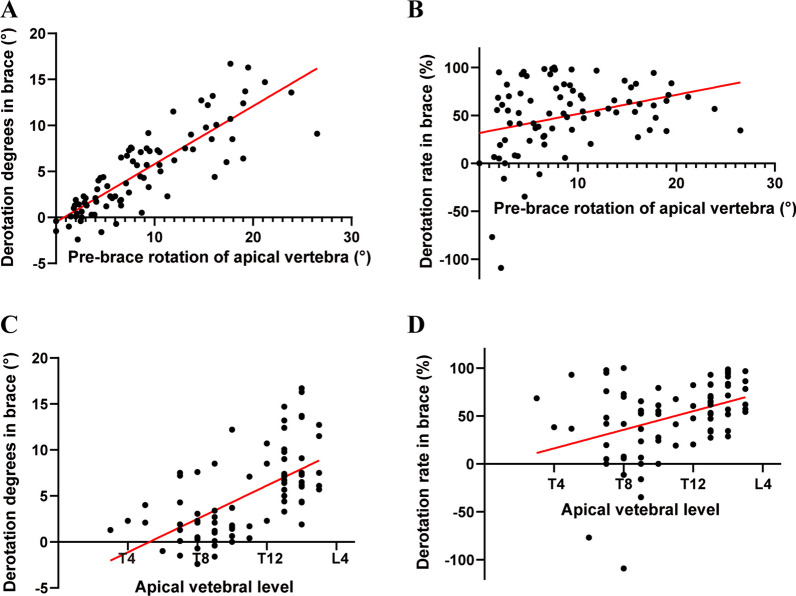
The rotation of apical vertebra was decreased from 8.8 ± 6.0 degrees before bracing to 3.8 ± 3.3 degrees immediately after bracing (p < 0.001), and the derotation rate was 49.2 ± 38.3%. The derotation degrees in brace was significantly correlated with major curve Cobb angle (r = 0.240, p = 0.030), minor curve Cobb angle (r = 0.256, p = 0.020) and total curve Cobb angle (r = 0.266, p = 0.016). Both the pre-brace apical vertebral rotation and apical vertebral level were significantly correlated with derotation effects in brace (p < 0.001). Patients with thoracic major curve showed worse derotation effects than those with lumbar major curve (p < 0.001). In addition, patients with coronal balance showed better in-brace derotation effects than those with coronal decompensation (p = 0.005).
A satisfactory apical vertebral derotation rate (approximately 50%) could be obtained immediately after bracing in AIS patients. Pre-brace Cobb angle of curve, pre-brace apical vertebral rotation, apical vertebral level and coronal balance exhibited close associations with in-brace derotation effects of apical vertebra.
探讨支具矫形对顶椎椎体旋转的影响,探索影响青少年特发性脊柱侧凸(AIS)患者支具矫形中椎体旋转的因素。对于 AIS 患者,椎体旋转会导致外观异常,并作为曲线进展的指标。然而,很少有研究调查支具对顶椎椎体的精确旋转矫正效果。EOS 成像系统的应用能够在站立位时对椎体旋转进行轴向的定量评估。
共纳入 82 例符合条件的患者,所有患者均在支具矫形前和支具矫形后即刻进行 EOS 影像学评估。记录患者的临床人口统计学数据(年龄、性别、Risser 征和月经状态)。分析顶椎旋转矫正与关键参数(年龄、支具前 Cobb 角、胸椎后凸、腰椎前凸、椎体旋转、骨盆轴向旋转和顶椎椎体水平)之间的相关性。还分析了性别、Risser 征、顶椎椎体水平、初潮状态、冠状面平衡和矢状面平衡分层的支具内旋转矫正效果。
顶椎旋转从支具前的 8.8±6.0 度减少到支具后的 3.8±3.3 度(p<0.001),旋转矫正率为 49.2±38.3%。支具内顶椎旋转度数与主弯 Cobb 角(r=0.240,p=0.030)、次弯 Cobb 角(r=0.256,p=0.020)和总弯 Cobb 角(r=0.266,p=0.016)显著相关。支具前顶椎旋转和顶椎椎体水平与支具内旋转矫正效果显著相关(p<0.001)。胸椎主弯患者的旋转矫正效果差于腰椎主弯患者(p<0.001)。此外,冠状面平衡患者的支具内旋转矫正效果优于冠状面失代偿患者(p=0.005)。
AIS 患者支具矫形后即刻可获得满意的顶椎椎体旋转矫正率(约 50%)。支具前的主弯 Cobb 角、支具前顶椎旋转、顶椎椎体水平和冠状面平衡与顶椎椎体的支具内旋转矫正效果密切相关。