Division of Toxicology and Experimental Medicine, CSIR-Central Drug Research Institute, Lucknow, 226031, India.
Academy of Scientific & Innovative Research (AcSIR), Ghaziabad, 201002, India.
Cell Death Dis. 2024 May 13;15(5):331. doi: 10.1038/s41419-024-06662-1.
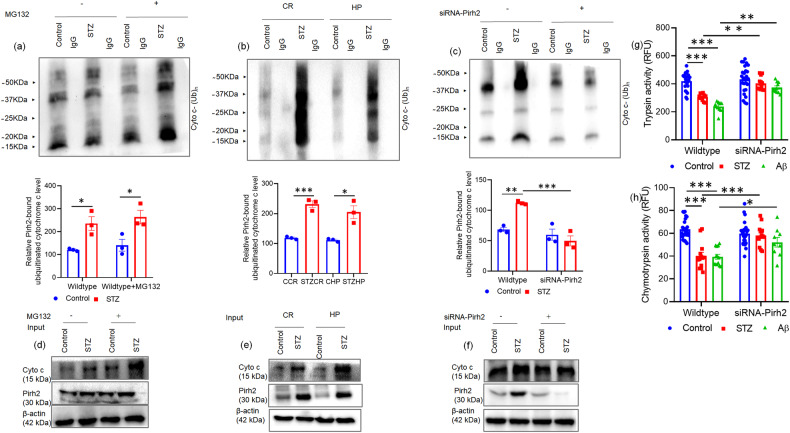
Pirh2 is an E3 ubiquitin ligase known to regulate the DNA damage responses through ubiquitylation of various participating signaling factors. DNA damage is a key pathological contributor to Alzheimer's disease (AD), therefore, the role of Pirh2 was investigated in streptozotocin and oligomer Aβ induced rodent experimental model of AD. Pirh2 protein abundance increased during AD conditions, and transient silencing of Pirh2 inhibited the disease-specific pathological markers like level of p-Tau, βamyloid, acetylcholinesterase activity, and neuronal death. Biochemically, Pirh2 silencing significantly attenuated the oxidative stress, depleted mitochondrial membrane potential, cytochrome c translocation from mitochondria to cytosol, and depleted mitochondrial complex-I activity, and ATP level. Pirh2 silencing also inhibited the altered level of VDAC1, hsp75, hexokinase1, t-Bid, caspase-9, and altered level of apoptotic proteins (Bcl-2, Bax). MALDI-TOF/TOF, co-immunoprecipitation, and UbcH13-linked ubiquitylation assay confirmed the interaction of Pirh2 with cytochrome c and the role of Pirh2 in ubiquitylation of cytochrome c, along with Pirh2-dependent altered proteasome activity. Additionally, Pirh2 silencing further inhibited the translocation of mitochondrion-specific endonuclease G and apoptosis-inducing factors to the nucleus and DNA damage. In conclusion, findings suggested the significant implication of Pirh2 in disease pathogenesis, particularly through impaired mitochondrial function, including biochemical alterations, translocation of cytochrome c, endonuclease G and apoptosis-inducing factor, DNA damage, and neuronal apoptosis.
Pirh2 是一种 E3 泛素连接酶,已知通过泛素化各种参与信号转导的因子来调节 DNA 损伤反应。DNA 损伤是阿尔茨海默病(AD)的关键病理因素,因此研究了 Pirh2 在链脲佐菌素和寡聚体 Aβ诱导的 AD 啮齿动物实验模型中的作用。在 AD 条件下,Pirh2 蛋白丰度增加,瞬时沉默 Pirh2 可抑制 p-Tau、β淀粉样蛋白、乙酰胆碱酯酶活性和神经元死亡等疾病特异性病理标志物。从生物化学角度来看,Pirh2 沉默显著减弱了氧化应激、耗竭了线粒体膜电位、细胞色素 c 从线粒体向细胞质易位、以及线粒体复合物-I 活性和 ATP 水平。Pirh2 沉默还抑制了 VDAC1、hsp75、己糖激酶 1、t-Bid、caspase-9 和凋亡蛋白(Bcl-2、Bax)水平的改变。MALDI-TOF/TOF、共免疫沉淀和 UbcH13 连接泛素化测定证实了 Pirh2 与细胞色素 c 的相互作用,以及 Pirh2 在细胞色素 c 泛素化中的作用,以及 Pirh2 依赖性的蛋白酶体活性改变。此外,Pirh2 沉默进一步抑制了线粒体特异性内切核酸酶 G 和凋亡诱导因子向核内的易位以及 DNA 损伤。总之,研究结果表明 Pirh2 在疾病发病机制中具有重要意义,特别是通过损害线粒体功能,包括生化改变、细胞色素 c、内切核酸酶 G 和凋亡诱导因子的易位、DNA 损伤和神经元凋亡。