Yunan Key Laboratory for Plateau Mountain Ecology and Restoration of Degraded Environments, School of Ecology and Environmental Sciences, Yunnan University, Kunming, 650091, Yunnan, China.
Great Lakes Institute for Environmental Research, University of Windsor, Windsor, ON, N9B 3P4, Canada.
Sci Rep. 2024 May 13;14(1):10934. doi: 10.1038/s41598-024-61333-7.
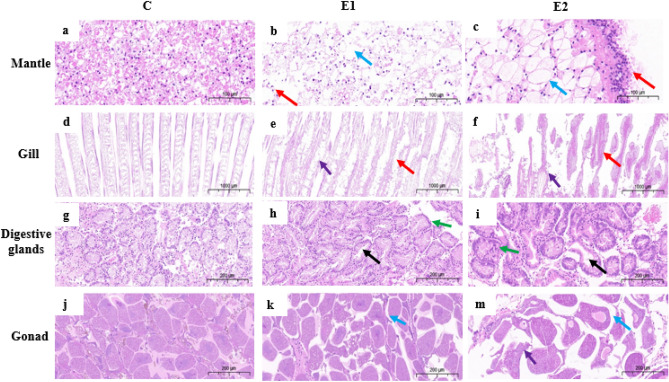
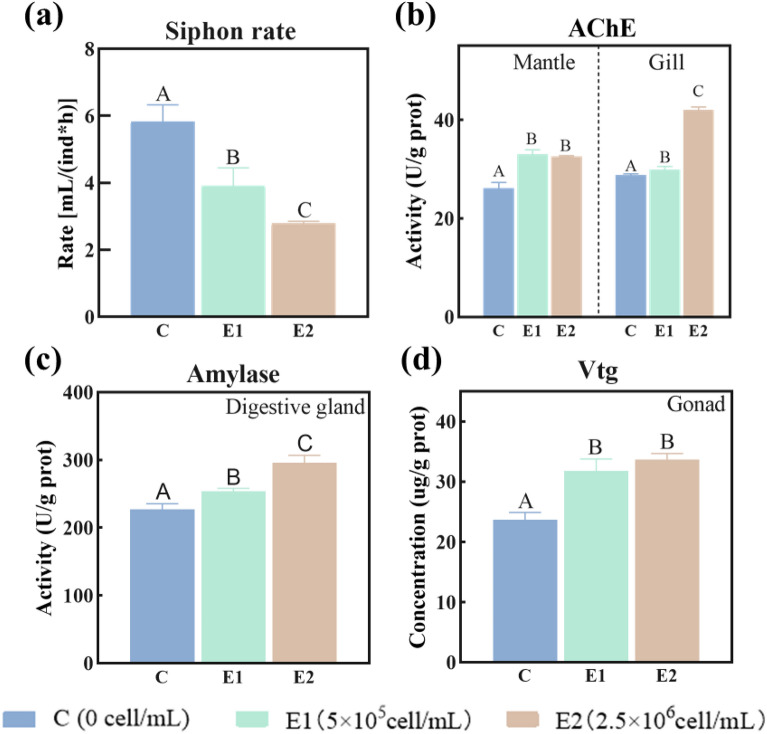
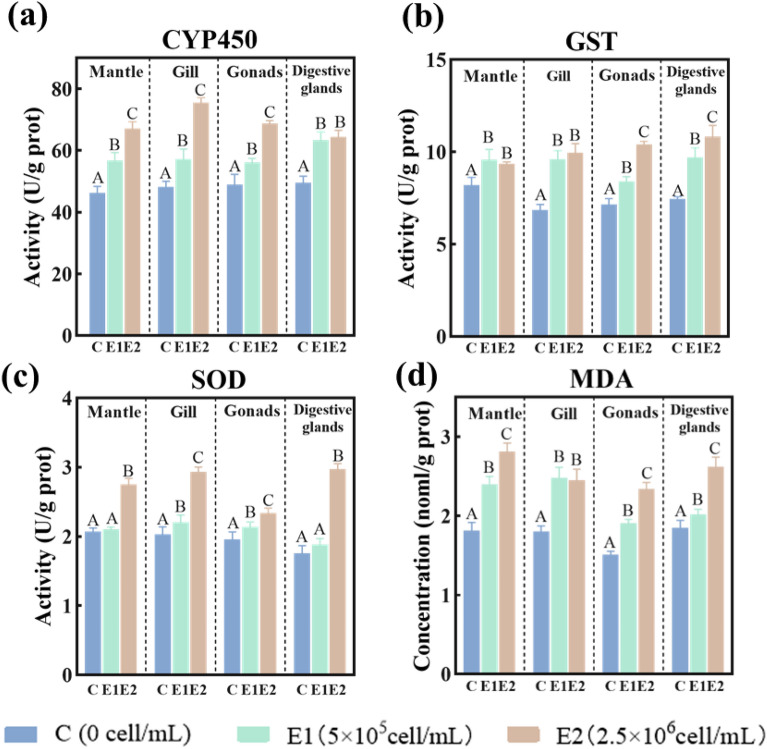
Cyanobacteria bloom and the secondary metabolites released by the microorganism are extremely harmful to aquatic animals, yet study on their adverse effects in zoobenthos is rare. Corbicula fluminea widely distributed in freshwater environment with algal blooms. It is a typical filter feeding zoobenthos that may be affected by the secondary metabolites of cyanobacteria due to its high filtering rate. In this study, C. fluminea was exposed to Microcystis aeruginosa exudates (MaE) for 96 h, which was obtained from 5 × 10 cells/mL and 2.5 × 10 cells/mL exponential stage M. aeruginosa culture solution that represented cyanobacteria cell density needs environmental risk precaution control and emergent control, respectively. The responses of C. fluminea critical organs to MaE were analyzed and evaluated based on histopathological sections, antitoxicity biomarkers, and organ function biomarkers. The results showed that all the organs underwent structural disorders, cell vacuolization, apoptosis, and necrosis, and the damage levels increased as MaE concentration increased. The detoxification and antioxidant defense systems biomarkers in each organ response to MaE exposure differently and the level of reaction improved when MaE concentration increased. The siphon rate and acetylcholinesterase activity showed that the filtration function decreased significantly as the MaE concentration increased. Increased activity of glutathione S-transferase and amylase in the digestive gland indicate that it is the major detoxification organ of C. fluminea. Increased vitellogenin concentration and enlarged oocytes in the gonad indicate that MaE may have an estrogenic effect on C. fluminea. This study demonstrates that cyanobacteria threat benthic bivalves by inducing oxidative stress, inhibiting filtering feeding system, and disturbing digestion system and reproduction potential of C. fluminea.
蓝藻水华及其释放的次生代谢产物对水生动物具有极高的危害性,但关于其对底栖无脊椎动物的不良影响的研究却很少。铜锈环棱螺广泛分布于富营养化水体中,是一种典型的滤食性底栖无脊椎动物,由于其具有较高的滤食率,可能会受到蓝藻次生代谢产物的影响。在本研究中,铜锈环棱螺分别暴露于 5×10 细胞/毫升和 2.5×10 细胞/毫升指数生长期铜绿微囊藻培养液中提取的微囊藻胞外分泌物(MaE)96 小时,这两个浓度分别代表了环境风险需要预防控制和紧急控制的蓝藻细胞密度。基于组织病理学切片、解毒和抗氧化防御系统生物标志物以及器官功能生物标志物,分析和评估了 MaE 对铜锈环棱螺关键器官的响应。结果表明,所有器官均发生结构紊乱、细胞空泡化、细胞凋亡和坏死,且损伤程度随 MaE 浓度的增加而增加。各器官对 MaE 暴露的解毒和抗氧化防御系统生物标志物的反应不同,且随着 MaE 浓度的增加,反应水平提高。虹吸管率和乙酰胆碱酯酶活性表明,随着 MaE 浓度的增加,过滤功能显著降低。消化腺中谷胱甘肽 S-转移酶和淀粉酶活性的增加表明,铜锈环棱螺的主要解毒器官是消化腺。性腺中卵黄原蛋白浓度的增加和卵母细胞的增大表明,MaE 可能对铜锈环棱螺具有雌激素效应。本研究表明,蓝藻通过诱导氧化应激、抑制滤食系统以及干扰铜锈环棱螺的消化和生殖潜能来威胁底栖双壳贝类。