Duke University Medical Center, Durham, North Carolina, USA
Medical Research, Durham VA Health Care System, Durham, North Carolina, USA.
Ann Rheum Dis. 2024 Jun 12;83(7):830-837. doi: 10.1136/ard-2023-225266.
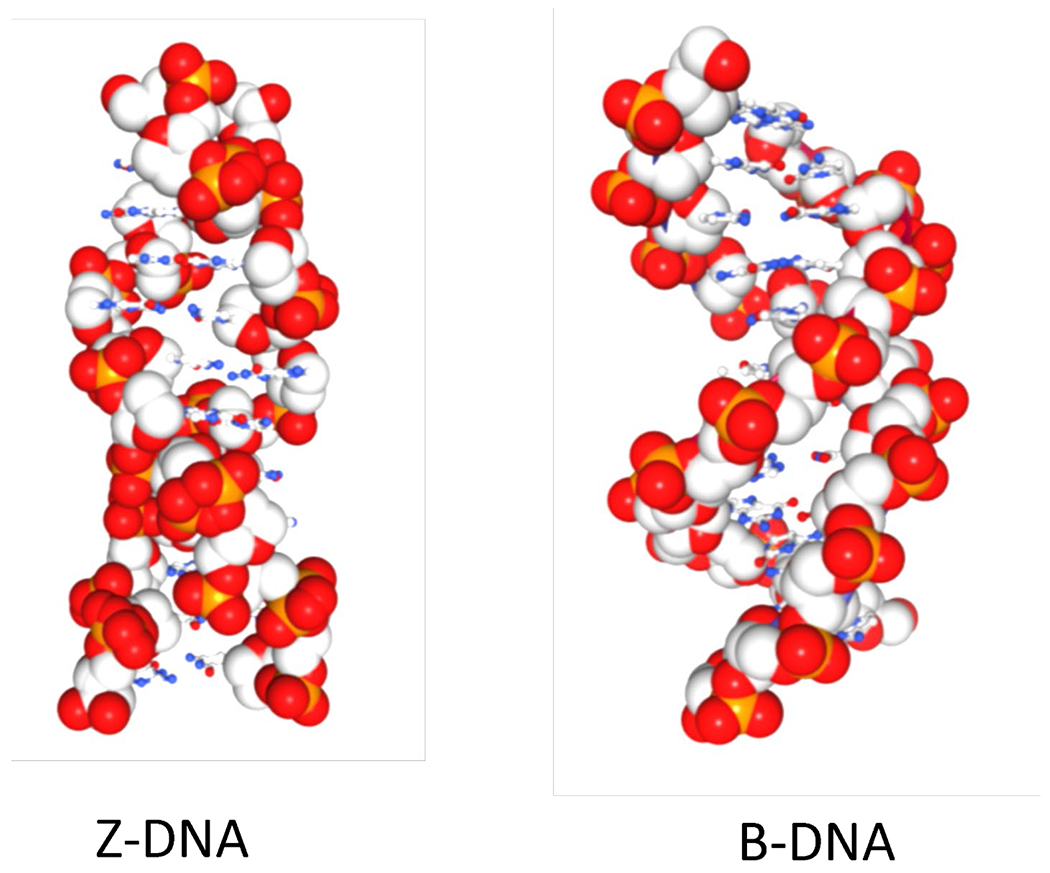
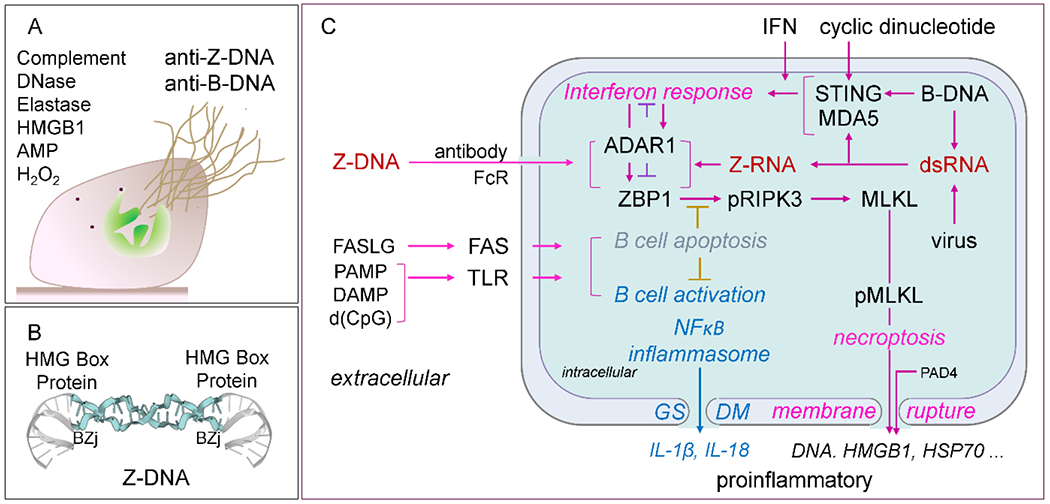
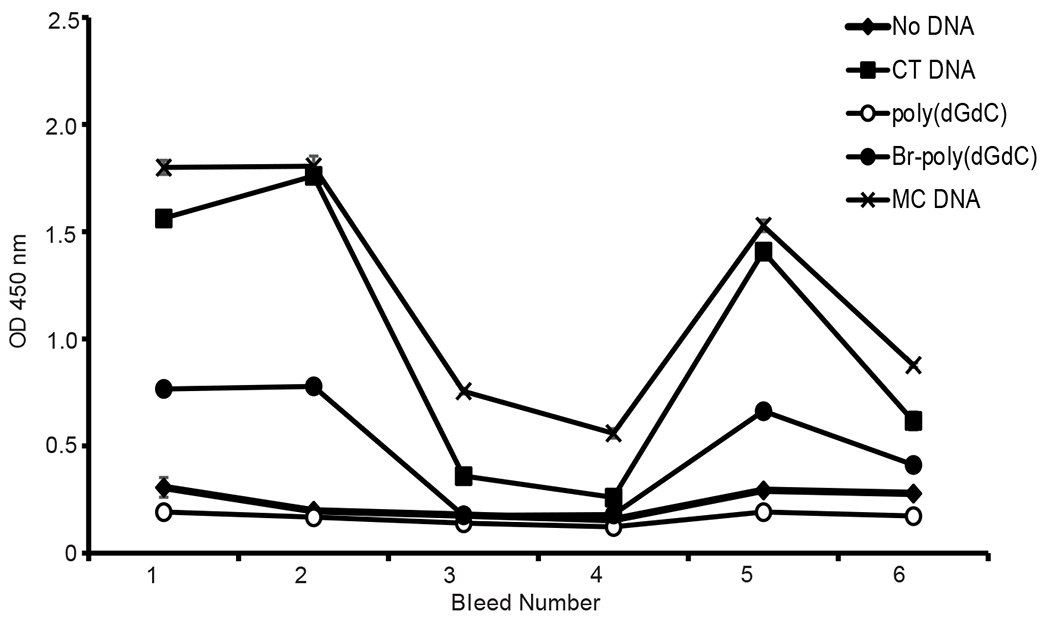
Systemic lupus erythematosus (SLE) is a prototypic autoimmune disease characterised by antibodies to DNA (anti-DNA) and other nuclear macromolecules. Anti-DNA antibodies are markers for classification and disease activity and promote pathogenesis by forming immune complexes that deposit in the tissue or stimulate cytokine production. Studies on the antibody response to DNA have focused primarily on a conformation of DNA known as B-DNA, the classic right-handed double helix. Among other conformations of DNA, Z-DNA is a left-handed helix with a zig-zag backbone; hence, the term Z-DNA. Z-DNA formation is favoured by certain base sequences, with the energetically unfavourable flip from B-DNA to Z-DNA dependent on conditions. Z-DNA differs from B-DNA in its immunogenicity in animal models. Furthermore, anti-Z-DNA antibodies, but not anti-B-DNA antibodies, can be present in otherwise healthy individuals. In SLE, antibodies to Z-DNA can occur in association with antibodies to B-DNA as a cross-reactive response, rising and falling together. While formed transiently in chromosomal DNA, Z-DNA is stably present in bacterial biofilms; biofilms can provide protection against antibiotics and other challenges including elements of host defence. The high GC content of certain bacterial DNA also favours Z-DNA formation as do DNA-binding proteins of bacterial or host origin. Together, these findings suggest that sources of Z-DNA can enhance the immunogenicity of DNA and, in SLE, stimulate the production of cross-reactive antibodies that bind both B-DNA and Z-DNA. As such, DNA can act as a molecular chameleon that, when stabilised in the Z-DNA conformation, can drive autoimmunity.
系统性红斑狼疮(SLE)是一种典型的自身免疫性疾病,其特征是存在针对 DNA(抗 DNA)和其他核大分子的抗体。抗 DNA 抗体是分类和疾病活动的标志物,并通过形成沉积在组织中的免疫复合物或刺激细胞因子产生来促进发病机制。对 DNA 抗体反应的研究主要集中在一种称为 B-DNA 的 DNA 构象上,B-DNA 是经典的右手双螺旋。在其他 DNA 构象中,Z-DNA 是一种具有锯齿状骨架的左手螺旋;因此,术语为 Z-DNA。Z-DNA 的形成受到某些碱基序列的青睐,从 B-DNA 到 Z-DNA 的能量不利翻转取决于条件。Z-DNA 在动物模型中的免疫原性与 B-DNA 不同。此外,在其他健康个体中可能存在抗 Z-DNA 抗体,而不是抗 B-DNA 抗体。在 SLE 中,抗 Z-DNA 抗体可以与抗 B-DNA 抗体一起发生作为交叉反应性反应,一起上升和下降。虽然在染色体 DNA 中短暂形成,但 Z-DNA 在细菌生物膜中稳定存在;生物膜可以提供对抗生素和其他挑战的保护,包括宿主防御的元素。某些细菌 DNA 的高 GC 含量也有利于 Z-DNA 的形成,细菌或宿主来源的 DNA 结合蛋白也是如此。总之,这些发现表明 Z-DNA 的来源可以增强 DNA 的免疫原性,并在 SLE 中刺激产生结合 B-DNA 和 Z-DNA 的交叉反应性抗体。因此,DNA 可以作为一种分子变色龙,当稳定在 Z-DNA 构象中时,可引发自身免疫。