Department of Anesthesiology, Far East Memorial Hospital, New Taipei City 220, Taiwan.
Department of Physical Medicine and Rehabilitation, Chang Gung Memorial Hospital, Taoyuan 33378, Taiwan.
Aging (Albany NY). 2024 May 15;16(10):8599-8610. doi: 10.18632/aging.205827.
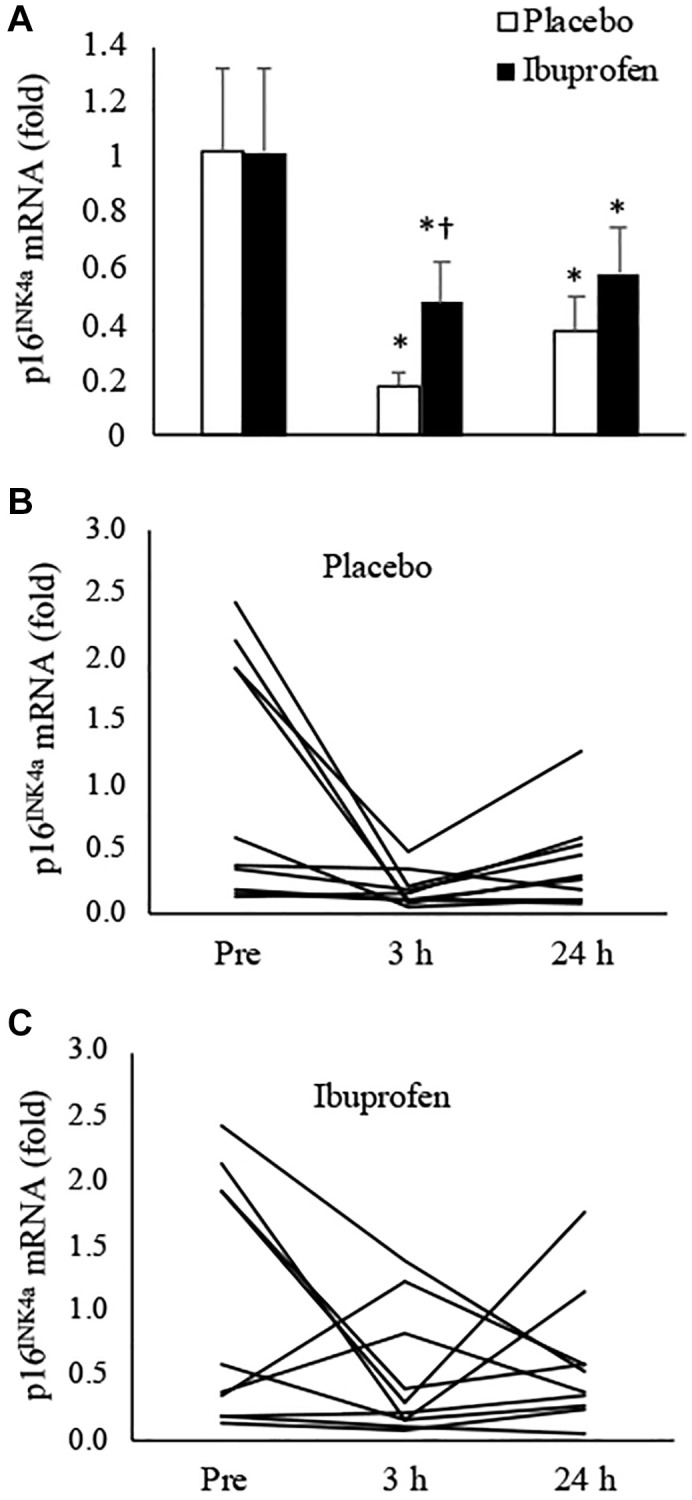
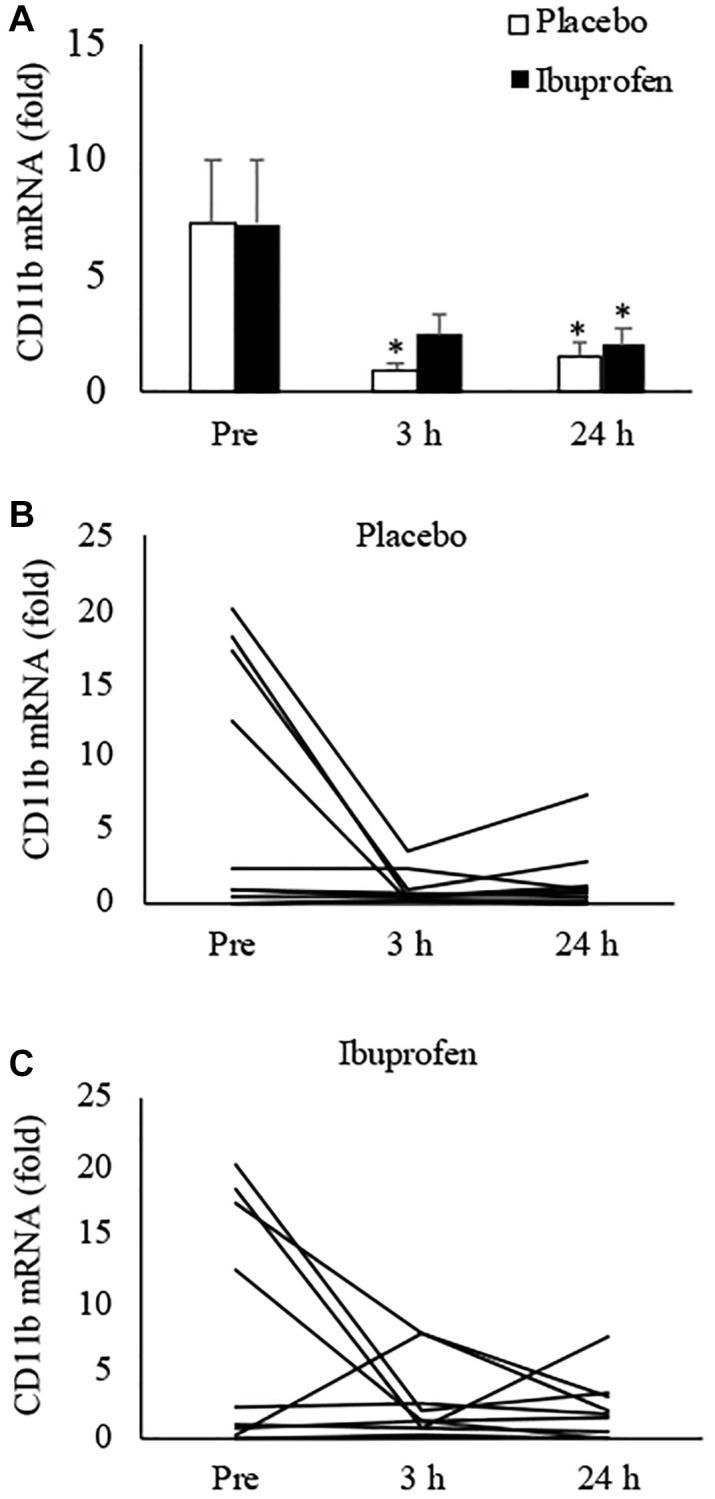
Higher intensity exercise, despite causing more tissue damage, improved aging conditions. We previously observed decreased p16 mRNA in human skeletal muscle after high-intensity interval exercise (HIIE), with no change following equivalent work in moderate-intensity continuous exercise. This raises the question of whether the observed senolytic effect of exercise is mediated by inflammation, an immune response induced by muscle damage. In this study, inflammation was blocked using a multiple dose of ibuprofen (total dose: 1200 mg), a commonly consumed nonsteroidal anti-inflammatory drug (NSAID), in a placebo-controlled, counterbalanced crossover trial. Twelve men aged 20-26 consumed ibuprofen or placebo before and after HIIE at 120% maximum aerobic power. Multiple muscle biopsies were taken for tissue analysis before and after HIIE. p16 cells were located surrounding myofibers in muscle tissues. The maximum decrease in p16 mRNA levels within muscle tissues occurred at 3 h post-exercise (-82%, < 0.01), gradually recovering over the next 3-24 h. A concurrent reduction pattern in CD11b mRNA (-87%, < 0.01) was also found within the same time frame. Ibuprofen treatment attenuated the post-exercise reduction in both p16 mRNA and CD11b mRNA. The strong correlation (r = 0.88, < 0.01) between p16 mRNA and CD11b mRNA in muscle tissues suggests a connection between the markers of tissue aging and pro-inflammatory myeloid differentiation. In conclusion, our results suggest that the senolytic effect of high-intensity exercise on human skeletal muscle is mediated by acute inflammation.
高强度运动尽管会造成更多的组织损伤,但能改善衰老状况。我们之前观察到,高强度间歇运动(HIIE)后人类骨骼肌中的 p16mRNA 减少,而在中强度持续运动后则没有变化。这就提出了一个问题,即运动的观察到的衰老细胞选择性清除作用是否是由炎症介导的,炎症是由肌肉损伤引起的免疫反应。在这项研究中,我们使用了一种多剂量的布洛芬(总剂量:1200mg),一种常用的非甾体抗炎药(NSAID),在安慰剂对照、交叉平衡试验中阻断了炎症。12 名年龄在 20-26 岁的男性在最大有氧能力的 120%下进行 HIIE 前后分别服用布洛芬或安慰剂。在 HIIE 前后,对肌肉组织进行了多次肌肉活检以进行组织分析。p16 细胞位于肌肉组织中的肌纤维周围。肌肉组织中 p16mRNA 水平的最大下降发生在运动后 3 小时(-82%,<0.01),在接下来的 3-24 小时内逐渐恢复。在同一时间范围内,还发现 CD11b mRNA 呈同步减少模式(-87%,<0.01)。布洛芬治疗减弱了运动后 p16mRNA 和 CD11bmRNA 的减少。肌肉组织中 p16mRNA 和 CD11bmRNA 之间存在很强的相关性(r=0.88,<0.01),这表明组织衰老标志物与促炎髓样分化之间存在联系。总之,我们的结果表明,高强度运动对人类骨骼肌的衰老细胞选择性清除作用是由急性炎症介导的。