Department of Epidemiology and Statistics, College of Public Health, Zhengzhou University, Zhengzhou City, 450001, Henan Province, China.
Henan Key Laboratory of Tumor Epidemiology and State Key Laboratory of Esophageal Cancer Prevention & Treatment, Zhengzhou University, Zhengzhou City, 450052, Henan Province, China.
BMC Cancer. 2024 May 16;24(1):598. doi: 10.1186/s12885-024-12370-y.
Results regarding whether it is essential to incorporate genetic variants into risk prediction models for esophageal cancer (EC) are inconsistent due to the different genetic backgrounds of the populations studied. We aimed to identify single-nucleotide polymorphisms (SNPs) associated with EC among the Chinese population and to evaluate the performance of genetic and non-genetic factors in a risk model for developing EC.
A meta-analysis was performed to systematically identify potential SNPs, which were further verified by a case-control study. Three risk models were developed: a genetic model with weighted genetic risk score (wGRS) based on promising SNPs, a non-genetic model with environmental risk factors, and a combined model including both genetic and non-genetic factors. The discrimination ability of the models was compared using the area under the receiver operating characteristic curve (AUC) and the net reclassification index (NRI). The Akaike information criterion (AIC) and Bayesian information criterion (BIC) were used to assess the goodness-of-fit of the models.
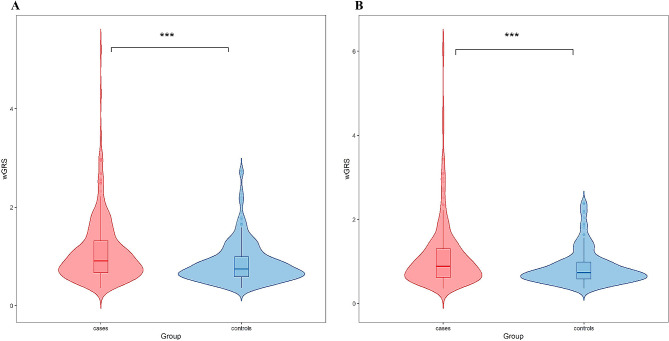
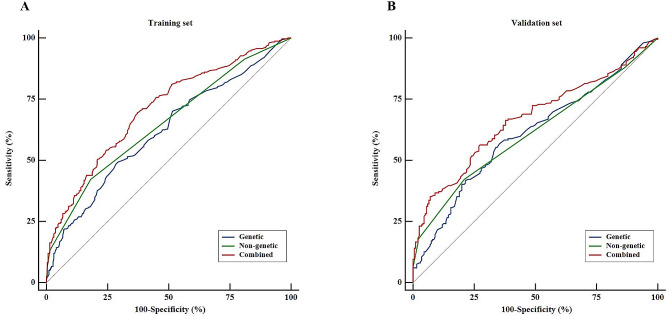
Five promising SNPs were ultimately utilized to calculate the wGRS. Individuals in the highest quartile of the wGRS had a 4.93-fold (95% confidence interval [CI]: 2.59 to 9.38) increased risk of EC compared with those in the lowest quartile. The genetic or non-genetic model identified EC patients with AUCs ranging from 0.618 to 0.650. The combined model had an AUC of 0.707 (95% CI: 0.669 to 0.743) and was the best-fitting model (AIC = 750.55, BIC = 759.34). The NRI improved when the wGRS was added to the risk model with non-genetic factors only (NRI = 0.082, P = 0.037).
Among the three risk models for EC, the combined model showed optimal predictive performance and can help to identify individuals at risk of EC for tailored preventive measures.
由于所研究人群的遗传背景不同,关于是否有必要将遗传变异纳入食管癌(EC)风险预测模型的结果并不一致。我们旨在确定与中国人 EC 相关的单核苷酸多态性(SNP),并评估遗传和非遗传因素在 EC 发病风险模型中的表现。
进行荟萃分析以系统地鉴定潜在的 SNP,进一步通过病例对照研究进行验证。构建了三个风险模型:基于有希望的 SNP 的加权遗传风险评分(wGRS)的遗传模型、具有环境危险因素的非遗传模型以及包含遗传和非遗传因素的综合模型。使用接收者操作特征曲线(ROC)下面积(AUC)和净重新分类指数(NRI)比较模型的判别能力。使用赤池信息量准则(AIC)和贝叶斯信息准则(BIC)评估模型的拟合优度。
最终利用五个有前途的 SNP 来计算 wGRS。与最低四分位数相比,wGRS 最高四分位数的个体 EC 风险增加了 4.93 倍(95%置信区间[CI]:2.59 至 9.38)。遗传或非遗传模型识别 EC 患者的 AUC 范围为 0.618 至 0.650。综合模型的 AUC 为 0.707(95%CI:0.669 至 0.743),是最佳拟合模型(AIC=750.55,BIC=759.34)。当 wGRS 添加到仅具有非遗传因素的风险模型中时,NRI 会提高(NRI=0.082,P=0.037)。
在 EC 的三个风险模型中,综合模型显示出最佳的预测性能,有助于识别 EC 风险个体,以便采取针对性的预防措施。