Zhu Mianmian, Singer Stacy D, Guan Le Luo, Chen Guanqun
Department of Agricultural, Food and Nutritional Science, University of Alberta, EdmontonAlberta, T6G 2P5 Canada.
Agriculture and Agri-Food Canada, Lethbridge Research and Development Centre, LethbridgeAlberta, T1J 4B1 Canada.
Adv Biotechnol (Singap). 2024;2(2):17. doi: 10.1007/s44307-024-00024-w. Epub 2024 May 11.
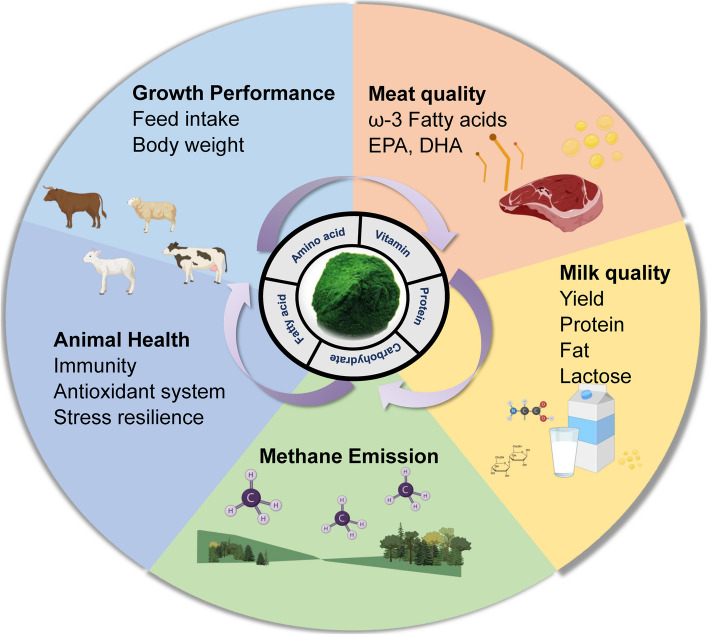
The global demand for animal-derived foods has led to a substantial expansion in ruminant production, which has raised concerns regarding methane emissions. To address these challenges, microalgal species that are nutritionally-rich and contain bioactive compounds in their biomass have been explored as attractive feed additives for ruminant livestock production. In this review, we discuss the different microalgal species used for this purpose in recent studies, and review the effects of microalgal feed supplements on ruminant growth, performance, health, and product quality, as well as their potential contributions in reducing methane emissions. We also examine the potential complexities of adopting microalgae as feed additives in the ruminant industry.
全球对动物源性食品的需求导致反刍动物生产大幅扩张,这引发了对甲烷排放的担忧。为应对这些挑战,营养丰富且生物质中含有生物活性化合物的微藻物种已被探索作为反刍动物养殖生产中具有吸引力的饲料添加剂。在本综述中,我们讨论了近期研究中用于此目的的不同微藻物种,并综述了微藻饲料添加剂对反刍动物生长、性能、健康和产品质量的影响,以及它们在减少甲烷排放方面的潜在贡献。我们还研究了在反刍动物产业中采用微藻作为饲料添加剂的潜在复杂性。