Intensive Care Unit, School of Medicine, Mianyang Central Hospital, University of Electronic Science and Technology of China, Mianyang, Sichuan Province, China.
Department of Nursing, School of Medicine, Mei He: RN, BSN, Mianyang Central Hospital, University of Electronic Science and Technology of China, No.12 Changjia Alley, Jingzhong Street, Fucheng District, Mianyang, 621000, Sichuan Province, China.
Neurosurg Rev. 2024 May 17;47(1):222. doi: 10.1007/s10143-024-02439-4.
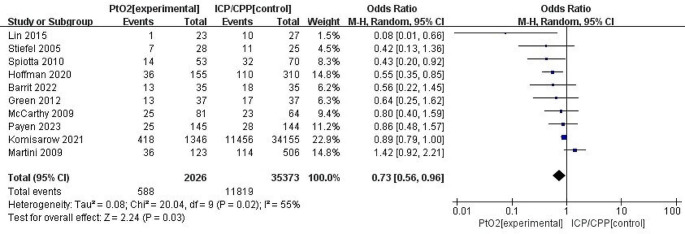
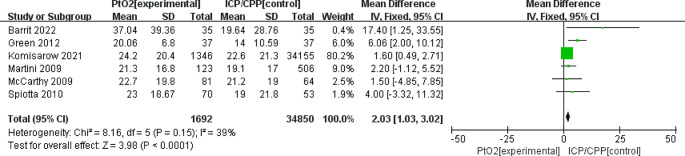
To assess whether monitoring brain tissue oxygen partial pressure (PbtO) or employing intracranial pressure (ICP)/cerebral perfusion pressure (CCP)-guided management improves patient outcomes, including mortality, hospital length of stay (LOS), mean daily ICP and mean daily CCP during the intensive care unit(ICU)stay. We searched the Web of Science, EMBASE, PubMed, Cochrane Library, and MEDLINE databases until December 12, 2023. Prospective randomized controlled and cohort studies were included. A meta-analysis was performed for the primary outcome measure, mortality, following the Preferred Reporting Items for Systematic Reviews and Meta-Analyses guidelines. Eleven studies with a total of 37,492 patients were included. The mortality in the group with PbtO was 29.0% (odds ratio: 0.73;95% confidence interval [CI]:0.56-0.96; P = 0.03; I = 55%), demonstrating a significant benefit. The overall hospital LOS was longer in the PbtO group than that in the ICP/CPP group (mean difference:2.03; 95% CI:1.03-3.02; P<0.0001; I = 39%). The mean daily ICP in the PbtO monitoring group was lower than that in the ICP/CPP group (mean difference:-1.93; 95% CI: -3.61 to -0.24; P = 0.03; I = 41%). Moreover, PbtO monitoring did not improve the mean daily CPP (mean difference:2.43; 95%CI: -1.39 to 6.25;P = 0.21; I = 56%).Compared with ICP/CPP monitoring, PbtO monitoring reduced the mortality and the mean daily ICP in patients with severe traumatic brain injury; however, no significant effect was noted on the mean daily CPP. In contrast, ICP/CPP monitoring alone was associated with a short hospital stay.
为了评估监测脑组织氧分压(PbtO)或采用颅内压(ICP)/脑灌注压(CPP)指导管理是否改善患者预后,包括死亡率、住院时间(LOS)、重症监护病房(ICU)期间的平均每日 ICP 和平均每日 CCP。我们检索了 Web of Science、EMBASE、PubMed、Cochrane 图书馆和 MEDLINE 数据库,检索截止日期为 2023 年 12 月 12 日。纳入前瞻性随机对照和队列研究。根据系统评价和荟萃分析的首选报告项目指南,对主要结局指标(死亡率)进行了荟萃分析。纳入了 11 项共 37492 例患者的研究。PbtO 组的死亡率为 29.0%(优势比:0.73;95%置信区间 [CI]:0.56-0.96;P=0.03;I=55%),表明有显著获益。PbtO 组的总体住院 LOS 长于 ICP/CPP 组(平均差异:2.03;95%CI:1.03-3.02;P<0.0001;I=39%)。PbtO 监测组的平均每日 ICP 低于 ICP/CPP 组(平均差异:-1.93;95%CI:-3.61 至-0.24;P=0.03;I=41%)。此外,PbtO 监测并未改善平均每日 CPP(平均差异:2.43;95%CI:-1.39 至 6.25;P=0.21;I=56%)。与 ICP/CPP 监测相比,PbtO 监测可降低严重创伤性脑损伤患者的死亡率和平均每日 ICP,但对平均每日 CPP 无显著影响。相比之下,单独 ICP/CPP 监测与较短的住院时间相关。