Department of Surgery, The Ohio State University Wexner Medical Center and James Comprehensive Cancer Center, Columbus, OH, USA.
Ann Surg Oncol. 2024 Aug;31(8):5283-5292. doi: 10.1245/s10434-024-15435-1. Epub 2024 May 18.
New persistent opioid use (NPOU) after surgery has been identified as a common complication. This study sought to assess the long-term health outcomes among patients who experienced NPOU after gastrointestinal (GI) cancer surgery.
Patients who underwent surgery for hepato-pancreato-biliary and colorectal cancer between 2007 and 2019 were identified using the Surveillance, Epidemiology, and End Results (SEER)-Medicare-linked database. Mixed-effect multivariable logistic regression and Cox proportional hazard models were used to estimate the risk of mortality and hospital visits related to falls, respiratory events, or pain symptoms.
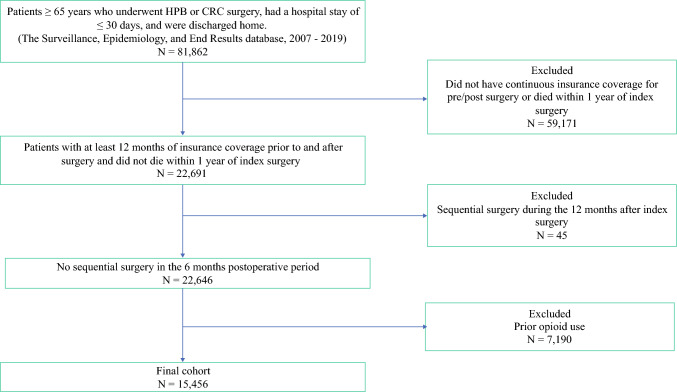
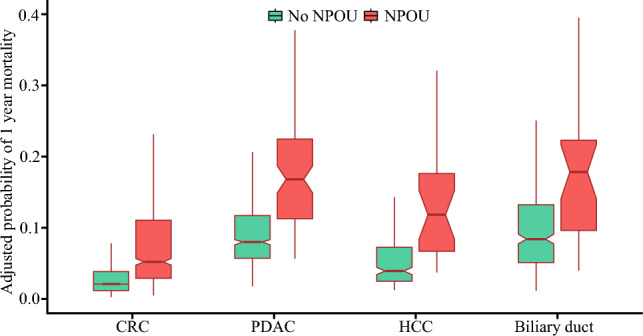
Among 15,456 patients who underwent GI cancer surgery, 967(6.6%) experienced NPOU. Notably, the patients at risk for the development of NPOU were those with a history of substance abuse (odds ratio [OR], 1.45; 95% confidence interval [CI], 1.14-1.84), moderate social vulnerability (OR, 1.26; 95% CI, 1.06-1.50), an advanced disease stage (OR, 4.42; 95% CI, 3.51-5.82), or perioperative opioid use (OR, 3.07; 95% CI, 2.59-3.63. After control for competing risk factors, patients who experienced NPOU were more likely to visit a hospital for falls, respiratory events, or pain symptoms (OR, 1.45, 95% CI 1.18-1.78). Moreover, patients who experienced NPOU had a greater risk of death at 1 year (hazard ratio [HR], 2.15; 95% CI, 1.74-2.66).
Approximately 1 in 15 patients experienced NPOU after GI cancer surgery. NPOU was associated with an increased risk of subsequent hospital visits and higher mortality. Targeted interventions for individuals at higher risk for NPOU after surgery should be used to help mitigate the harmful effects of NPOU.
手术后出现新的持续性阿片类药物使用(NPOU)已被确定为一种常见的并发症。本研究旨在评估胃肠道(GI)癌症手术后出现 NPOU 的患者的长期健康结果。
使用监测、流行病学和最终结果(SEER)-医疗保险关联数据库,确定 2007 年至 2019 年间接受肝胰胆和结直肠癌症手术的患者。使用混合效应多变量逻辑回归和 Cox 比例风险模型来估计与跌倒、呼吸事件或疼痛症状相关的死亡率和住院就诊的风险。
在 15456 名接受 GI 癌症手术的患者中,有 967 名(6.6%)经历了 NPOU。值得注意的是,有发展 NPOU 风险的患者包括有药物滥用史(比值比[OR],1.45;95%置信区间[CI],1.14-1.84)、中度社会脆弱性(OR,1.26;95%CI,1.06-1.50)、晚期疾病阶段(OR,4.42;95%CI,3.51-5.82)或围手术期阿片类药物使用(OR,3.07;95%CI,2.59-3.63)。在控制竞争风险因素后,经历 NPOU 的患者更有可能因跌倒、呼吸事件或疼痛症状而住院就诊(OR,1.45,95%CI 1.18-1.78)。此外,经历 NPOU 的患者在 1 年内死亡的风险更高(风险比[HR],2.15;95%CI,1.74-2.66)。
大约每 15 名接受 GI 癌症手术的患者中就有 1 名经历 NPOU。NPOU 与随后住院就诊和更高死亡率的风险增加相关。对于手术后 NPOU 风险较高的个体,应采用有针对性的干预措施,以帮助减轻 NPOU 的有害影响。