Department of Haematology, School of Allied Health Sciences, University for Development Studies, Tamale, Ghana.
Department of Medical Laboratory Science, Faculty of Health Science and Technology, Ebonyi State University, Abakaliki, Nigeria.
Biomed Res Int. 2024 May 10;2024:6607281. doi: 10.1155/2024/6607281. eCollection 2024.
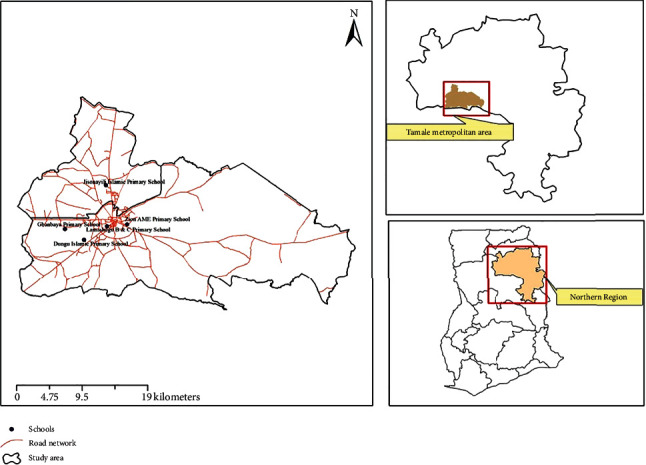
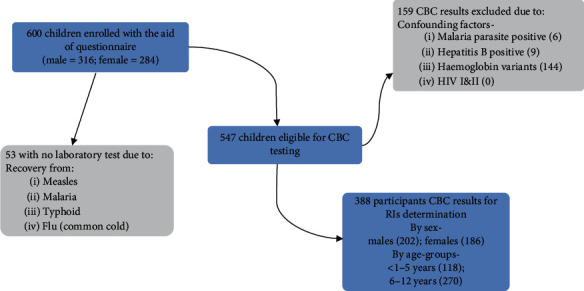
Reliable laboratory diagnostic results are key for evaluating and improving children's health. To interpret these results, child-specific reference intervals (RIs), which account for constant biological changes and physiological development with sex and age, are required, as recommended by the Clinical and Laboratory Standards Institute (CLSI). This study presents age- and sex-specific reference intervals for complete blood count (CBC) parameters in children (<1-12 years old) in the Northern Region of Ghana. In this cross-sectional study, 600 healthy children from randomly sampled schools in Tamale (the Northern Region) were recruited and screened. Data from 388 eligible children were used to nonparametrically determine the reference intervals of CBC parameters at the 2.5 and 97.5 percentiles. The CBC reference intervals were compared for variations in sex and age groups using the Wilcoxon rank-sum test. There were no statistically significant differences in most CBC parameters by sex (RBC, Hb, HCT, MCH, RDW (CV/SD), WBC, LYM#, MON#(%) NEU#(%), EOS#(%), and BAS#(%); > 0.05) and age group (RBC, MCV, RDW (CV/SD), WBC, LYM#, MON#(%) NEU#(%), EOS#(%), and BAS%; > 0.05). However, there were observable differences between this locally established CBC reference interval and that used for children at Tamale Teaching Hospital (manufacturer's RIs). This study emphasises the importance of determining reference intervals representative of the local child population and incorporating them into the current reporting system of laboratories in the Northern Region to ensure the provision of effective and efficient healthcare services.
可靠的实验室诊断结果是评估和改善儿童健康的关键。为了解读这些结果,需要根据临床和实验室标准协会(CLSI)的建议,使用特定于儿童的参考区间(RIs),这些区间考虑了性别和年龄的生物学变化和生理发育。本研究介绍了加纳北部地区<1-12 岁儿童全血细胞计数(CBC)参数的年龄和性别特异性参考区间。在这项横断面研究中,从塔马利(北部地区)随机抽取的学校中招募并筛选了 600 名健康儿童。使用 388 名合格儿童的数据,采用非参数方法确定了 CBC 参数在 2.5%和 97.5%百分位数的参考区间。使用 Wilcoxon 秩和检验比较了 CBC 参数在性别和年龄组之间的差异。大多数 CBC 参数在性别(RBC、Hb、HCT、MCH、RDW(CV/SD)、WBC、LYM#、MON#(%)、NEU#(%)、EOS#(%)和 BAS#(%))和年龄组(RBC、MCV、RDW(CV/SD)、WBC、LYM#、MON#(%)、NEU#(%)、EOS#(%)和 BAS%)之间没有统计学上的显著差异(>0.05)。然而,与塔马利教学医院(制造商的 RIs)使用的 CBC 参考区间相比,本研究中建立的参考区间存在明显差异。本研究强调了确定代表当地儿童人群的参考区间并将其纳入北方地区实验室当前报告系统的重要性,以确保提供有效和高效的医疗保健服务。