Rebollar Ramón Eizaga, Hierro Paula Lozano, Fernández Ana Mercedes Martínez-Almendros
Department of Anesthesiology and Reanimation, Puerta del Mar University Hospital, Cádiz, Spain\.
Saudi J Med Med Sci. 2024 Apr-Jun;12(2):117-124. doi: 10.4103/sjmms.sjmms_612_23. Epub 2024 Apr 5.
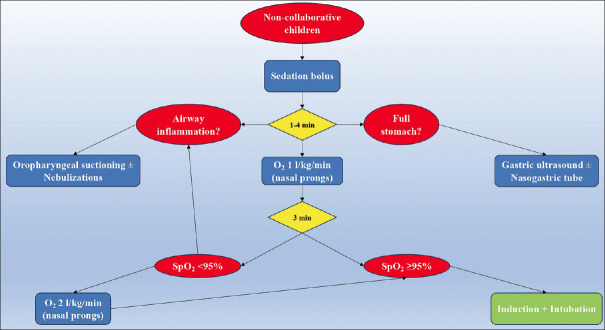
Tracheal intubation in pediatric patients is a clinical scenario that can quickly become an emergency. Complication rates can potentially reach up to 60% in rapid sequence intubation. An alternate to this is delayed sequence intubation, which may reduce potential complications-mostly hypoxemia-and can be especially useful in non-cooperative children. This technique consists of the prior airway and oxygenation optimization. This is done through sedation using agents that preserve ventilatory function and protective reflexes and continuous oxygen therapy-prior and after the anesthetic induction-using nasal prongs. The objective of this narrative review is to provide a broader perspective on delayed sequence intubation by defining the concept and indications; reviewing its safety, effectiveness, and complications; and describing the anesthetic agents and oxygen therapy techniques used in this procedure.
小儿气管插管是一种可能迅速演变为紧急情况的临床场景。在快速顺序诱导插管中,并发症发生率可能高达60%。对此的一种替代方法是延迟顺序诱导插管,这可能会减少潜在并发症——主要是低氧血症——并且在不合作的儿童中可能特别有用。该技术包括预先优化气道和氧合。这是通过使用能保留通气功能和保护性反射的药物进行镇静以及在麻醉诱导前后使用鼻导管进行持续氧疗来实现的。本叙述性综述的目的是通过定义概念和适应症、回顾其安全性、有效性和并发症以及描述该操作中使用的麻醉药物和氧疗技术,对延迟顺序诱导插管提供更广泛的视角。