Hayasaka Junnosuke, Hoteya Shu, Suzuki Yugo, Ochiai Yorinari, Mitsunaga Yutaka, Odagiri Hiroyuki, Masui Akira, Kikuchi Daisuke, Takazawa Yutaka
Gastroenterology, Toranomon Hospital, Tokyo, JPN.
Pathology, Toranomon Hospital, Tokyo, JPN.
Cureus. 2024 Apr 17;16(4):e58467. doi: 10.7759/cureus.58467. eCollection 2024 Apr.
Gastric neoplasm of the fundic gland type (GNFG) is a tumor with a good prognosis. However, since it has not been compared with conventional gastric adenocarcinoma (CGA), it is unknown whether it has a good prognosis or requires surveillance after treatment. The purpose of this study was to determine the prognosis and metachronous gastric tumor rates compared with those of CGA.
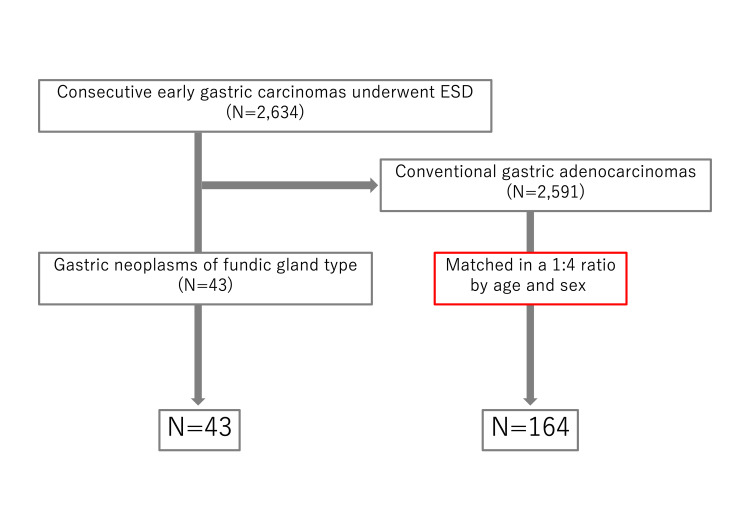
We conducted a single-center, retrospective, matched-cohort study using our database from January 2010 to December 2021. We extracted GNFG data from the endoscopic submucosal dissection (ESD) database and matched patients with conventional early gastric cancer as controls in a 1:4 ratio by age and sex. GNFG and CGA were compared for the overall survival (OS), disease-specific survival, progression-free survival, and metachronous gastric tumor rates.
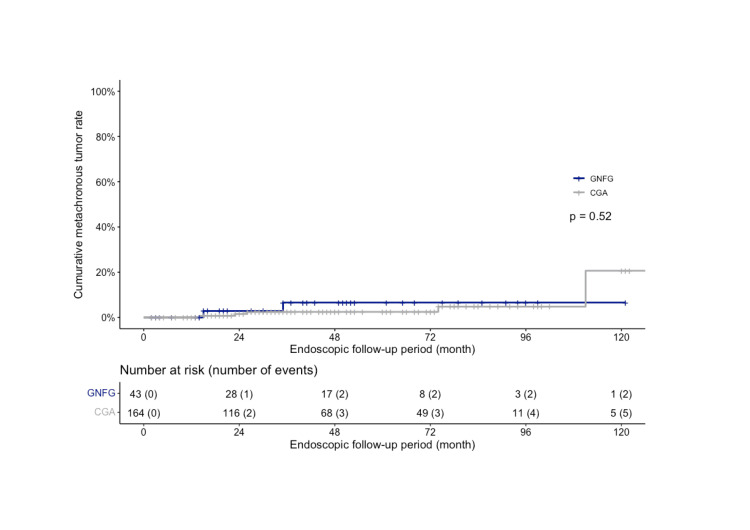
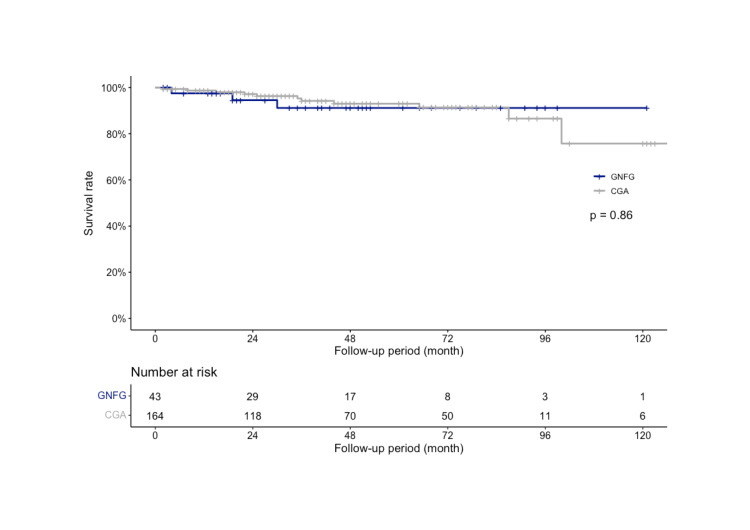
Overall, 43 lesions were GNFG and 164 CGAs were matched. There were three deaths in the GNFG group and 11 deaths in the CGA group. There was no significant difference in the OS between the two groups (P=0.81). The five-year OS rates for the GNFG and CGA groups were 90.9% and 92.9%, respectively. No disease-specific deaths or recurrences were observed in either group. There was no significant difference in the cumulative metachronous gastric tumor rate between the two groups (P=0.17). The cumulative five-year metachronous gastric tumor rates for the GNFG and CGA groups were 6.6% and 2.5%, respectively.
The prognosis for GNFG is good, however, not better than that for CGA. The metachronous gastric tumor rate after ESD in GNFG was not lower than that in CGA. Therefore, after ESD, GNFG may need to be managed in the same way as CGA.
胃底腺型胃肿瘤(GNFG)是一种预后良好的肿瘤。然而,由于尚未将其与传统胃腺癌(CGA)进行比较,因此尚不清楚它是否具有良好的预后或治疗后是否需要监测。本研究的目的是确定与CGA相比的预后和异时性胃肿瘤发生率。
我们使用2010年1月至2021年12月的数据库进行了一项单中心、回顾性、匹配队列研究。我们从内镜黏膜下剥离术(ESD)数据库中提取GNFG数据,并按年龄和性别以1:4的比例将患者与传统早期胃癌作为对照进行匹配。比较GNFG和CGA的总生存期(OS)、疾病特异性生存期、无进展生存期和异时性胃肿瘤发生率。
总体而言,有43个病变为GNFG,164个CGA进行了匹配。GNFG组有3例死亡,CGA组有11例死亡。两组之间的OS无显著差异(P=0.81)。GNFG组和CGA组的五年OS率分别为90.9%和92.9%。两组均未观察到疾病特异性死亡或复发。两组之间的累积异时性胃肿瘤发生率无显著差异(P=0.17)。GNFG组和CGA组的累积五年异时性胃肿瘤发生率分别为6.6%和2.5%。
GNFG的预后良好,但不比CGA好。GNFG在ESD后的异时性胃肿瘤发生率不低于CGA。因此,ESD后,GNFG可能需要与CGA以相同的方式进行管理。