Imtiaz Zarghona, Kato Ayaka, Kopell Brian H, Qasim Salman E, Davis Arianna Neal, Martinez Lizbeth Nunez, Heflin Matt, Kulkarni Kaustubh, Morsi Amr, Gu Xiaosi, Saez Ignacio
Nash Family Department of Neuroscience and the Friedman Brain Institute, Icahn School of Medicine at Mount Sinai, New York, NY, USA.
Department of Psychiatry, Icahn School of Medicine at Mount Sinai, New York, NY, USA.
bioRxiv. 2024 May 11:2024.05.10.593406. doi: 10.1101/2024.05.10.593406.
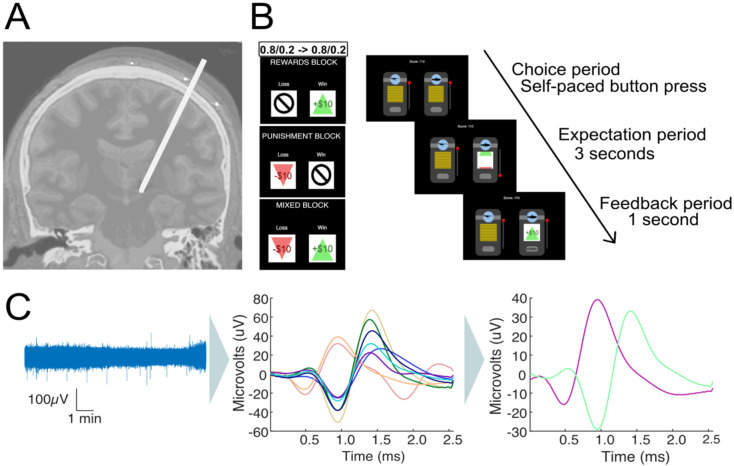
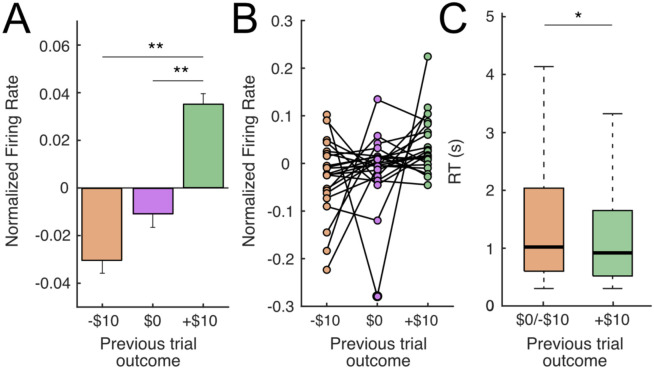
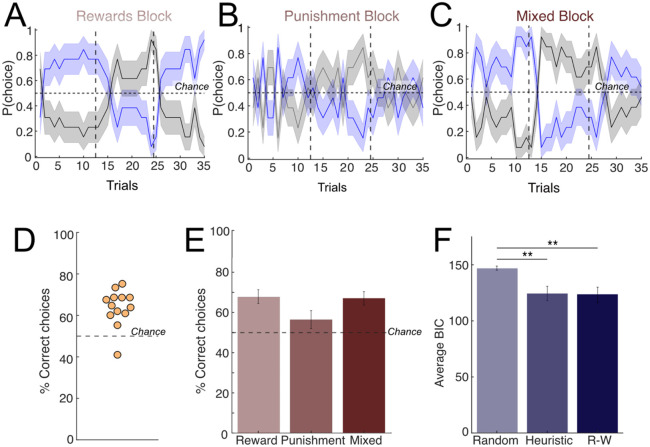
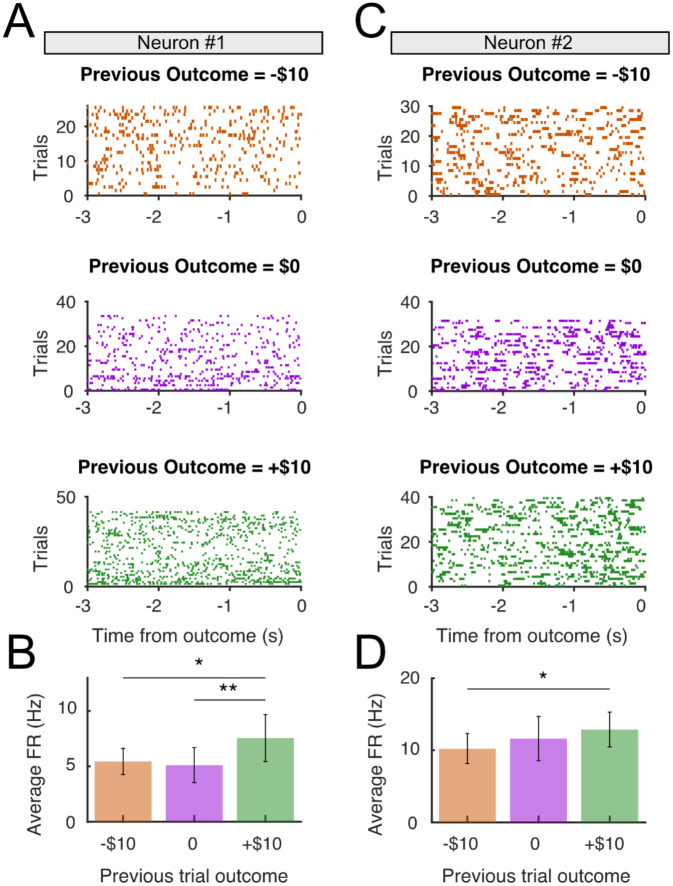
Dopamine (DA) signals originating from substantia nigra (SN) neurons are centrally involved in the regulation of motor and reward processing. DA signals behaviorally relevant events where reward outcomes differ from expectations (reward prediction errors, RPEs). RPEs play a crucial role in learning optimal courses of action and in determining response vigor when an agent expects rewards. Nevertheless, how reward expectations, crucial for RPE calculations, are conveyed to and represented in the dopaminergic system is not fully understood, especially in the human brain where the activity of DA neurons is difficult to study. One possibility, suggested by evidence from animal models, is that DA neurons explicitly encode reward expectations. Alternatively, they may receive RPE information directly from upstream brain regions. To address whether SN neuron activity directly reflects reward expectation information, we directly examined the encoding of reward expectation signals in human putative DA neurons by performing single-unit recordings from the SN of patients undergoing neurosurgery. Patients played a two-armed bandit decision-making task in which they attempted to maximize reward. We show that neuronal firing rates (FR) of putative DA neurons during the reward expectation period explicitly encode reward expectations. First, activity in these neurons was modulated by previous trial outcomes, such that FR were greater after positive outcomes than after neutral or negative outcome trials. Second, this increase in FR was associated with shorter reaction times, consistent with an invigorating effect of DA neuron activity during expectation. These results suggest that human DA neurons explicitly encode reward expectations, providing a neurophysiological substrate for a signal critical for reward learning.
源自黑质(SN)神经元的多巴胺(DA)信号在运动调节和奖赏处理中起着核心作用。DA信号标记行为相关事件,即奖赏结果与预期不同的情况(奖赏预测误差,RPE)。当个体预期奖赏时,RPE在学习最优行动过程和确定反应活力方面起着关键作用。然而,对于RPE计算至关重要的奖赏预期是如何传递到多巴胺能系统并在其中表征的,目前尚未完全理解,尤其是在人类大脑中,DA神经元的活动很难进行研究。动物模型的证据表明,一种可能性是DA神经元明确编码奖赏预期。或者,它们可能直接从上游脑区接收RPE信息。为了探究SN神经元活动是否直接反映奖赏预期信息,我们通过对接受神经外科手术患者的SN进行单单元记录,直接检测了人类假定DA神经元中奖赏预期信号的编码情况。患者执行双臂赌博决策任务,试图使奖赏最大化。我们发现,在奖赏预期期,假定DA神经元的神经放电频率(FR)明确编码了奖赏预期。首先,这些神经元的活动受先前试验结果的调节,因此在阳性结果试验后,FR高于中性或阴性结果试验后的FR。其次,FR的这种增加与更短的反应时间相关,这与预期期DA神经元活动的增强作用一致。这些结果表明,人类DA神经元明确编码奖赏预期,为奖赏学习中一种关键信号提供了神经生理学基础。