Royer Michael F, Hauser Michelle E, Zamora Astrid N, Campero Maria Ines, Garcia Dulce, Gabaray Martha, Sheats Jylana L, King Abby C
Stanford Prevention Research Center, Stanford University School of Medicine.
Division of General Surgery, Department of Surgery, Stanford University School of Medicine.
Res Sq. 2024 May 7:rs.3.rs-4331290. doi: 10.21203/rs.3.rs-4331290/v1.
Food insecurity, an ongoing and accelerating problem in the U.S., is an economic and social condition involving limited or uncertain access to adequate food. Some of the highest rates of food insecurity in 2022 were found among individuals who were Hispanic-Latinx (20.8%), a population that already faces disproportionate health and socioeconomic disadvantages. There remains an urgent health-related need to identify sustainable strategies to prevent food insecurity in the Latinx population.
A first-generation pilot investigation was conducted using data derived from a sub-study connected to the Computerized Physical Activity Support for Seniors (COMPASS) Trial, a 12-month cluster-randomized controlled trial among older Latinx adults. The sub-study focused on two nutrition interventions that included 1) the Food Literacy and Nutrition (FLAN) curriculum, and 2) a nutrition information-only control. Research hypotheses aimed to determine whether the FLAN intervention reduced food insecurity and increased daily fruit and vegetable servings.
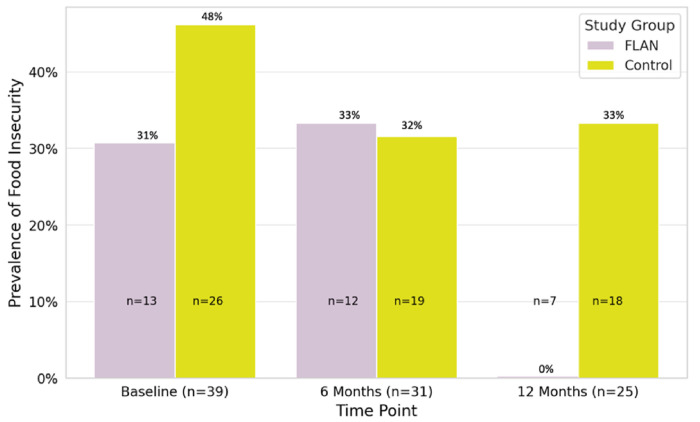
On average, participants (n = 39) were 61.5 years of age (SD = 6.7), mostly female (69%), and reported Spanish as their primary language (69%). The FLAN intervention was associated with decreased odds of food insecurity at 12 months (AOR = 0.71, 95% CI = 0.54, 0.95; = 0.03) when compared to the nutrition-information only control intervention. Although no between-group differences in daily fruit and vegetable servings were found, there was a significant correlation between changes in daily fruit and vegetable servings from baseline to six months and changes in food insecurity from baseline to 12 months (r = -0.51, = 0.01).
The FLAN intervention, a bilingual and culturally tailored educational curriculum, yielded 12-month improvements in food security among a small sample of older Latinx adults. Evidence from this investigation suggests the potential utility of implementing the FLAN curriculum among individuals who are at an increased risk of food insecurity. Further investigation in a larger sample is merited to determine whether the 12-month decreases in food insecurity that were produced by the FLAN intervention can be replicated.
ClinicalTrials.gov Identifier: NCT02111213.
粮食不安全是美国一个持续且日益严重的问题,它是一种经济和社会状况,涉及获得充足食物的机会有限或不确定。2022年,粮食不安全率最高的人群包括西班牙裔拉丁裔(20.8%),这一群体已经面临着不成比例的健康和社会经济劣势。迫切需要确定可持续的策略来预防拉丁裔人群的粮食不安全问题。
采用第一代试点调查,数据来源于与老年人计算机化身体活动支持(COMPASS)试验相关的一项子研究,该试验是一项针对拉丁裔老年成年人的为期12个月的整群随机对照试验。子研究聚焦于两种营养干预措施,包括1)食品素养与营养(FLAN)课程,以及2)仅提供营养信息的对照。研究假设旨在确定FLAN干预措施是否能减少粮食不安全状况并增加每日水果和蔬菜的摄入量。
参与者平均年龄为61.5岁(标准差=6.7),大多数为女性(69%),且报告称西班牙语是其主要语言(69%)。与仅提供营养信息的对照干预措施相比,FLAN干预措施与12个月时粮食不安全几率的降低相关(调整后比值比=0.71,95%置信区间=0.54,0.95;P=0.03)。虽然未发现两组在每日水果和蔬菜摄入量上存在差异,但从基线到6个月每日水果和蔬菜摄入量的变化与从基线到12个月粮食不安全状况的变化之间存在显著相关性(r=-0.51,P=0.01)。
FLAN干预措施是一种双语且针对文化定制的教育课程,在一小部分拉丁裔老年成年人样本中,使粮食安全状况在12个月内得到改善。这项调查的证据表明,在粮食不安全风险增加的个体中实施FLAN课程具有潜在效用。值得在更大样本中进行进一步调查,以确定FLAN干预措施所带来的粮食不安全状况在12个月内的改善是否能够重现。
ClinicalTrials.gov标识符:NCT02111213。