Department of Public Health Sciences, University of Miami Miller School of Medicine, 1140 NW 14th St, 912 Don Soffer Clinical Research Center, Miami, FL, 33136, USA.
Center for Health Care Research and Policy, Case Western Reserve University School of Medicine, Cleveland, OH, USA.
Sci Rep. 2024 May 20;14(1):11509. doi: 10.1038/s41598-024-62179-9.
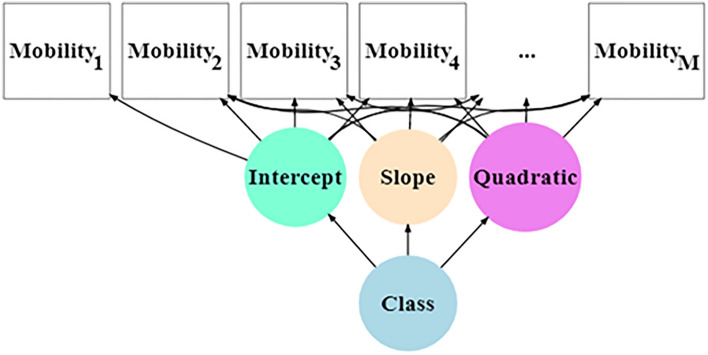
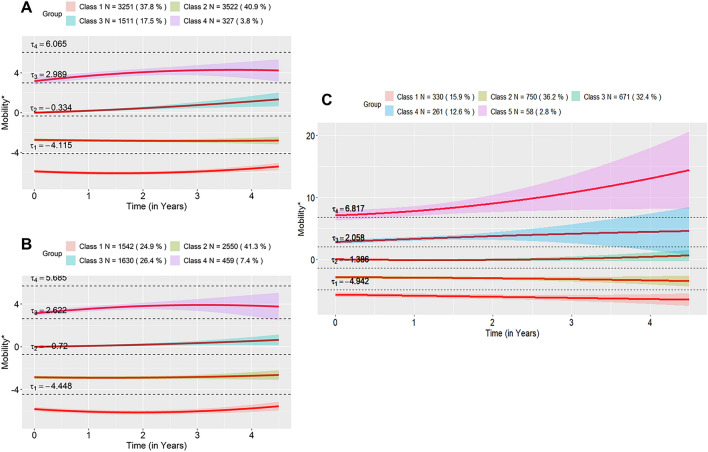
Loss of ambulation is common and highly variable in Parkinson's disease (PD), and poorly understood from the perspectives of those with PD. Gaining insights to the anticipated perceived trajectories and their drivers, will facilitate patient-centered care. Latent class growth analysis, a person-centered mixture modelling approach, was applied to 16,863 people with PD stratified by early (N = 8612; < 3 years), mid (N = 6181; 3-10 years) and later (N = 2070; > 10 years) disease to discern clusters with similar longitudinal patterns of self-reported walking difficulty, measured by EuroQoL 5D-5L that is validated for use in PD. There were four clusters in early and mid-disease strata, with a fifth identified in later disease. Trajectories ranged from none to moderate walking difficulty, with small clusters with severe problems. The percentage of subjects with moderate (early = 17.5%, mid = 26.4%, later = 32.5%) and severe (early = 3.8%, mid = 7.4%, later = 15.4%) walking difficulty at baseline increased across disease duration groups. The trajectories tended to be stable with variability in moderate and severe groups. Across strata, clusters with moderate to severe problems were associated with more severe impairment, depression, anxiety, arthritis, higher BMI, lower income, and lower education, but no consistent race or gender differences. The findings reveal distinct longitudinal patterns in perceived difficulties in walking in PD.
行动能力丧失在帕金森病(PD)中很常见且高度可变,从 PD 患者的角度来看,这种情况很难理解。深入了解预期的感知轨迹及其驱动因素将有助于实现以患者为中心的护理。潜在类别增长分析是一种以人为中心的混合建模方法,应用于按早期(N=8612;<3 年)、中期(N=6181;3-10 年)和晚期(N=2070;>10 年)分层的 16863 名 PD 患者,以辨别具有相似纵向自我报告行走困难模式的聚类,使用经过验证可用于 PD 的 EuroQoL 5D-5L 进行测量。在早期和中期疾病分层中发现了四个聚类,在晚期疾病中发现了第五个聚类。轨迹范围从没有到中度行走困难,有小的聚类存在严重问题。中度(早期=17.5%,中期=26.4%,晚期=32.5%)和重度(早期=3.8%,中期=7.4%,晚期=15.4%)行走困难的患者百分比在疾病持续时间组中增加。轨迹往往稳定,中度和重度组存在变异性。在各层中,中度至重度问题的聚类与更严重的障碍、抑郁、焦虑、关节炎、更高的 BMI、较低的收入和较低的教育程度相关,但没有一致的种族或性别差异。这些发现揭示了 PD 中感知行走困难的不同纵向模式。