Instituto de Investigación en Recursos Cinegéticos (IREC, CSIC-UCLM-JCCM), Ronda de Toledo 12, 13071, Ciudad Real, Spain.
Centro de Investigação em Biodiversidade e Recursos Genéticos, InBIO Laboratório Associado, CIBIO, Universidade Do Porto, Campus de Vairão, 4485-661, Vairão, Portugal.
Sci Rep. 2024 May 20;14(1):11478. doi: 10.1038/s41598-024-62432-1.
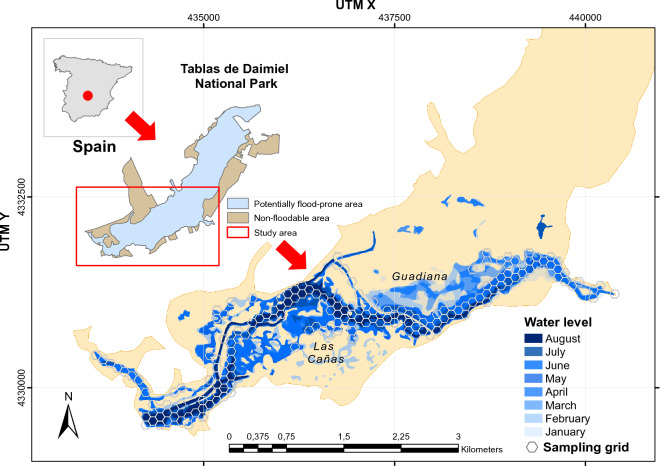
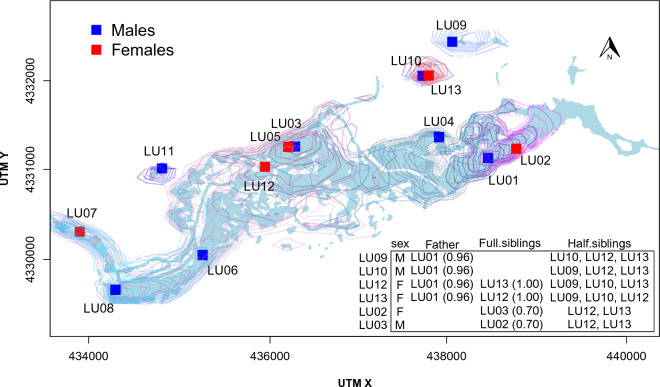
The Eurasian otter Lutra lutra is a territorial semi-aquatic carnivore usually found at low densities in rivers, coastal areas, and wetlands. Its diet is based on prey associated with aquatic environments. Mediterranean rivers are highly seasonal, and suffer reduced flow during the summer, resulting in isolated river sections (pools) that sometimes can be left with a minimal amount of water, leading to concentrations of food for otters. To our knowledge, this process, which was known to field naturalists, has not been accurately described, nor have otter densities been estimated under these conditions. In this study, we describe the population size and movements of an aggregation of otters in an isolated pool in the Guadiana River in the Tablas de Daimiel National Park (central Spain), which progressively dried out during the spring-summer of 2022, in a context of low connectivity due to the absence of circulating water in the Guadiana and Gigüela rivers. Using non-invasive genetic sampling of 120 spraints collected along 79.4 km of sampling transects and spatial capture-recapture methods, we estimated the otter density at 1.71 individuals/km of river channel length (4.21 individuals/km) in a progressively drying river pool, up to five times higher than previously described in the Iberian Peninsula. The movement patterns obtained with the spatial capture-recapture model are not quite different from those described in low density, which seems to indicate a wide home range overlap, with low signs of territoriality.
欧亚水獭 Lutra lutra 是一种具有领地性的半水生食肉动物,通常在河流、沿海地区和湿地中低密度存在。它的饮食主要以与水生环境相关的猎物为基础。地中海河流的季节性很强,夏季流量减少,导致河流的孤立河段(池塘)有时只剩下少量的水,导致水獭食物集中。据我们所知,这种过程虽然被野外自然学家所熟知,但尚未被准确描述,也没有在这些条件下估计水獭的密度。在这项研究中,我们描述了在塔布拉斯·德·达米尔国家公园(西班牙中部)瓜迪亚纳河的一个孤立池塘中聚集的水獭种群规模和运动情况,该池塘在 2022 年春季和夏季逐渐干涸,由于瓜迪亚纳河和吉古埃拉河没有循环水,连通性较低。我们使用非侵入性遗传采样技术,对沿着 79.4 公里的采样样线收集的 120 个粪便样本进行了采样,并使用空间捕获-再捕获方法,估计了逐渐干涸的河流池塘中每公里河道长度的水獭密度为 1.71 只/公里(4.21 只/公里),比以前在伊比利亚半岛描述的密度高五倍。通过空间捕获-再捕获模型获得的运动模式与低密度描述的模式没有太大区别,这似乎表明它们的活动范围重叠广泛,领地性较低。