Murphy Sean M, Adams Jennifer R, Waits Lisette P, Cox John J
Wildlife Management Division New Mexico Department of Game & Fish Santa Fe New Mexico USA.
Department of Fish and Wildlife Sciences University of Idaho Moscow Idaho USA.
Ecol Evol. 2021 Oct 7;11(21):15047-15061. doi: 10.1002/ece3.8187. eCollection 2021 Nov.
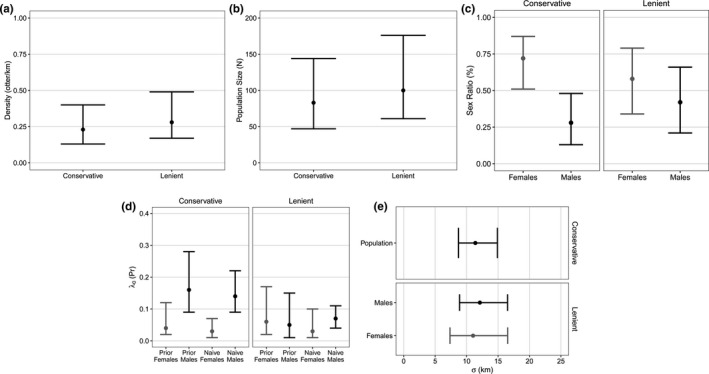
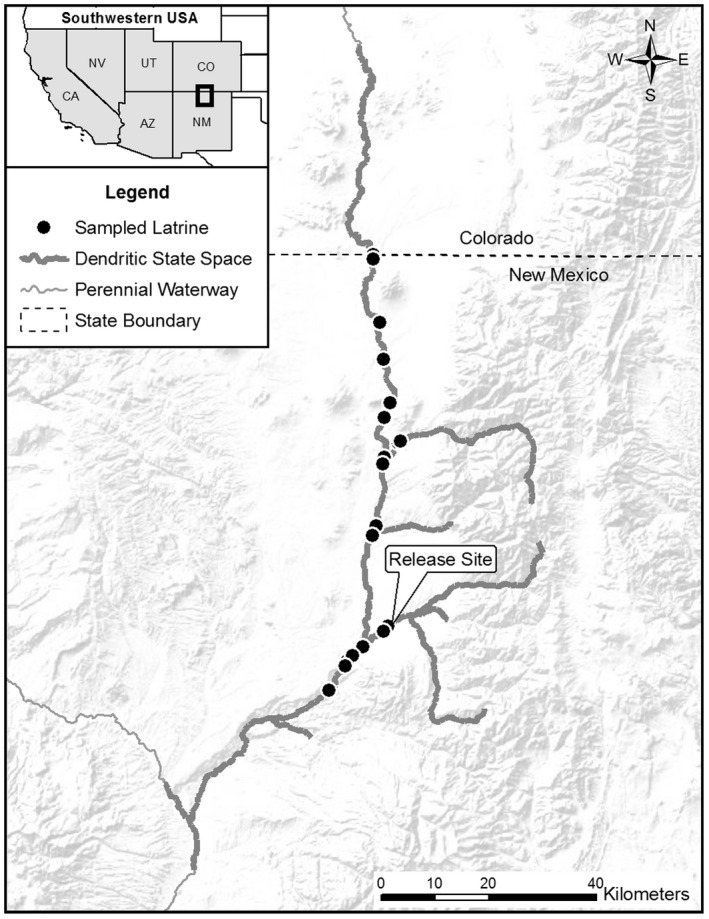
Monitoring the demographics and genetics of reintroduced populations is critical to evaluating reintroduction success, but species ecology and the landscapes that they inhabit often present challenges for accurate assessments. If suitable habitats are restricted to hierarchical dendritic networks, such as river systems, animal movements are typically constrained and may violate assumptions of methods commonly used to estimate demographic parameters. Using genetic detection data collected via fecal sampling at latrines, we demonstrate applicability of the spatial capture-recapture (SCR) network distance function for estimating the size and density of a recently reintroduced North American river otter () population in the Upper Rio Grande River dendritic network in the southwestern United States, and we also evaluated the genetic outcomes of using a small founder group ( = 33 otters) for reintroduction. Estimated population density was 0.23-0.28 otter/km, or 1 otter/3.57-4.35 km, with weak evidence of density increasing with northerly latitude (β = 0.33). Estimated population size was 83-104 total otters in 359 km of riverine dendritic network, which corresponded to average annual exponential population growth of 1.12-1.15/year since reintroduction. Growth was ≥40% lower than most reintroduced river otter populations and strong evidence of a founder effect existed 8-10 years post-reintroduction, including 13-21% genetic diversity loss, 84%-87% genetic effective population size decline, and rapid divergence from the source population ( accumulation = 0.06/generation). Consequently, genetic restoration via translocation of additional otters from other populations may be necessary to mitigate deleterious genetic effects in this small, isolated population. Combined with non-invasive genetic sampling, the SCR network distance approach is likely widely applicable to demogenetic assessments of both reintroduced and established populations of multiple mustelid species that inhabit aquatic dendritic networks, many of which are regionally or globally imperiled and may warrant reintroduction or augmentation efforts.
监测重新引入种群的人口统计学和遗传学对于评估重新引入的成功至关重要,但物种生态学及其栖息的景观往往给准确评估带来挑战。如果适宜栖息地仅限于分层的树枝状网络,如河流系统,动物的活动通常会受到限制,这可能会违反常用于估计人口统计学参数的方法的假设。利用通过在便溺处进行粪便采样收集的基因检测数据,我们证明了空间捕获 - 重捕(SCR)网络距离函数在美国西南部上里奥格兰德河树枝状网络中用于估计最近重新引入的北美水獭种群规模和密度的适用性,并且我们还评估了使用一个小的奠基者群体(n = 33只水獭)进行重新引入的遗传结果。估计种群密度为0.23 - 0.28只水獭/公里,即1只水獭/3.57 - 4.35公里,有微弱证据表明密度随纬度向北增加(β = 0.33)。在359公里的河流树枝状网络中,估计种群总数为83 - 104只水獭,这相当于自重新引入以来平均每年1.12 - 1.15的指数种群增长率。该增长率比大多数重新引入的水獭种群低≥40%,并且在重新引入8 - 10年后存在强烈的奠基者效应证据,包括13 - 21%的遗传多样性丧失、84% - 87%的遗传有效种群规模下降以及与源种群的快速分化(每代累积FST = 0.06)。因此,可能有必要通过从其他种群转移额外的水獭来进行基因恢复,以减轻这个小的孤立种群中的有害基因效应。结合非侵入性基因采样,SCR网络距离方法可能广泛适用于对栖息在水生树枝状网络中的多种鼬科物种的重新引入和已建立种群的遗传人口统计学评估,其中许多物种在区域或全球范围内受到威胁,可能需要重新引入或增加种群数量的努力。