Faculty of Nursing Science, Université Laval, Québec, QC, G1V 0A6, Canada.
Department of Family Medicine and Division of Geriatric Medicine, McGill University, Montreal, QC, H3S 1Z1, Canada.
BMC Health Serv Res. 2024 May 21;24(1):646. doi: 10.1186/s12913-024-11095-9.
During the COVID-19 pandemic, numerous long-term care (LTC) homes faced restrictions that prevented face-to-face visits. To address this challenge and maintain family connections, many LTC homes facilitated the use of electronic tablets to connect residents with their family caregivers. Our study sought to explore the acceptability of this practice among staff members and managers, focusing on their experiences with facilitating videoconferencing.
A convergent mixed method research was performed. Qualitative and quantitative data collection through semi-structured interviews to assess the acceptability of videoconferencing in long-term care homes and to explore the characteristics of these settings. Quantitative data on the acceptability of the intervention were collected using a questionnaire developed as part of the project. The study included a convenience sample of 17 staff members and four managers.
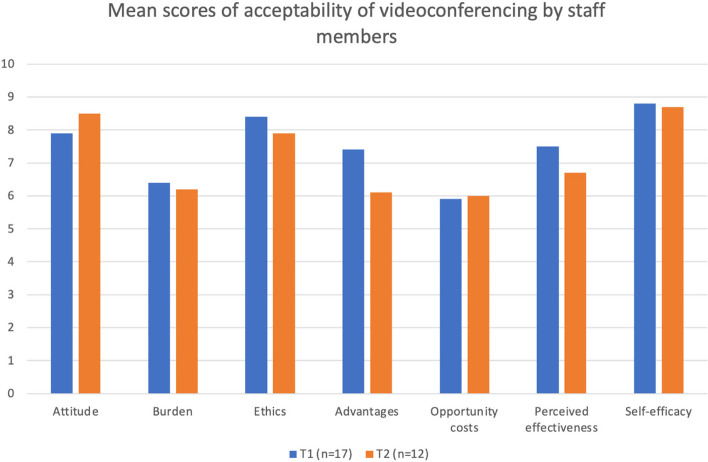
Managers described LTC homes' characteristics, and the way videoconferencing was implemented within their institutions. Affective attitude, burden, ethicality, opportunity costs, perceived effectiveness, and self-efficacy are reported as per the constructs of the Theoretical Framework of Acceptability. The results suggest a favorable acceptability and a positive attitude of managers and staff members toward the use of videoconferencing in long-term care to preserve and promote contact between residents and their family caregivers. However, participants reported some challenges related to the burden and the costs regarding the invested time and staff shortage.
LTC home staff reported a clear understanding of the acceptability and challenges regarding the facilitation of videoconferencing by residents to preserve their contact with family caregivers.
在 COVID-19 大流行期间,许多长期护理(LTC)院面临着限制,禁止面对面探访。为了应对这一挑战并保持家庭联系,许多 LTC 院允许使用电子平板电脑将居民与他们的家庭护理人员联系起来。我们的研究旨在探索员工和管理人员对这种做法的接受程度,重点是他们在促进视频会议方面的经验。
采用收敛混合方法研究。通过半结构化访谈进行定性和定量数据收集,以评估长期护理院视频会议的可接受性,并探讨这些环境的特点。使用作为项目一部分开发的问卷收集有关干预措施可接受性的定量数据。该研究包括 17 名员工和 4 名管理人员的便利样本。
管理人员描述了长期护理院的特点,以及在他们的机构中实施视频会议的方式。情感态度、负担、伦理、机会成本、感知效果和自我效能感是根据可接受性理论框架的结构报告的。结果表明,管理人员和员工对长期护理中使用视频会议来保持和促进居民与其家庭护理人员之间的联系持可接受和积极的态度。然而,参与者报告了一些与负担和时间投入以及人员短缺有关的挑战。
长期护理院的工作人员清楚地了解促进居民进行视频会议以保持与家庭护理人员联系的可接受性和挑战。