Iyer Sai Prasad N, Pino Christopher J, Yessayan Lenar T, Goldstein Stuart L, Weir Matthew R, Westover Angela J, Catanzaro David A, Chung Kevin K, Humes H David
Department of Medical Affairs, SeaStar Medical, Denver, CO.
Division of Nephrology, Department of Medicine, University of Michigan, Ann Arbor, MI.
Transplant Direct. 2024 May 16;10(6):e1627. doi: 10.1097/TXD.0000000000001627. eCollection 2024 Jun.
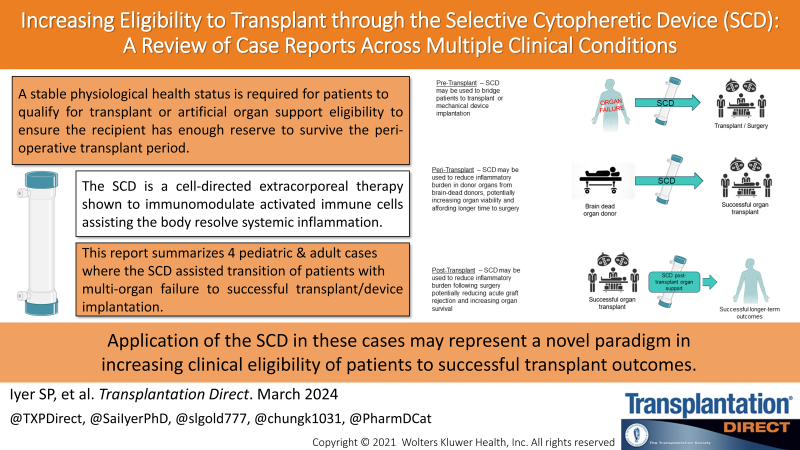
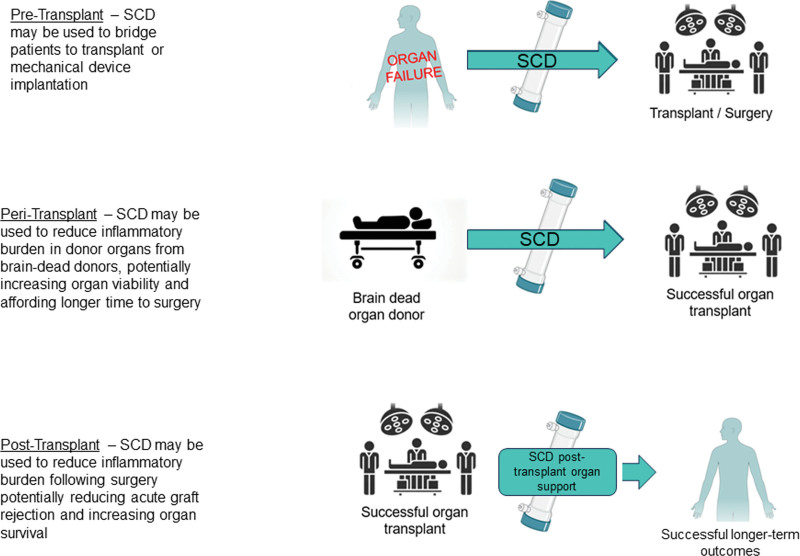
A stable, minimum physiological health status is required for patients to qualify for transplant or artificial organ support eligibility to ensure the recipient has enough reserve to survive the perioperative transplant period. Herein, we present a novel strategy to stabilize and improve patient clinical status through extracorporeal immunomodulation of systemic hyperinflammation with impact on multiple organ systems to increase eligibility and feasibility for transplant/device implantation. This involves treatment with the selective cytopheretic device (SCD), a cell-directed extracorporeal therapy shown to adhere and immunomodulate activated neutrophils and monocytes toward resolution of systemic inflammation. In this overview, we describe a case series of successful transition of pediatric and adult patients with multiorgan failure to successful transplant/device implantation procedures by treatment with the SCD in the following clinical situations: pediatric hemophagocytic lymphohistiocytosis, and adult hepatorenal and cardiorenal syndromes. Application of the SCD in these cases may represent a novel paradigm in increasing clinical eligibility of patients to successful transplant outcomes.
患者要符合移植或人工器官支持的条件,需要有稳定的最低生理健康状态,以确保接受者有足够的储备来度过围手术期移植阶段。在此,我们提出一种新策略,通过对全身炎症反应进行体外免疫调节来稳定和改善患者的临床状态,这种炎症反应会影响多个器官系统,从而提高移植/装置植入的可能性和可行性。这涉及使用选择性血细胞分离装置(SCD)进行治疗,这是一种细胞导向的体外治疗方法,已证明可黏附并免疫调节活化的中性粒细胞和单核细胞,以解决全身炎症。在本综述中,我们描述了一系列病例,这些多器官功能衰竭的儿科和成年患者通过在以下临床情况中使用SCD治疗,成功过渡到成功的移植/装置植入手术:儿科噬血细胞性淋巴组织细胞增生症,以及成人肝肾综合征和心肾综合征。在这些病例中应用SCD可能代表了一种提高患者成功移植结局临床可能性的新范例。