Zhao Bingcong, Li Zhigang, Shi Chuan, Liu Yan, Sun Yang, Li Bin, Zhang Jie, Gong Zhizhong, Wang Yuanzheng, Ma Xuehong, Yang Xinjing, Jiang Huili, Fu Yuanbo, Wang Xin, Li Yang, Liu Hengchia, Bao Tuya, Fei Yutong
Department of Acupuncture and Moxibustion, Beijing Hospital of Traditional Chinese Medicine, Capital Medical University, Beijing, People's Republic of China.
Beijing Key Laboratory of Acupuncture Neuromodulation, Beijing, People's Republic of China.
Neuropsychiatr Dis Treat. 2024 May 16;20:1049-1064. doi: 10.2147/NDT.S446034. eCollection 2024.
Anxious depression (AD) is a common, distinct depression subtype. This exploratory subgroup analysis aimed to explore the effects of acupuncture as an add-on therapy of selective serotonin reuptake inhibitors (SSRIs) for patients with AD or non-anxious depression (NAD).
Four hundred and sixty-five patients with moderate-to-severe depression from the AcuSDep pragmatic trial were included in analysis. Patients were randomly assigned to receive MA+SSRIs, EA+SSRIs, or SSRIs alone (1:1:1) for six weeks. AD was defined by using dimensional criteria. The measurement instruments included 17-items Hamilton Depression Scale (HAMD-17), Self-Rating Depression Scale (SDS), Clinical Global Impression (CGI), Rating Scale for Side Effects (SERS), and WHO Quality of Life-BREF (WHOQOL-BREF). Comparison between AD and NAD subgroups and comparisons between groups within either AD or NAD subgroups were conducted.
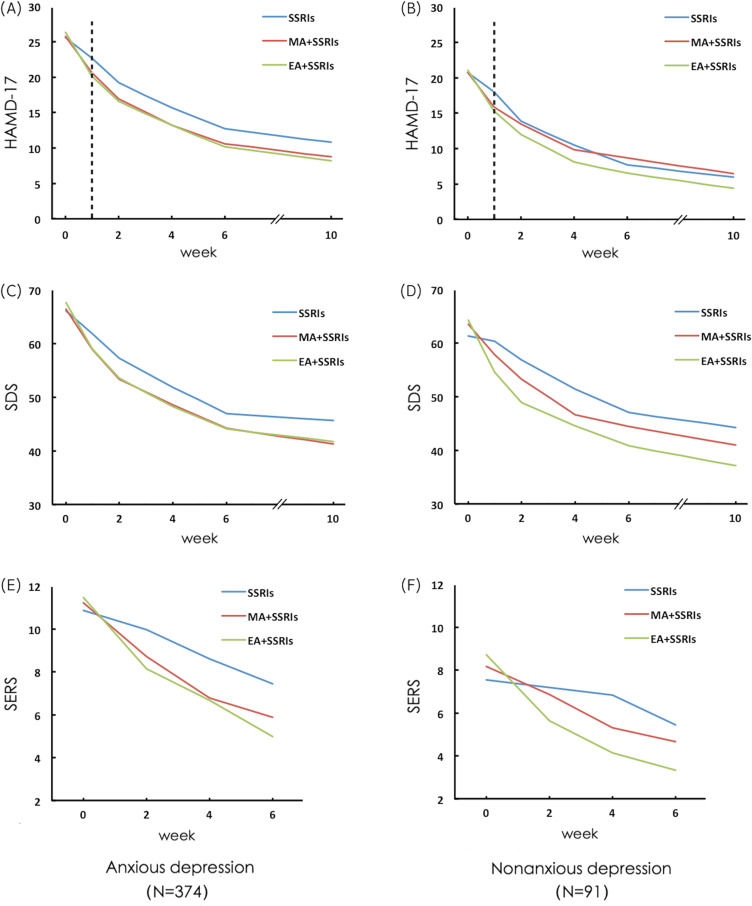
Eighty percent of the patients met the criteria for AD. The AD subgroup had poorer clinical manifestations and treatment outcomes compared to those of the NAD subgroup. For AD patients, the HAMD response rate, remission rate, early onset rate, and the score changes on each scale at most measurement points on the two acupuncture groups were significantly better than the SSRIs group. For NAD patients, the HAMD early onset rates of the two acupuncture groups were significantly better than the SSRIs group.
For AD subtype patients, either MA or EA add-on SSRIs showed comprehensive improvements, with small-to-medium effect sizes. For NAD subtype patients, both the add-on acupuncture could accelerate the response to SSRIs treatment. The study contributed to the existing literature by providing insights into the potential benefits of acupuncture in combination with SSRIs, especially for patients with AD subtypes. Due to its limited nature as a post hoc subgroup analysis, prospectively designed, high-quality trials are warranted.
ChiCTR-TRC-08000297.
焦虑抑郁(AD)是一种常见的、独特的抑郁亚型。这项探索性亚组分析旨在探讨针刺作为选择性5-羟色胺再摄取抑制剂(SSRIs)的附加疗法对AD或非焦虑抑郁(NAD)患者的影响。
纳入AcuSDep实用试验中465例中重度抑郁症患者进行分析。患者被随机分配接受电针联合SSRIs、经皮穴位电刺激联合SSRIs或单用SSRIs(1:1:1)治疗6周。采用维度标准定义AD。测量工具包括17项汉密尔顿抑郁量表(HAMD-17)、自评抑郁量表(SDS)、临床总体印象量表(CGI)、副反应量表(SERS)和世界卫生组织生存质量简表(WHOQOL-BREF)。对AD和NAD亚组进行比较,并在AD或NAD亚组内进行组间比较。
80%的患者符合AD标准。与NAD亚组相比,AD亚组的临床表现和治疗效果较差。对于AD患者,两个针刺组在大多数测量点的HAMD反应率、缓解率、起效率以及各量表评分变化均显著优于SSRIs组。对于NAD患者,两个针刺组的HAMD起效率显著优于SSRIs组。
对于AD亚型患者,电针或经皮穴位电刺激联合SSRIs均显示出全面改善,效应大小为中到小。对于NAD亚型患者,附加针刺均可加速对SSRIs治疗的反应。本研究通过揭示针刺联合SSRIs的潜在益处,尤其是对AD亚型患者的益处,为现有文献做出了贡献。由于作为事后亚组分析其性质有限,因此需要进行前瞻性设计的高质量试验。
ChiCTR-TRC-08000297。