Armour Mike, Smith Caroline A, Wang Li-Qiong, Naidoo Dhevaksha, Yang Guo-Yan, MacPherson Hugh, Lee Myeong Soo, Hay Phillipa
NICM Health Research Institute, Western Sydney University, Penrith, NSW 2751, Australia.
Translational Health Research Institute, School of Medicine, Western Sydney University, Penrith, NSW 2751, Australia.
J Clin Med. 2019 Jul 31;8(8):1140. doi: 10.3390/jcm8081140.
Depression is commonly treated with anti-depressant medication and/or psychological interventions. Patients with depression are common users of complementary therapies, such as acupuncture, either as a replacement for, or adjunct to, their conventional treatments. This systematic review and meta-analysis examined the effectiveness of acupuncture in major depressive disorder.
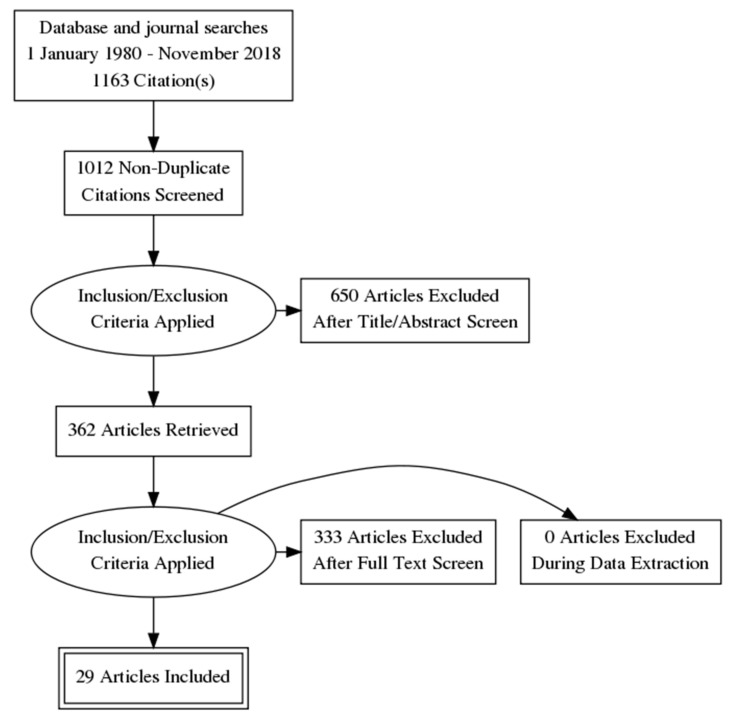
A search of English (Medline, PsychINFO, Google Scholar, and CINAL), Chinese (China National Knowledge Infrastructure Database (CNKI) and Wanfang Database), and Korean databases was undertaken from 1980 to November 2018 for clinical trials using manual, electro, or laser acupuncture.
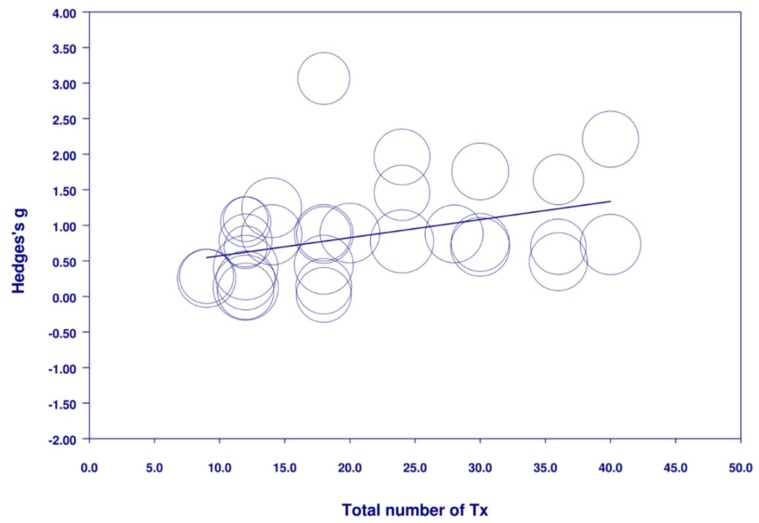
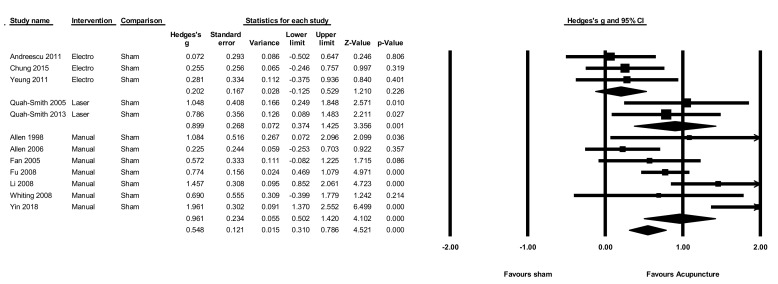
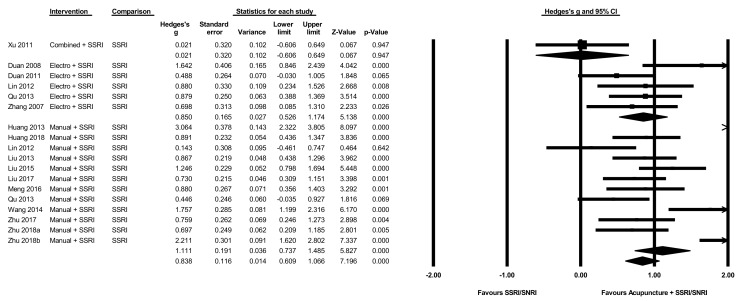
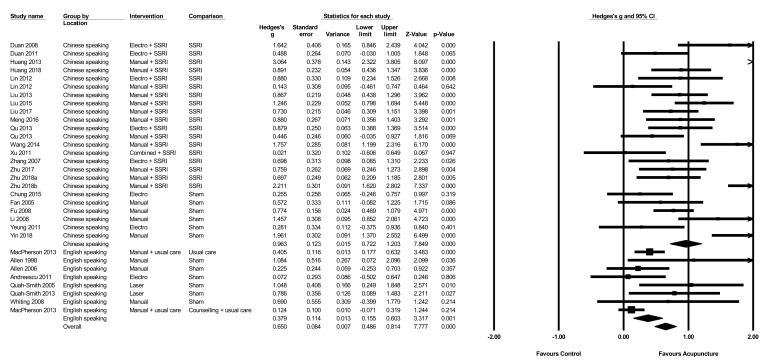
Twenty-nine studies including 2268 participants were eligible and included in the meta-analysis. Twenty-two trials were undertaken in China and seven outside of China. Acupuncture showed clinically significant reductions in the severity of depression compared to usual care (Hedges (g) = 0.41, 95% confidence interval (CI) 0.18 to 0.63), sham acupuncture (g = 0.55, 95% CI 0.31 to 0.79), and as an adjunct to anti-depressant medication (g = 0.84, 95% CI 0.61 to 1.07). A significant correlation between an increase in the number of acupuncture treatments delivered and reduction in the severity of depression ( = 0.015) was found.
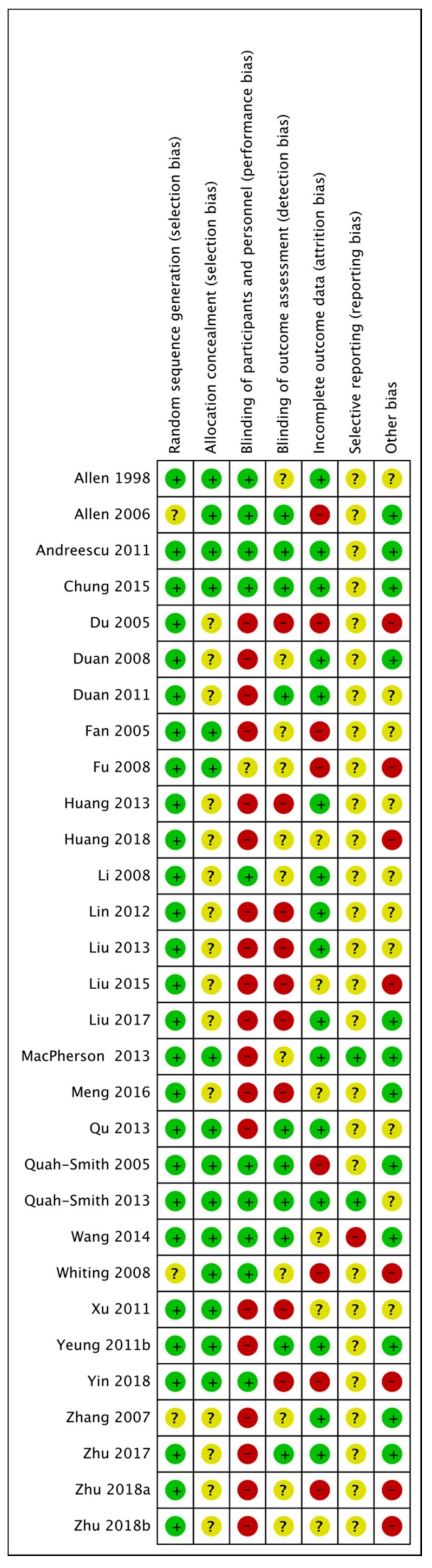
The majority of the included trials were at a high risk of bias for performance blinding. The applicability of findings in Chinese populations to other populations is unclear, due to the use of a higher treatment frequency and number of treatments in China. The majority of trials did not report any post-trial follow-up and safety reporting was poor.
Acupuncture may be a suitable adjunct to usual care and standard anti-depressant medication.
抑郁症通常采用抗抑郁药物和/或心理干预进行治疗。抑郁症患者常使用补充疗法,如针灸,作为传统治疗的替代或辅助手段。本系统评价和荟萃分析探讨了针灸治疗重度抑郁症的有效性。
检索了1980年至2018年11月的英文数据库(Medline、PsychINFO、谷歌学术和CINAL)、中文数据库(中国知网数据库(CNKI)和万方数据库)以及韩文数据库,以查找使用手动、电针或激光针灸的临床试验。
29项研究(包括2268名参与者)符合纳入标准并被纳入荟萃分析。22项试验在中国进行,7项在中国以外进行。与常规护理相比,针灸在临床上显著降低了抑郁严重程度(Hedges(g)=0.41,95%置信区间(CI)0.18至0.63),与假针灸相比(g=0.55,95%CI 0.31至0.79),作为抗抑郁药物的辅助手段时(g=0.84,95%CI 0.61至1.07)。发现针灸治疗次数增加与抑郁严重程度降低之间存在显著相关性(=0.015)。
纳入的大多数试验在实施盲法方面存在高偏倚风险。由于中国使用的治疗频率和治疗次数较高,中国人群的研究结果对其他人群的适用性尚不清楚。大多数试验未报告任何试验后随访情况,安全性报告较差。
针灸可能是常规护理和标准抗抑郁药物的合适辅助手段。