• 文献检索
  • 文档翻译
  • 深度研究
  • 学术资讯
  • Suppr Zotero 插件Zotero 插件
  • 邀请有礼
  • 套餐&价格
  • 历史记录
应用&插件
Suppr Zotero 插件Zotero 插件浏览器插件Mac 客户端Windows 客户端微信小程序
定价
高级版会员购买积分包购买API积分包
服务
文献检索文档翻译深度研究API 文档MCP 服务
关于我们
关于 Suppr公司介绍联系我们用户协议隐私条款
关注我们

Suppr 超能文献

核心技术专利:CN118964589B侵权必究
粤ICP备2023148730 号-1Suppr @ 2026

文献检索

告别复杂PubMed语法,用中文像聊天一样搜索,搜遍4000万医学文献。AI智能推荐,让科研检索更轻松。

立即免费搜索

文件翻译

保留排版,准确专业,支持PDF/Word/PPT等文件格式,支持 12+语言互译。

免费翻译文档

深度研究

AI帮你快速写综述,25分钟生成高质量综述,智能提取关键信息,辅助科研写作。

立即免费体验

鼠疫耶尔森菌可感染人体虱的Pawlowsky 腺,并可通过虱叮咬传播。

Yersinia pestis can infect the Pawlowsky glands of human body lice and be transmitted by louse bite.

机构信息

Laboratory of Bacteriology, Rocky Mountain Laboratories, National Institute of Allergy and Infectious Diseases, NIH, Hamilton, Montana, United States of America.

Rocky Mountain Veterinary Branch, Rocky Mountain Laboratories, National Institute of Allergy and Infectious Diseases, NIH, Hamilton, Montana, United States of America.

出版信息

PLoS Biol. 2024 May 21;22(5):e3002625. doi: 10.1371/journal.pbio.3002625. eCollection 2024 May.

DOI:10.1371/journal.pbio.3002625
PMID:38771885
原文链接:https://pmc.ncbi.nlm.nih.gov/articles/PMC11108126/
Abstract

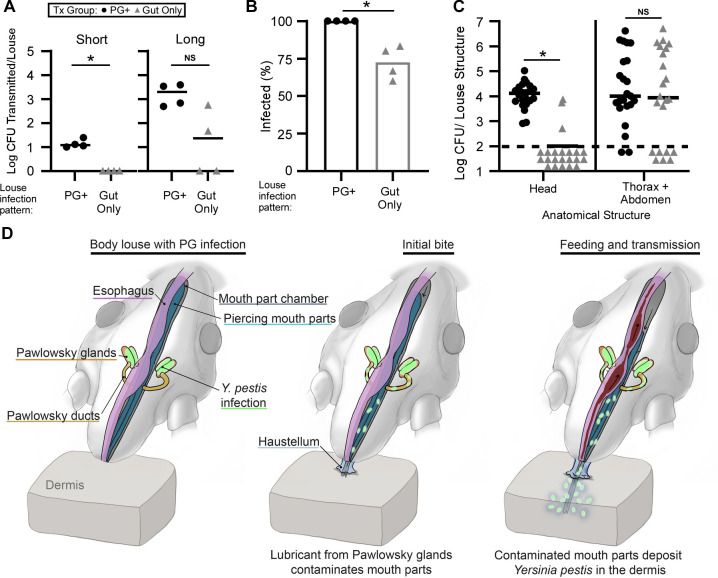
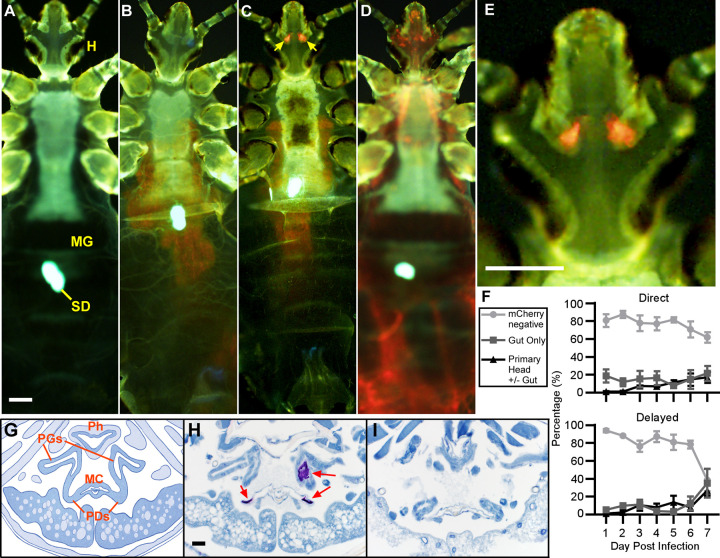
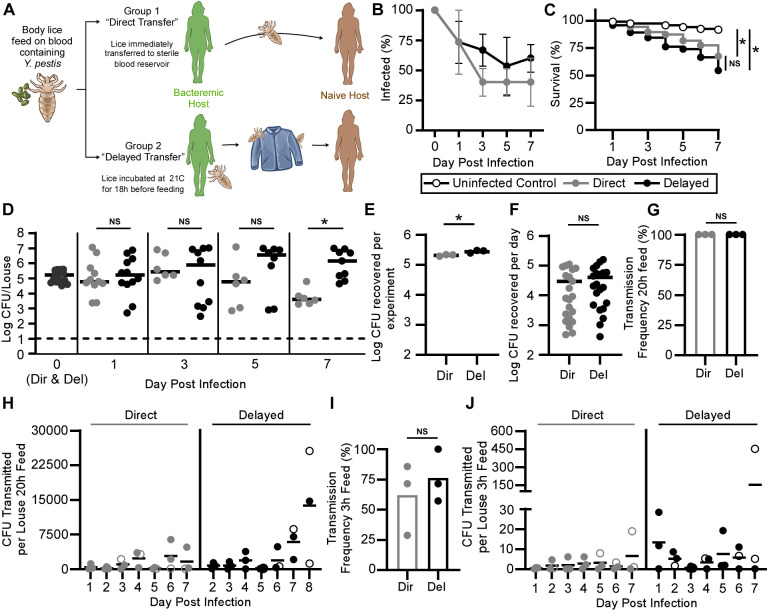
Yersinia pestis, the causative agent of plague, is a highly lethal vector-borne pathogen responsible for killing large portions of Europe's population during the Black Death of the Middle Ages. In the wild, Y. pestis cycles between fleas and rodents; occasionally spilling over into humans bitten by infectious fleas. For this reason, fleas and the rats harboring them have been considered the main epidemiological drivers of previous plague pandemics. Human ectoparasites, such as the body louse (Pediculus humanus humanus), have largely been discounted due to their reputation as inefficient vectors of plague bacilli. Using a membrane-feeder adapted strain of body lice, we show that the digestive tract of some body lice become chronically infected with Y. pestis at bacteremia as low as 1 × 10⁵ CFU/ml, and these lice routinely defecate Y. pestis. At higher bacteremia (≥1 × 10⁷ CFU/ml), a subset of the lice develop an infection within the Pawlowsky glands (PGs), a pair of putative accessory salivary glands in the louse head. Lice that developed PG infection transmitted Y. pestis more consistently than those with bacteria only in the digestive tract. These glands are thought to secrete lubricant onto the mouthparts, and we hypothesize that when infected, their secretions contaminate the mouthparts prior to feeding, resulting in bite-based transmission of Y. pestis. The body louse's high level of susceptibility to infection by gram-negative bacteria and their potential to transmit plague bacilli by multiple mechanisms supports the hypothesis that they may have played a role in previous human plague pandemics and local outbreaks.

摘要

鼠疫耶尔森菌是鼠疫的病原体,是一种高度致命的媒介传播病原体,在中世纪的黑死病期间导致欧洲大量人口死亡。在自然界中,鼠疫耶尔森菌在跳蚤和啮齿动物之间循环;偶尔会溢出到被感染跳蚤叮咬的人类身上。因此,跳蚤和携带它们的老鼠被认为是以前鼠疫大流行的主要流行病学驱动因素。人体寄生虫,如体虱(Pediculus humanus humanus),由于其作为鼠疫杆菌低效传播媒介的声誉而在很大程度上被忽视。使用适应膜饲养的体虱株,我们表明,在菌血症低至 1×10⁵ CFU/ml 时,一些体虱的消化道会慢性感染鼠疫耶尔森菌,并且这些虱子经常排出鼠疫耶尔森菌。在更高的菌血症(≥1×10⁷ CFU/ml)下,一部分虱子会在 Pawlowsky 腺(PGs)中感染,PGs 是虱子头部的一对假定的辅助唾液腺。与仅在消化道中感染细菌的虱子相比,感染 PG 的虱子更一致地传播鼠疫耶尔森菌。这些腺体被认为会分泌润滑剂到口器上,我们假设当它们受到感染时,它们的分泌物在叮咬前污染口器,导致基于叮咬的鼠疫耶尔森菌传播。体虱对革兰氏阴性菌的高度易感性及其通过多种机制传播鼠疫杆菌的潜力支持了这样一种假设,即它们可能在以前的人类鼠疫大流行和局部暴发中发挥了作用。
https://cdn.ncbi.nlm.nih.gov/pmc/blobs/141e/11108126/0ca89f0efd31/pbio.3002625.g003.jpg
https://cdn.ncbi.nlm.nih.gov/pmc/blobs/141e/11108126/653bd31e3db7/pbio.3002625.g001.jpg
https://cdn.ncbi.nlm.nih.gov/pmc/blobs/141e/11108126/f66a10a9dcef/pbio.3002625.g002.jpg
https://cdn.ncbi.nlm.nih.gov/pmc/blobs/141e/11108126/0ca89f0efd31/pbio.3002625.g003.jpg
https://cdn.ncbi.nlm.nih.gov/pmc/blobs/141e/11108126/653bd31e3db7/pbio.3002625.g001.jpg
https://cdn.ncbi.nlm.nih.gov/pmc/blobs/141e/11108126/f66a10a9dcef/pbio.3002625.g002.jpg
https://cdn.ncbi.nlm.nih.gov/pmc/blobs/141e/11108126/0ca89f0efd31/pbio.3002625.g003.jpg

相似文献

1
Yersinia pestis can infect the Pawlowsky glands of human body lice and be transmitted by louse bite.鼠疫耶尔森菌可感染人体虱的Pawlowsky 腺,并可通过虱叮咬传播。
PLoS Biol. 2024 May 21;22(5):e3002625. doi: 10.1371/journal.pbio.3002625. eCollection 2024 May.
2
Experimental model to evaluate the human body louse as a vector of plague.评估人体虱子作为鼠疫传播媒介的实验模型。
J Infect Dis. 2006 Dec 1;194(11):1589-96. doi: 10.1086/508995. Epub 2006 Oct 18.
3
Transmission efficiency of the plague pathogen (Y. pestis) by the flea, Xenopsylla skrjabini, to mice and great gerbils.方形黄鼠蚤对鼠疫病原体(鼠疫耶尔森菌)向小鼠和大沙鼠的传播效率。
Parasit Vectors. 2015 May 1;8:256. doi: 10.1186/s13071-015-0852-z.
4
Effects of low-temperature flea maintenance on the transmission of Yersinia pestis by Oropsylla montana.低温保存跳蚤对蒙塔山蚤传播鼠疫耶尔森菌的影响。
Vector Borne Zoonotic Dis. 2013 Jul;13(7):468-78. doi: 10.1089/vbz.2012.1017. Epub 2013 Apr 16.
5
Body lice, Yersinia pestis Orientalis, and Black Death.体虱、东方型鼠疫耶尔森菌与黑死病
Emerg Infect Dis. 2010 Oct;16(10):1649-51. doi: 10.3201/eid1610.100683.
6
Body lice, yersinia pestis orientalis, and black death.体虱、东方型鼠疫杆菌与黑死病
Emerg Infect Dis. 2010 May;16(5):892-3. doi: 10.3201/eid1605.091280.
7
Transovarial transmission of Yersinia pestis in its flea vector Xenopsylla cheopis.蚤传播鼠疫耶尔森菌的经卵传递。
Nat Commun. 2024 Aug 23;15(1):7266. doi: 10.1038/s41467-024-51668-0.
8
Poor vector competence of the human flea, Pulex irritans, to transmit Yersinia pestis.人体蚤(Pulex irritans)对鼠疫耶尔森菌的传播能力较差。
Parasit Vectors. 2021 Jun 10;14(1):317. doi: 10.1186/s13071-021-04805-3.
9
Biovar-related differences apparent in the flea foregut colonization phenotype of distinct Yersinia pestis strains do not impact transmission efficiency.在不同的鼠疫耶尔森菌菌株的蚤前肠定植表型中,生物变异相关的差异并不影响传播效率。
Parasit Vectors. 2020 Jul 1;13(1):335. doi: 10.1186/s13071-020-04207-x.
10
Evaluation of the murine immune response to Xenopsylla cheopis flea saliva and its effect on transmission of Yersinia pestis.对小鼠针对印鼠客蚤唾液的免疫反应及其对鼠疫耶尔森菌传播影响的评估。
PLoS Negl Trop Dis. 2014 Sep 25;8(9):e3196. doi: 10.1371/journal.pntd.0003196. eCollection 2014 Sep.

引用本文的文献

1
The spatiotemporal distribution of human pathogens in ancient Eurasia.古代欧亚大陆人类病原体的时空分布。
Nature. 2025 Jul;643(8073):1011-1019. doi: 10.1038/s41586-025-09192-8. Epub 2025 Jul 9.
2
An insight into the salivary gland content of the human body louse, Pediculus humanus.对人体虱子(人头虱)唾液腺成分的深入研究。
Sci Rep. 2025 May 26;15(1):18322. doi: 10.1038/s41598-025-01412-5.
3
Evolution of the Mitogenome: Insights Into the Mitogenomic Evolution of the Orders Siphonaptera and the Phthiraptera.线粒体基因组的进化:对蚤目和虱目的线粒体基因组进化的见解

本文引用的文献

1
Acquisition of yersinia murine toxin enabled Yersinia pestis to expand the range of mammalian hosts that sustain flea-borne plague.鼠疫耶尔森氏菌获得鼠类耶尔森氏菌毒素,使其能够扩大维持跳蚤传播鼠疫的哺乳动物宿主范围。
PLoS Pathog. 2021 Oct 14;17(10):e1009995. doi: 10.1371/journal.ppat.1009995. eCollection 2021 Oct.
2
Poor vector competence of the human flea, Pulex irritans, to transmit Yersinia pestis.人体蚤(Pulex irritans)对鼠疫耶尔森菌的传播能力较差。
Parasit Vectors. 2021 Jun 10;14(1):317. doi: 10.1186/s13071-021-04805-3.
3
Mouthpart sensory structures of the human head louse Pediculus humanus capitis.
Ecol Evol. 2025 Mar 11;15(3):e71108. doi: 10.1002/ece3.71108. eCollection 2025 Mar.
4
Plague history, Mongol history, and the processes of focalisation leading up to the Black Death: a response to Brack .鼠疫史、蒙古史以及导致黑死病的聚焦过程:对布拉克的回应
Med Hist. 2025 Feb 17;68(4):1-25. doi: 10.1017/mdh.2024.29.
5
Differential pathogenicity and lethality of bubonic plague (1720-1945) by sex, age and place.1720年至1945年间,腺鼠疫按性别、年龄和地点划分的致病性和致死率差异
Proc Biol Sci. 2024 Aug;291(2027):20240724. doi: 10.1098/rspb.2024.0724. Epub 2024 Jul 24.
人体头虱 Pediculus humanus capitis 的头部口器感觉结构。
Arthropod Struct Dev. 2020 Nov;59:100996. doi: 10.1016/j.asd.2020.100996. Epub 2020 Oct 16.
4
The role of louse-transmitted diseases in historical plague pandemics.虱子传播疾病在历史瘟疫大流行中的作用。
Lancet Infect Dis. 2021 Feb;21(2):e17-e25. doi: 10.1016/S1473-3099(20)30487-4. Epub 2020 Oct 6.
5
Where Are We With Human Lice? A Review of the Current State of Knowledge.人类虱子的现状如何?对现有知识的综述。
Front Cell Infect Microbiol. 2020 Jan 21;9:474. doi: 10.3389/fcimb.2019.00474. eCollection 2019.
6
Complexin in ivermectin resistance in body lice.体虱对伊维菌素耐药性中的复合蛋白。
PLoS Genet. 2018 Aug 6;14(8):e1007569. doi: 10.1371/journal.pgen.1007569. eCollection 2018 Aug.
7
Human ectoparasites and the spread of plague in Europe during the Second Pandemic.人类体外寄生虫与第二次大流行期间欧洲鼠疫的传播。
Proc Natl Acad Sci U S A. 2018 Feb 6;115(6):1304-1309. doi: 10.1073/pnas.1715640115. Epub 2018 Jan 16.
8
"Fleaing" the Plague: Adaptations of Yersinia pestis to Its Insect Vector That Lead to Transmission.“逃离”瘟疫:鼠疫耶尔森菌适应其昆虫媒介从而导致传播的机制。
Annu Rev Microbiol. 2017 Sep 8;71:215-232. doi: 10.1146/annurev-micro-090816-093521.
9
The Role of Early-Phase Transmission in the Spread of Yersinia pestis.早期传播在鼠疫耶尔森菌传播中的作用
J Med Entomol. 2015 Nov;52(6):1183-92. doi: 10.1093/jme/tjv128. Epub 2015 Aug 19.
10
Retracing the evolutionary path that led to flea-borne transmission of Yersinia pestis.追溯导致鼠疫耶尔森菌通过跳蚤传播的进化路径。
Cell Host Microbe. 2014 May 14;15(5):578-86. doi: 10.1016/j.chom.2014.04.003.