Zhang Yujiang, Dai Xiang, Wang Qiguo, Chen Hongjian, Meng Weiwei, Wu Kemei, Luo Tao, Wang Xinhui, Rehemu Azhati, Guo Rong, Yu Xiaotao, Yang Ruifu, Cao Hanli, Song Yajun
The Center for Disease Control and Prevention of the Xinjiang Uygur Autonomous Region, Urumqi, 830002, China.
Qinghai Institute for Endemic Diseases Prevention and Control, Xining, 811602, China.
Parasit Vectors. 2015 May 1;8:256. doi: 10.1186/s13071-015-0852-z.
Plague, a zoonotic disease caused by Yersinia pestis, is characterized by its ability to persist in the plague natural foci. Junggar Basin plague focus was recently identified in China, with Rhombomys opimus (great gerbils) and Xenopsylla skrjabini as the main reservoir and vector for plague. No transmission efficiency data of X. skrjabini for Y. pestis is available till now.
In this study, we estimated the median infectious dose (ID50) and the blockage rates of X. skrjabini with Y. pestis, by using artificial feeders. We then evaluated the flea transmission ability of Y. pestis to the mice and great gerbils via artificial bloodmeal feeding. Finally, we investigated the transmission of Y. pestis to mice with fleas fed by infected great gerbils.
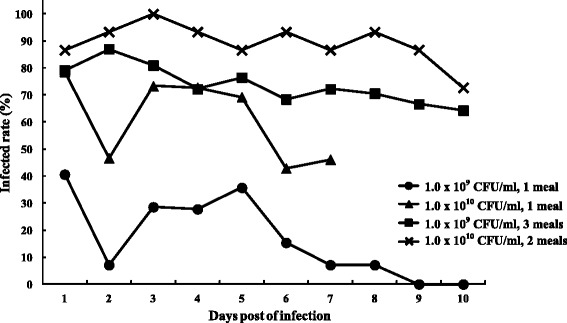
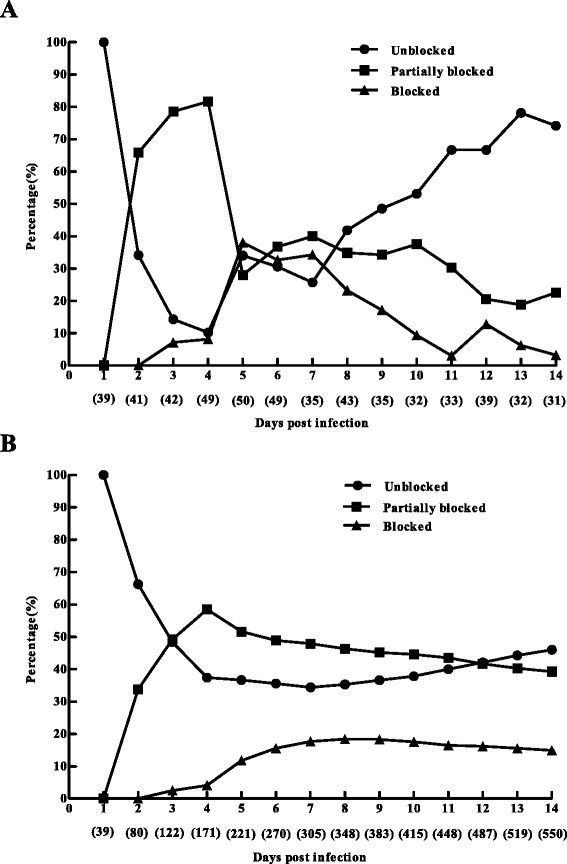
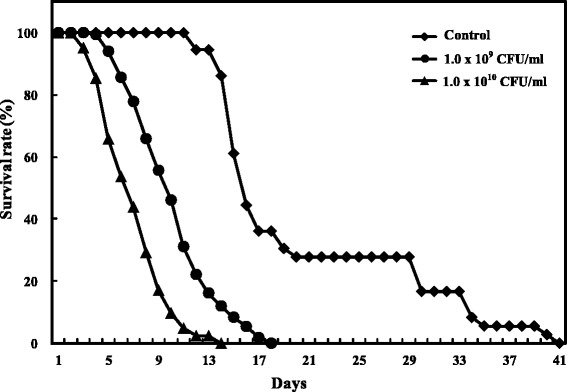
ID50 of Y. pestis to X. skrjabini was estimated as 2.04 × 10(5) CFU (95% CI, 1.45 × 10(5) - 3.18 × 10(5) CFU), around 40 times higher than that of X. cheopis. Although fleas fed by higher bacteremia bloodmeal had higher infection rates for Y. pestis, they lived significantly shorter than their counterparts. X. skrjabini could get fully blocked as early as day 3 post of infection (7.1%, 3/42 fleas), and the overall blockage rate of X. cheopis was estimated as 14.9% (82/550 fleas) during the 14 days of investigation. For the fleas infected by artificial feeders, they seemed to transmit plague more efficiently to great gerbils than mice. Our single flea transmission experiments also revealed that, the transmission capacity of naturally infected fleas (fed by infected great gerbils) was significantly higher than that of artificially infected ones (fed by artificial feeders).
Our results indicated that ID50 of Y. pestis to X. skrjabini was higher than other fleas like X. cheopis, and its transmission efficiency to mice might be lower than other flea vectors in the artificial feeding modes. We also found different transmission potentials in the artificially infected fleas and the naturally infected ones. Further studies are needed to figure out the role of X. skrjabini in the plague epidemiological cycles in Junggar Basin plague focus.
鼠疫是由鼠疫耶尔森菌引起的一种人畜共患病,其特点是能够在鼠疫自然疫源地持续存在。中国最近确定了准噶尔盆地鼠疫疫源地,以大沙鼠和谢氏山蚤作为鼠疫的主要宿主和传播媒介。目前尚无谢氏山蚤对鼠疫耶尔森菌传播效率的数据。
在本研究中,我们使用人工饲养器估算了谢氏山蚤对鼠疫耶尔森菌的半数感染剂量(ID50)和堵塞率。然后,我们通过人工血餐喂养评估了鼠疫耶尔森菌对小鼠和大沙鼠的蚤传播能力。最后,我们研究了用感染大沙鼠喂养的蚤将鼠疫耶尔森菌传播给小鼠的情况。
鼠疫耶尔森菌对谢氏山蚤的ID50估计为2.04×10⁵CFU(95%可信区间,1.45×10⁵ - 3.18×10⁵CFU),约为印鼠客蚤的40倍。尽管用高菌血症血餐喂养的蚤对鼠疫耶尔森菌的感染率更高,但它们的存活时间明显短于对照组。谢氏山蚤最早在感染后第3天就可能完全堵塞(7.1%,3/42只蚤),在14天的调查期间,印鼠客蚤的总体堵塞率估计为14.9%(82/550只蚤)。对于通过人工饲养器感染的蚤,它们似乎对大沙鼠传播鼠疫的效率高于对小鼠。我们的单蚤传播实验还表明,自然感染的蚤(由感染大沙鼠喂养)的传播能力明显高于人工感染的蚤(由人工饲养器喂养)。
我们的结果表明,鼠疫耶尔森菌对谢氏山蚤的ID50高于印鼠客蚤等其他蚤类,在人工喂养模式下,其对小鼠的传播效率可能低于其他蚤类传播媒介。我们还发现人工感染的蚤和自然感染的蚤具有不同的传播潜力。需要进一步研究以明确谢氏山蚤在准噶尔盆地鼠疫疫源地鼠疫流行周期中的作用。