Shen Kaiping, He Yuejun, Xia Tingting, Guo Yun, Wu Bangli, Han Xu, Chen Hongchun, Zhao Yan, Wu Pan, Liu Yuan
Forestry College, Research Center of Forest Ecology Guizhou University Guiyang China.
College of Eco-Environmental Engineering Guizhou Minzu University Guiyang China.
Ecol Evol. 2024 May 21;14(5):e11459. doi: 10.1002/ece3.11459. eCollection 2024 May.
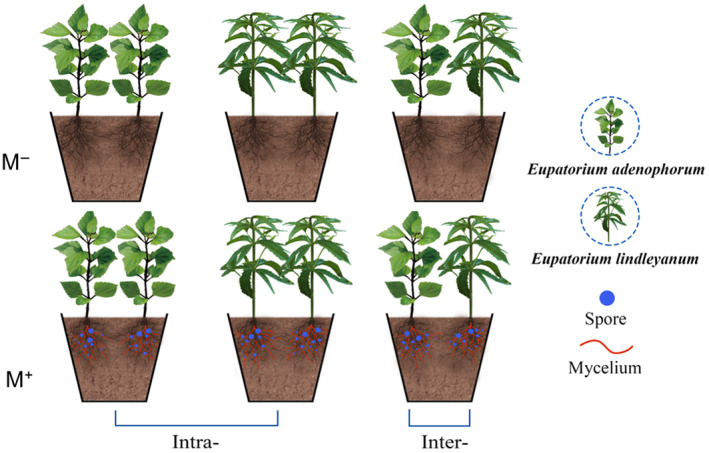
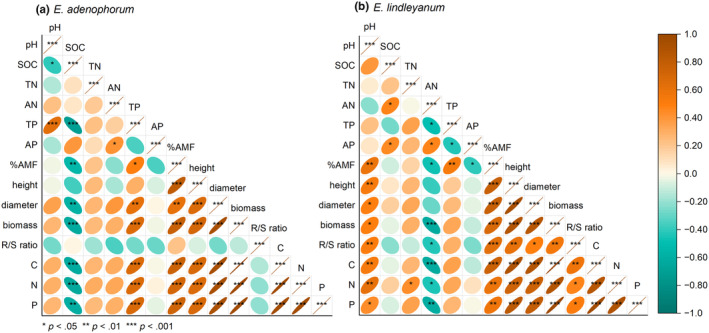
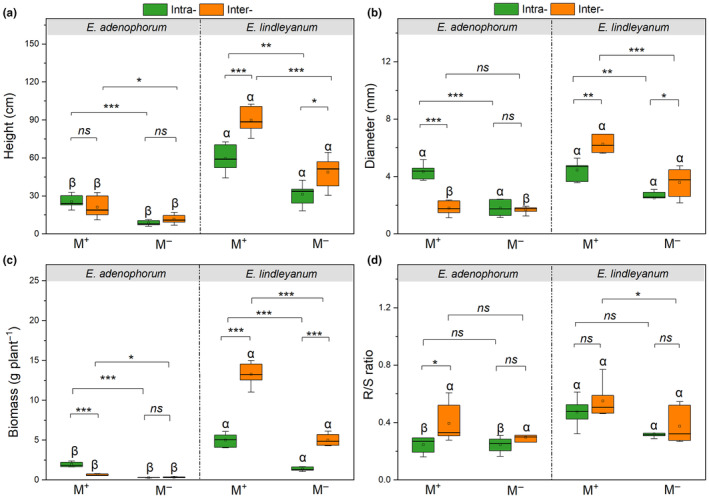
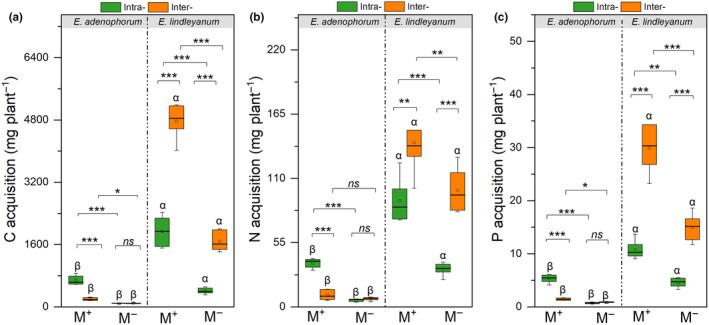
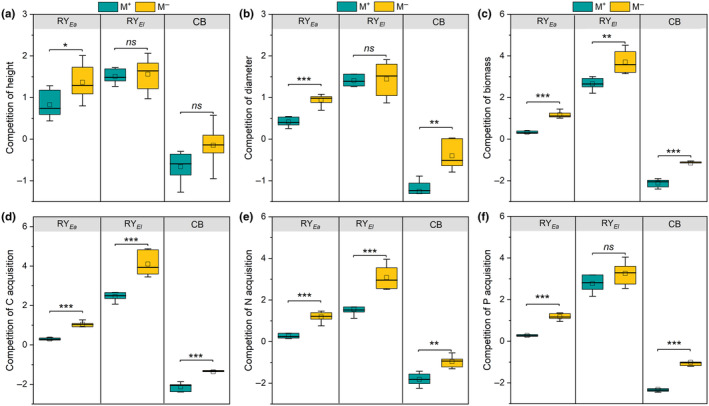
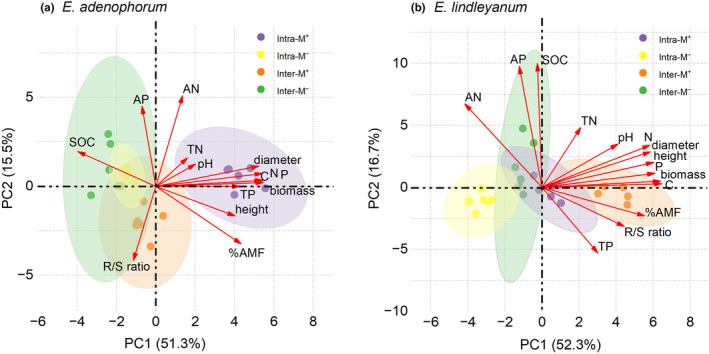
Plant invasions severely threaten natural ecosystems, and invasive plants often outcompete native plants across various ecosystems. Arbuscular mycorrhizal (AM) fungi, serving as beneficial microorganisms for host plants, can greatly influence the competitive outcomes of invasive plants against native plants. However, it remains unclear how AM fungi alter the competitive balance between native and invasive species. A competitive experiment was conducted using an invasive paired with a native congener . Specifically, both species were inoculated with (M) or without (M) the fungus under intraspecific (Intra-) and interspecific (Inter-) competition. Plant traits were measured and analyzed regarding the growth and nutrition of both species. The results exhibited that the AM fungus significantly increased the height, diameter, biomass, C, N, and P acquisition of both the invasive and the native . The root mycorrhizal colonization and the mycorrhizal dependency of native were greater than those of invasive . Under M, the Inter-competition inhibited the growth and nutrition of invasive compared to the Intra- competition. Further, native exhibited higher competitiveness than invasive in growth and nutrition. Meanwhile, the AM fungus significantly improved the competitiveness of native over invasive . In conclusion, AM fungus improved the competitive advantage of native over invasive in growth and nutrition, potentially contributing to native species competitively resisting the invasion of exotic species. These findings emphasize the importance of AM fungi in helping native plants resist the invasion of exotic plants and further contribute to understanding plant invasion prevention mechanisms.
植物入侵严重威胁自然生态系统,入侵植物在各种生态系统中往往比本地植物更具竞争力。丛枝菌根(AM)真菌作为宿主植物的有益微生物,能极大地影响入侵植物与本地植物的竞争结果。然而,尚不清楚AM真菌如何改变本地物种与入侵物种之间的竞争平衡。使用一种入侵植物与其本地同属植物进行了一项竞争实验。具体而言,在种内(Intra-)和种间(Inter-)竞争条件下,两种植物均接种(M)或不接种(M)该真菌。对两种植物的生长和营养方面的植物性状进行了测量和分析。结果表明,AM真菌显著增加了入侵植物和本地植物的高度、直径、生物量、碳、氮和磷的获取量。本地植物的根菌根定殖和菌根依赖性大于入侵植物。在接种真菌(M)的情况下,与种内竞争相比,种间竞争抑制了入侵植物的生长和营养。此外,在生长和营养方面,本地植物表现出比入侵植物更高的竞争力。同时,AM真菌显著提高了本地植物相对于入侵植物的竞争力。总之,AM真菌在生长和营养方面提高了本地植物相对于入侵植物的竞争优势,可能有助于本地物种在竞争中抵御外来物种的入侵。这些发现强调了AM真菌在帮助本地植物抵御外来植物入侵方面的重要性,并进一步有助于理解植物入侵预防机制。