Rodrigues Aguiar Maria de Fatima, Guterres Meiriane Mendes, Benarrosh Eduarda Magalhães, Verri Waldiceu Aparecido, Calixto-Campos Cássia, Dias Quintino Moura
Laboratory of Neuro and Immunopharmacology (NIMFAR)-Oswaldo Cruz Foundation, Fiocruz Rondônia, Rua da Beira, 7671, BR 364, Km 3.5, Bairro Lagoa, Porto Velho, Rondônia, Brazil.
Postgraduate Program in Experimental Biology (PGBIOEXP), Federal University of Rondônia, Campus-BR 364, Km 9.5, Porto Velho, Rondônia, Brazil.
J Parasitol Res. 2024 May 14;2024:3771926. doi: 10.1155/2024/3771926. eCollection 2024.
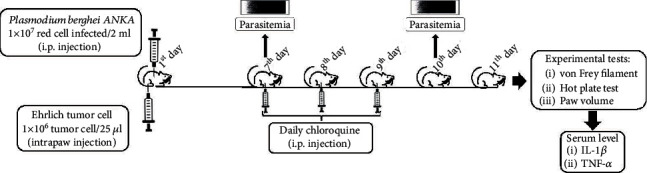
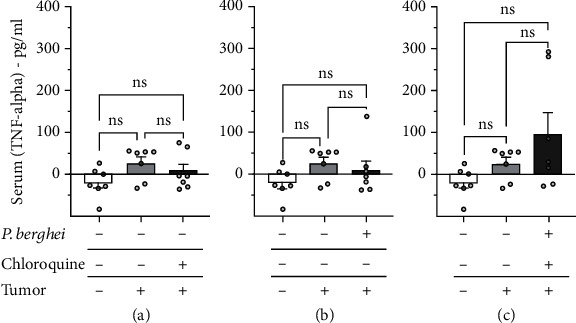
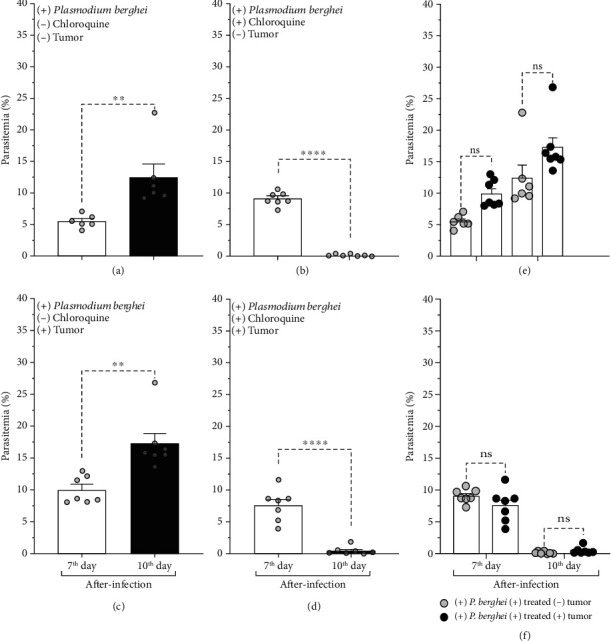
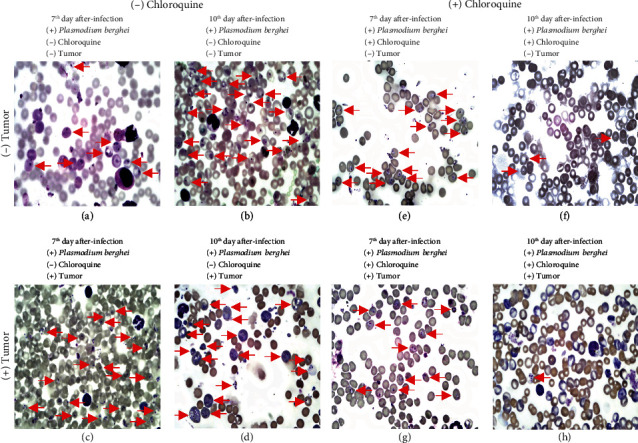
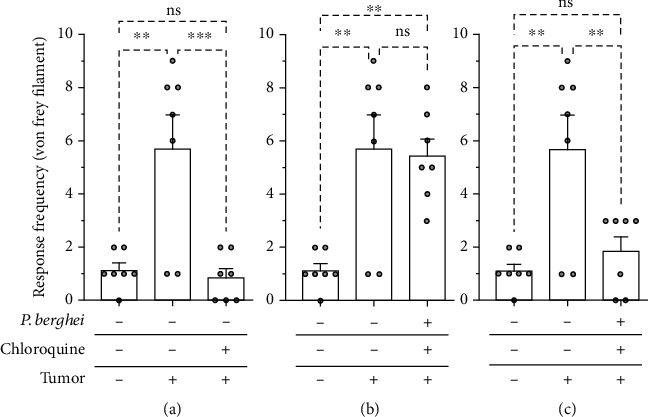
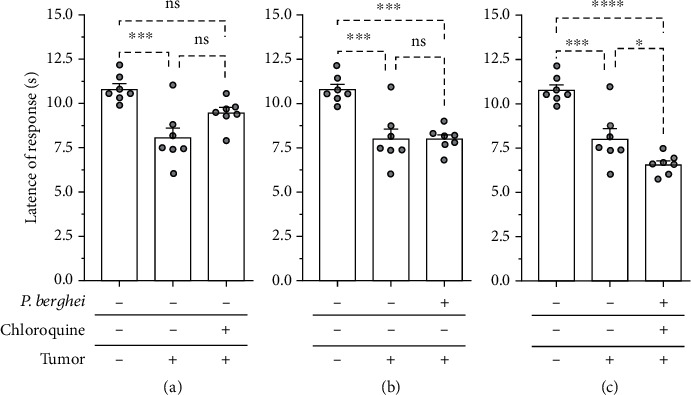
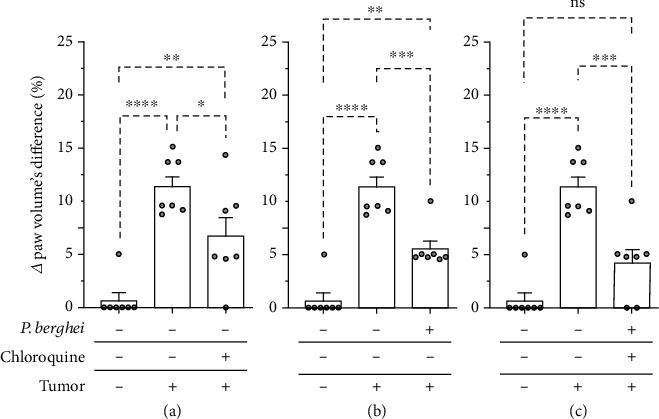
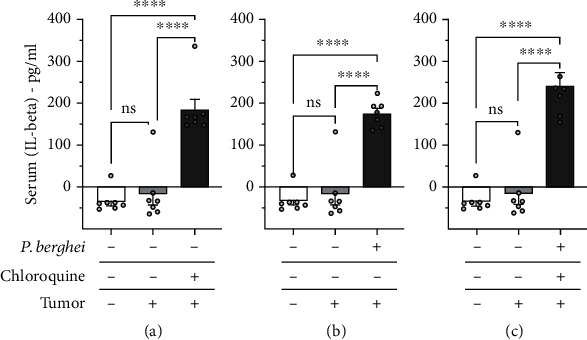
Comorbidities that involve infectious and noninfectious diseases, such as malaria and cancer, have been described. Cancer and malaria induce changes in the nociceptive and inflammatory responses through similar pathophysiological mechanisms. However, it is unclear whether malaria and antimalarial treatment can change the inflammatory and nociceptive responses induced by solid cancer. Therefore, the present study experimentally evaluated the effect of infection by strain ANKA and chloroquine treatment on the nociceptive and inflammatory responses induced by the solid Ehrlich tumor in male BALB/c mice. On the 1 experimental day, mice were infected with and injected with tumor cells in the left hind paw. From the 7 to the 9 experimental day, mice were treated daily with chloroquine. The parasitemia was evaluated on the 7 and 10 days after infection. On the 11 experimental day, mice were evaluated on the von Frey filament test, the hot plate test, and the paw volume test. At the end of the experimental tests on the 11th day, the peripheral blood of all mice was collected for dosing of IL-1 and TNF-. The blood parasitemia significantly increased from the 7 to the 10 day. The chloroquine treatment significantly decreased the parasitemia on the 10 day. The presence of the tumor did not significantly change the parasitemia on the 7 and 10 days in mice treated and nontreated with chloroquine. On the 11 day, the mechanical and thermal nociceptive responses significantly increased in mice with tumors. The treatment with antimalarial significantly reduced the mechanical nociceptive response induced by tumors. The hyperalgesia induced by tumors did not change with malaria. The mechanical and thermal hyperalgesia induced by the tumor was significantly reduced in mice treated and healed from malaria. On the 11 day, the volume of the paw injected by the tumor was significantly increased. The mice treated with chloroquine, infected with malaria, or healed of malaria showed reduced paw edema induced by the tumor. Mice with tumors did not show a change in IL- and TNF- serum levels. Mice with tumors showed a significant increase in serum levels of IL-1 but not TNF- when treated with chloroquine, infected with malaria, or healed of malaria. In conclusion, the results show that malaria infection and chloroquine treatment can influence, in synergic form, the nociceptive and inflammatory responses induced by the solid tumor. Moreover, the mechanical antinociception, the thermal hyperalgesia, and the antiedema effect observed in mice treated with chloroquine and healed from malaria can be related to the increase in the serum level of IL-1.
已描述了涉及感染性和非感染性疾病(如疟疾和癌症)的合并症。癌症和疟疾通过相似的病理生理机制诱导伤害性和炎症反应的变化。然而,尚不清楚疟疾和抗疟治疗是否会改变实体癌诱导的炎症和伤害性反应。因此,本研究通过实验评估了ANKA株感染和氯喹治疗对雄性BALB/c小鼠实体艾氏瘤诱导的伤害性和炎症反应的影响。在实验第1天,小鼠感染并在左后爪注射肿瘤细胞。从实验第7天至第9天,小鼠每天接受氯喹治疗。在感染后第7天和第10天评估疟原虫血症。在实验第11天,对小鼠进行von Frey细丝试验、热板试验和爪体积试验评估。在第11天实验测试结束时,采集所有小鼠的外周血用于检测白细胞介素-1(IL-1)和肿瘤坏死因子-α(TNF-α)。从第7天到第10天,血液疟原虫血症显著增加。氯喹治疗在第10天显著降低了疟原虫血症。在接受和未接受氯喹治疗的小鼠中,肿瘤的存在在第7天和第10天并未显著改变疟原虫血症。在第11天,有肿瘤的小鼠的机械性和热性伤害性反应显著增加。抗疟治疗显著降低了肿瘤诱导的机械性伤害性反应。肿瘤诱导的痛觉过敏并未因疟疾而改变。在接受治疗且疟疾已治愈的小鼠中,肿瘤诱导的机械性和热性痛觉过敏显著降低。在第11天,肿瘤注射爪的体积显著增加。接受氯喹治疗、感染疟疾或疟疾已治愈的小鼠,其肿瘤诱导的爪水肿减轻。有肿瘤的小鼠的白细胞介素和肿瘤坏死因子血清水平未显示变化。当接受氯喹治疗、感染疟疾或疟疾已治愈时,有肿瘤的小鼠的白细胞介素-1血清水平显著升高,但肿瘤坏死因子血清水平未升高。总之,结果表明,疟疾感染和氯喹治疗可以协同影响实体瘤诱导的伤害性和炎症反应。此外,在接受氯喹治疗且疟疾已治愈的小鼠中观察到的机械性抗伤害感受、热性痛觉过敏和抗水肿作用可能与白细胞介素-1血清水平的升高有关。