Department of Oncology, Jiangxi Provincial People's Hospital, The First Affiliated Hospital of Nanchang Medical College, Nanchang, China.
Jiangxi Medical College, Nanchang University, Nanchang, China.
Front Immunol. 2024 May 7;15:1399975. doi: 10.3389/fimmu.2024.1399975. eCollection 2024.
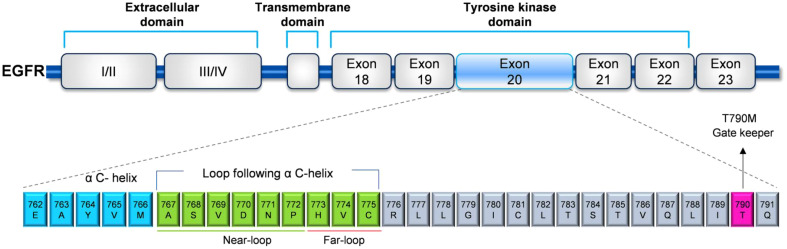
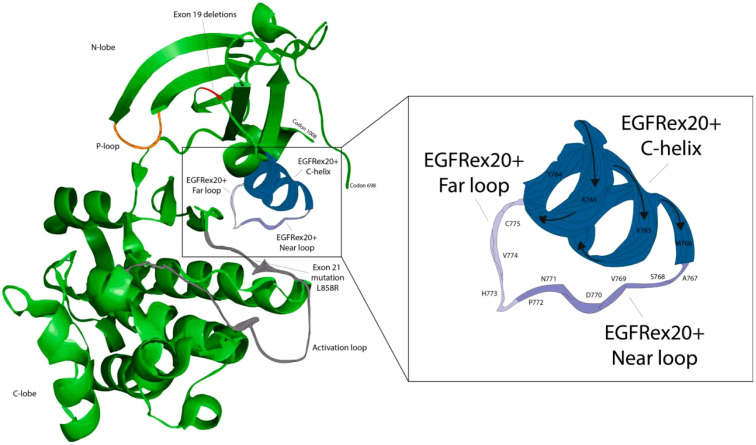
Recently, targeted therapy and immunotherapy have emerged as effective treatment options for non-small cell lung cancer (NSCLC). This progress has been facilitated by the rapid development of diagnostic and therapeutic technologies and the continuous research and development of new drugs, leading to a new era in precision medicine for NSCLC. This is a breakthrough for patients with common mutations in the human epidermal growth factor receptor (EGFR) gene in NSCLC. Consequently, the use of targeted drugs has significantly improved survival. Nevertheless, certain rare genetic mutations are referred to as EGFR exon 20 insertion (ex20ins) mutations, which differ in structure from conventional EGFR gene mutations, namely, exon 19 deletion mutations (19-Del) and exon 21 point mutations. Owing to their distinct structural characteristics, patients harboring these EGFR ex20ins mutations are unresponsive to traditional tyrosine kinase inhibitor (TKI) therapy. This particular group of patients did not fall within the scope of their applicability. However, the activating A763_Y764insFQEA mutation elicits a more pronounced response than mutations in the near and far regions of the C-helix immediately following it and should, therefore, be treated differently. Currently, there is a lack of effective treatments for EGFR ex20ins mutations NSCLC. The efficacy of chemotherapy has been relatively favorable, whereas the effectiveness of immunotherapy remains ambiguous owing to inadequate clinical data. In addition, the efficacy of the first- and second-generation targeted drugs remains limited. However, third-generation and novel targeted drugs have proven to be effective. Although novel EGFR-TKIs are expected to treat EGFR ex20ins mutations in patients with NSCLC, they face many challenges. The main focus of this review is on emerging therapies that target NSCLC with EGFR ex20ins and highlight major ongoing clinical trials while also providing an overview of the associated challenges and research advancements in this area.
近年来,针对治疗非小细胞肺癌(NSCLC)的靶向治疗和免疫治疗已成为有效的治疗选择。这一进展得益于诊断和治疗技术的快速发展,以及新药的不断研究和开发,为 NSCLC 的精准医学带来了一个新时代。这对于 NSCLC 中人类表皮生长因子受体(EGFR)基因常见突变的患者来说是一个突破。因此,靶向药物的使用显著提高了生存率。然而,某些罕见的基因突变为 EGFR 外显子 20 插入(ex20ins)突变,其结构与传统的 EGFR 基因突变(即外显子 19 缺失突变(19-Del)和外显子 21 点突变)不同。由于其独特的结构特征,携带这些 EGFR ex20ins 突变的患者对传统的酪氨酸激酶抑制剂(TKI)治疗无反应。这组特定的患者不在其适用范围内。然而,激活的 A763_Y764insFQEA 突变比其后面 C 螺旋附近和远处的突变产生更明显的反应,因此应区别对待。目前,针对 EGFR ex20ins 突变的 NSCLC 缺乏有效的治疗方法。化疗的疗效相对较好,而免疫治疗的疗效由于临床数据不足而不明确。此外,第一代和第二代靶向药物的疗效仍然有限。然而,第三代和新型靶向药物已被证明是有效的。虽然新型 EGFR-TKIs 有望治疗 NSCLC 患者的 EGFR ex20ins 突变,但它们面临许多挑战。本文的主要重点是针对 EGFR ex20ins 的 NSCLC 新兴疗法,突出主要的正在进行的临床试验,同时概述该领域的相关挑战和研究进展。