Department of Medicine and Surgery, University of Insubria, Varese, Italy; National Hemophilia Center and Institute of Thrombosis and Hemostasis, Sheba Medical Center, Tel-Hashomer, Israel; The Amalia Biron Institute of thrombosis research, Aviv University.
Department of Medicine and Surgery, University of Insubria, Varese.
Haematologica. 2024 Oct 1;109(10):3110-3124. doi: 10.3324/haematol.2023.283682.
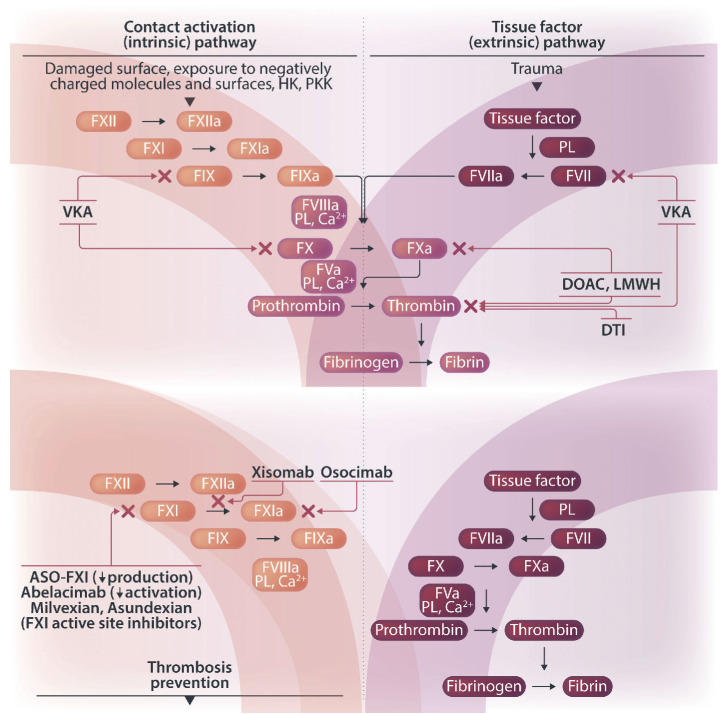
Anticoagulants have long been fundamental in preventing and treating thromboembolic disorders, with a recent shift of focus towards direct oral anticoagulants, thanks to their ease of use, efficacy, and safety. Despite these advancements, bleeding complications remain a major concern with any anticoagulant, highlighting the need for safer drugs. Factor XI (FXI) inhibitors have emerged as promising agents in this regard, offering a novel approach by targeting upstream factors in the coagulation system. Phase II trials have shown encouraging outcomes, indicating a reduced bleeding risk compared to that associated with traditional anticoagulants, particularly in the context of cardiovascular disease management when combined with antiplatelet therapy. However, the variability in findings and limited efficacy data call for a cautious interpretation pending insights from phase III trials. These trials are essential for validating the potential of FXI inhibitors to balance bleeding risk reduction and maintain anticoagulant efficacy. This review explores the pharmacology, potential indications, clinical data, and future directions of FXI inhibitors, providing a perspective on their evolving role in anticoagulant therapy. It also provides a detailed analysis of data from published clinical trials on FXI inhibitors in various indications. Preliminary data from ongoing trials are also outlined. As the field moves forward, a cautiously optimistic outlook can be expected, focusing on comprehensive data from phase III trials to define the role of FXI inhibitors in various clinical scenarios.
抗凝剂在预防和治疗血栓栓塞性疾病方面一直起着重要作用,由于其使用方便、疗效好、安全性高,最近的关注点转向了直接口服抗凝剂。尽管取得了这些进展,但任何抗凝剂都存在出血并发症这一主要问题,这突出表明需要更安全的药物。因子 XI(FXI)抑制剂在这方面已成为有前途的药物,通过针对凝血系统上游因素提供了一种新的方法。II 期临床试验结果令人鼓舞,表明与传统抗凝剂相比,出血风险降低,特别是在与抗血小板治疗联合用于心血管疾病管理时。然而,由于 III 期临床试验的结果尚未明确,因此需要谨慎解释研究结果的变异性和有限的疗效数据。这些试验对于验证 FXI 抑制剂降低出血风险和维持抗凝疗效的潜力至关重要。本综述探讨了 FXI 抑制剂的药理学、潜在适应证、临床数据和未来方向,提供了其在抗凝治疗中不断发展的作用的观点。它还对已发表的关于 FXI 抑制剂在各种适应证中的临床试验数据进行了详细分析,并概述了正在进行的试验的初步数据。随着该领域的发展,可以预期会采取谨慎乐观的态度,重点关注 III 期试验的全面数据,以确定 FXI 抑制剂在各种临床情况下的作用。