Clinical Department of Interventional Cardiology, John Paul II Hospital, Krakow, 31-202, Poland.
Department of Thromboembolic Disorders, Institute of Cardiology, Jagiellonian University Medical College, Krakow, 31-202, Poland.
Cardiovasc Diabetol. 2023 Jul 17;22(1):182. doi: 10.1186/s12933-023-01905-5.
Type 2 diabetes mellitus (T2DM) patients are at high risk of cardiovascular (CV) events. Factor XI (FXI) is associated with arterial thromboembolism, including myocardial infarction (MI), stroke, and CV mortality. The role of FXI in T2DM is unknown. We investigated whether plasma FXI is associated with CV events in T2DM patients in long-term observation.
In 133 T2DM patients (aged 66 ± 8 years, 40.6% women, median T2DM duration 5 [2-10] years) we assessed plasma FXI levels, along with fibrin clot properties, thrombin generation, and fibrinolysis proteins. A composite endpoint of MI, stroke, or CV death, as well as CV mortality alone were assessed during a median follow-up of 72 months.
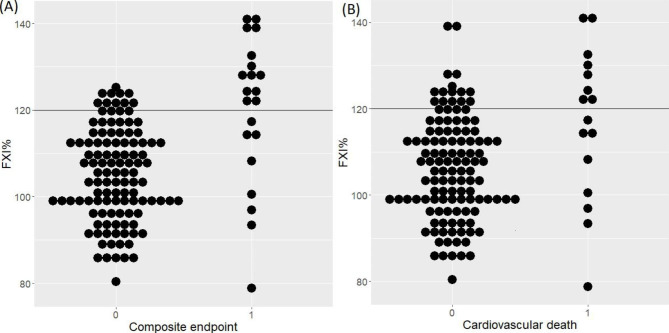
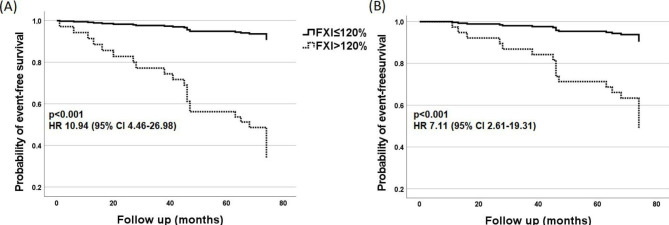
Plasma FXI above the 120% upper normal limit was detected in 25 (18.8%) patients and showed positive association with LDL cholesterol and thrombin activatable fibrinolysis inhibitor, but not glycated hemoglobin, inflammatory markers or thrombin generation. The composite endpoint (n = 21, 15.8%) and CV death alone (n = 16, 12%) were more common in patients with elevated FXI (hazard ratio [HR] 10.94, 95% confidence interval [CI] 4.46-26.87, p < 0.001 and HR 7.11, 95% CI 2.61-19.31, p < 0.001, respectively). On multivariable analysis, FXI remained an independent predictor of the composite endpoint and CV death, regardless of concomitant coronary artery disease.
To our knowledge, this study is the first to show that in T2DM patients, elevated FXI could predict major CV events, including mortality, which suggest that anti-FXI agents might be a potential novel antithrombotic option in this disease.
2 型糖尿病(T2DM)患者发生心血管(CV)事件的风险较高。因子 XI(FXI)与动脉血栓栓塞事件相关,包括心肌梗死(MI)、中风和 CV 死亡率。FXI 在 T2DM 中的作用尚不清楚。我们研究了在长期观察中,血浆 FXI 是否与 T2DM 患者的 CV 事件相关。
在 133 名 T2DM 患者(年龄 66±8 岁,40.6%为女性,T2DM 病程中位数为 5[2-10]年)中,我们评估了血浆 FXI 水平,以及纤维蛋白凝块特性、凝血酶生成和纤维蛋白溶解蛋白。在中位随访 72 个月期间,评估了 MI、中风或 CV 死亡的复合终点,以及单独的 CV 死亡率。
25 名(18.8%)患者的血浆 FXI 超过 120%的正常上限,且与 LDL 胆固醇和凝血酶激活的纤维蛋白溶解抑制剂呈正相关,而与糖化血红蛋白、炎症标志物或凝血酶生成无关。在 FXI 升高的患者中,复合终点(n=21,15.8%)和单独的 CV 死亡(n=16,12%)更为常见(风险比[HR]10.94,95%置信区间[CI]4.46-26.87,p<0.001 和 HR 7.11,95% CI 2.61-19.31,p<0.001)。多变量分析显示,无论是否合并冠状动脉疾病,FXI 仍然是复合终点和 CV 死亡的独立预测因子。
据我们所知,这项研究首次表明,在 T2DM 患者中,升高的 FXI 可预测主要 CV 事件,包括死亡率,这表明抗 FXI 药物可能是该疾病中一种潜在的新型抗血栓形成选择。