Division of Otorhinolaryngology Head and Neck Surgery, Geneva University Hospitals and University of Geneva, Geneva, Switzerland.
Kinesiology Laboratory, Geneva University Hospitals and University of Geneva, Geneva, Switzerland.
Sci Rep. 2024 May 23;14(1):11757. doi: 10.1038/s41598-024-62335-1.
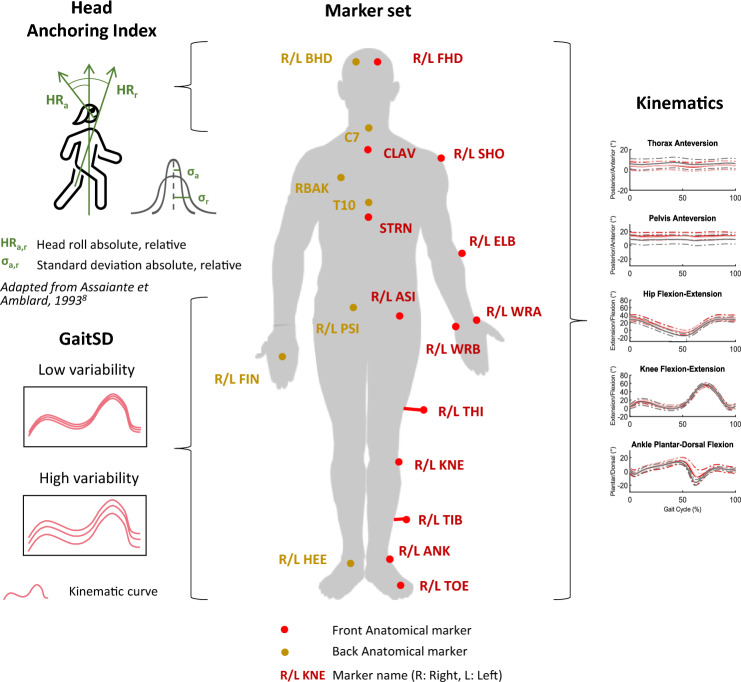
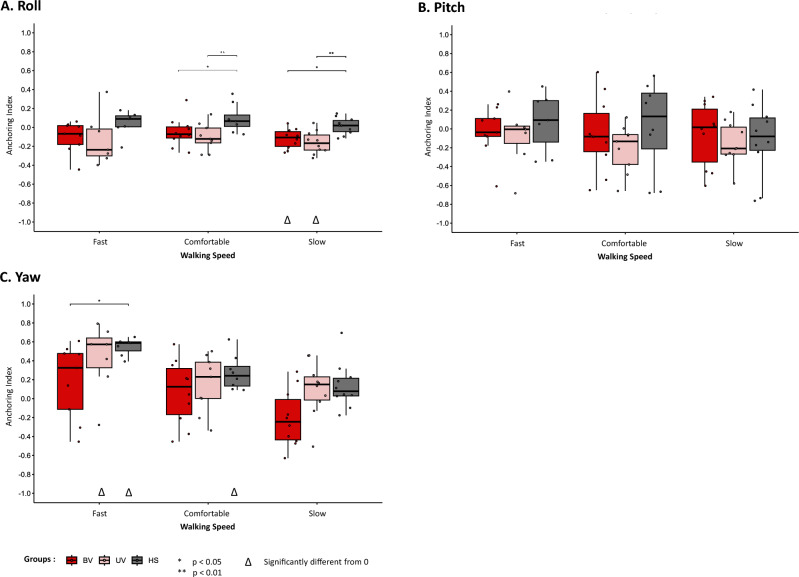
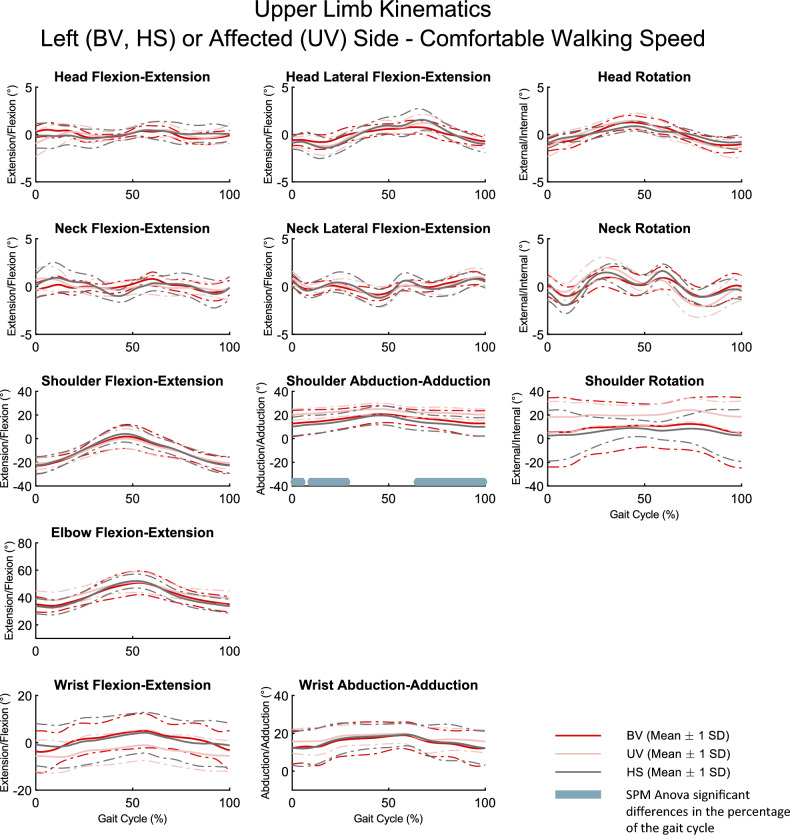
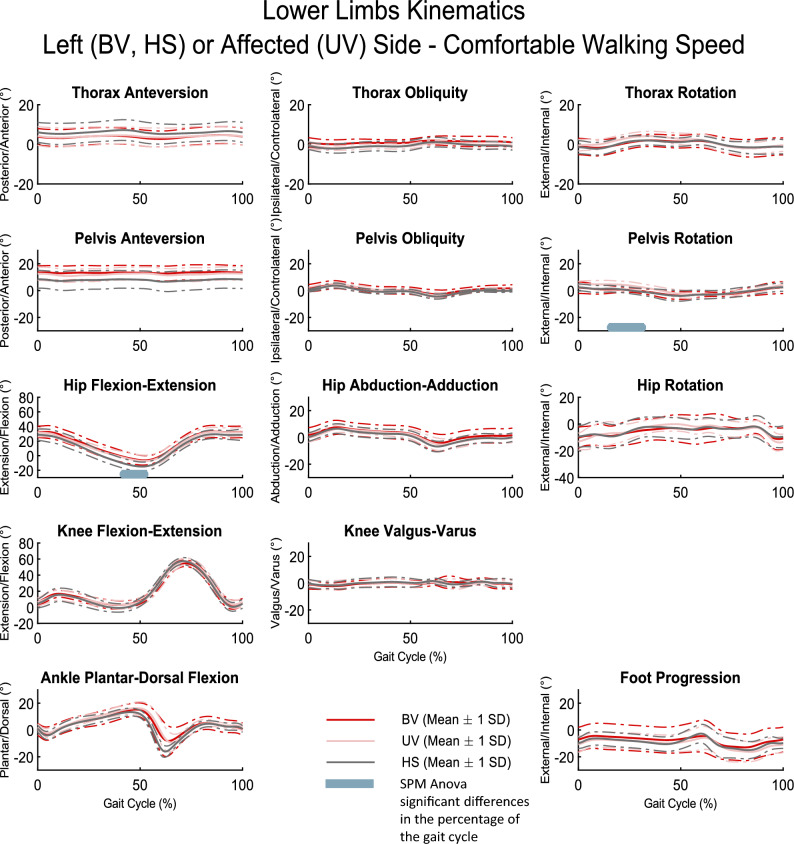
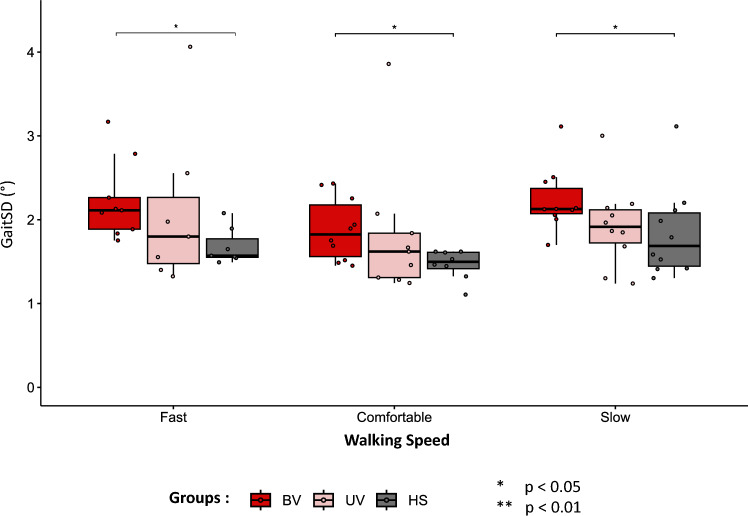
Chronic imbalance is a frequent and limiting symptom of patients with chronic unilateral and bilateral vestibulopathy. A full-body kinematic analysis of the movement of patients with vestibulopathy would provide a better understanding of the impact of the pathology on dynamic tasks such as walking. Therefore, this study aimed to investigate the global body movement during walking, its variability (assessed with the GaitSD), and the strategies to stabilise the head (assessed with the head Anchoring Index). The full-body motion capture data of 10 patients with bilateral vestibulopathy (BV), 10 patients with unilateral vestibulopathy (UV), and 10 healthy subjects (HS) walking at several speeds (slow, comfortable, and fast) were analysed in this prospective cohort study. We observed only a few significant differences between groups in parts of the gait cycle (shoulder abduction-adduction, pelvis rotation, and hip flexion-extension) during the analysis of kinematic curves. Only BV patients had significantly higher gait variability (GaitSD) for all three walking speeds. Head stabilisation strategies depended on the plan of motion and walking speed condition, but BV and UV patients tended to stabilise their head in relation to the trunk and HS tended to stabilise their head in space. These results suggest that GaitSD could be a relevant biomarker of chronic instability in BV and that the head Anchoring Index tends to confirm clinical observations of abnormal head-trunk dynamics in patients with vestibulopathy while walking.
慢性失衡是慢性单侧和双侧前庭病患者的常见且受限的症状。对前庭病患者的全身运动进行全面的运动分析,可以更好地了解病理对行走等动态任务的影响。因此,本研究旨在调查行走过程中的全身运动、其可变性(用步态标准差评估)以及稳定头部的策略(用头部固定指数评估)。本前瞻性队列研究分析了 10 例双侧前庭病(BV)患者、10 例单侧前庭病(UV)患者和 10 名健康受试者(HS)在不同速度(慢、舒适和快)下的全身运动捕捉数据。我们在对运动曲线进行分析时,仅观察到部分步态周期(肩部外展-内收、骨盆旋转和髋关节屈伸)中组间存在少数显著差异。只有 BV 患者在所有三种行走速度下的步态可变性(步态标准差)均显著较高。头部稳定策略取决于运动计划和行走速度条件,但 BV 和 UV 患者倾向于相对于躯干稳定头部,而 HS 则倾向于在空间中稳定头部。这些结果表明,步态标准差可能是 BV 慢性不稳定的一个相关生物标志物,而头部固定指数倾向于在行走时证实前庭病患者头部-躯干动力学异常的临床观察。