Uganda Medical Association (UMA), UMA-Acholi branch, Gulu City, Uganda.
Moroto Regional Referral Hospital, Moroto district, Mbale City, Uganda.
BMC Med Inform Decis Mak. 2024 May 23;24(1):132. doi: 10.1186/s12911-024-02536-w.
The COVID-19 pandemic has dramatically impacted communities worldwide, particularly in developing countries. To successfully control the pandemic, correct information and more than 80% vaccine coverage in a population were required. However, misinformation and disinformation could impact this, thus increasing COVID-19 vaccine hesitancy in communities. Several studies observed the effect of misinformation and disinformation on COVID-19 vaccine acceptance and other responses to the pandemic in the African continent. Thus, the most trusted sources of information on COVID-19 vaccines are critical for the successful management and control of the pandemic. This study aimed to assess the most trusted sources of information on COVID-19 vaccines during the pandemic in Uganda.
We conducted a cross-sectional study on 587 adult population members in northern Uganda. Single-stage stratified and systematic sampling methods were used to select participants from northern Uganda. An interviewer-administered questionnaire with an internal validity of Cronbach's α = 0.72 was used for data collection. An Institution Review Board (IRB) approved this study and Stata version 18 was used for data analysis. A Pearson Chi-square (χ2) analysis was conducted to assess associations between trusted sources of COVID-19 vaccine information and selected independent variables. Fisher's exact test considered associations when the cell value following cross-tabulation was < 5. A P-value < 0.05 was used as evidence for an association between trusted sources of information and independent variables. All results were presented as frequencies, proportions, Chi-square or Fisher's exact tests, and P-values at 95% Confidence Intervals (CI).
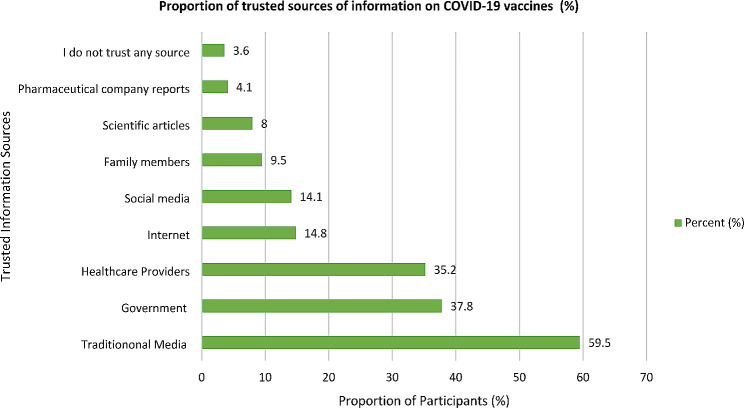
In a study of 587 participants, most were males, 335(57.1%), in the age group of 25-34 years, 180(31.4%), and the most trusted source of COVID-19 vaccine information were the traditional media sources for example, Televisions, Radios, and Newspapers, 349(33.6%). There was no significant association between sex and trusted sources of COVID-19 vaccine information. However, by age-group population, COVID-19 vaccine information was significantly associated with internet use (14.7% versus 85.3%; p = 0.02), information from family members (9.4% versus 90.6%; p < 0.01), and the Government/Ministry of Health (37.9% versus 62.1%; p < 0.01). Between healthcare workers and non-health workers, it was significantly associated with internet use (32.2% versus 67.8%; p = 0.03), healthcare providers (32.5% versus 67.5%; p < 0.018), the Government/Ministry of Health (31.1% versus 68.9%; p < 0.01), and scientific articles (44.7% versus 55.3%; p < 0.01).
The most trusted sources of COVID-19 vaccine information in northern Uganda were Televisions, Radios, and Newspapers. The trusted sources of COVID-19 vaccine information were not significantly different between males and females. However, there were significant differences among age groups and occupations of participants with younger age groups (≤ 44 years) and non-healthcare workers having more trust in Televisions, Radios, and Newspapers. Thus, for effective management of an epidemic, there is a need for accurate communication so that misinformation, disinformation, and malinformation in the era of "infodemic" do not disrupt the flow of correct information to communities.
COVID-19 大流行对全球社区产生了巨大影响,特别是在发展中国家。为了成功控制疫情,需要在人群中提供正确的信息和超过 80%的疫苗接种率。然而,错误信息和虚假信息可能会对此产生影响,从而增加社区对 COVID-19 疫苗的犹豫。一些研究观察了错误信息和虚假信息对非洲大陆 COVID-19 疫苗接受度和其他应对疫情的反应的影响。因此,COVID-19 疫苗最可信的信息来源对于成功管理和控制大流行至关重要。本研究旨在评估乌干达在大流行期间 COVID-19 疫苗最可信的信息来源。
我们在乌干达北部对 587 名成年人群进行了横断面研究。采用单阶段分层和系统抽样方法从北部乌干达选取参与者。使用内部信度 Cronbach's α=0.72 的访谈者管理问卷进行数据收集。使用 Stata 版本 18 进行数据分析。机构审查委员会 (IRB) 批准了这项研究,并使用 Pearson Chi-square (χ2) 分析评估了 COVID-19 疫苗信息可信来源与选定的独立变量之间的关联。当交叉表后的单元格值 < 5 时,使用 Fisher's 精确检验考虑关联。P 值 < 0.05 被用作信息来源与独立变量之间存在关联的证据。所有结果均以频率、比例、 χ2 或 Fisher's 精确检验和 95%置信区间 (CI) 的 P 值表示。
在一项对 587 名参与者的研究中,大多数是男性,335 名(57.1%),年龄在 25-34 岁之间,180 名(31.4%),最可信的 COVID-19 疫苗信息来源是传统媒体来源,例如电视、广播和报纸,有 349 名(33.6%)。性别与 COVID-19 疫苗信息可信来源之间没有显著关联。然而,按年龄组人口划分,COVID-19 疫苗信息与互联网使用显著相关(14.7%对 85.3%;p=0.02)、与家庭成员的信息相关(9.4%对 90.6%;p<0.01)、与政府/卫生部相关(37.9%对 62.1%;p<0.01)。在医护人员和非医护人员之间,与互联网使用显著相关(32.2%对 67.8%;p=0.03)、与医疗保健提供者显著相关(32.5%对 67.5%;p<0.018)、与政府/卫生部显著相关(31.1%对 68.9%;p<0.01)、与科学文章显著相关(44.7%对 55.3%;p<0.01)。
乌干达北部 COVID-19 疫苗最可信的信息来源是电视、广播和报纸。男性和女性之间 COVID-19 疫苗信息可信来源没有显著差异。然而,在年龄组和参与者职业之间存在显著差异,年龄在 44 岁以下的年轻群体和非医护人员更信任电视、广播和报纸。因此,为了有效管理疫情,需要进行准确的沟通,以防止“信息疫情”时代的错误信息、虚假信息和误导性信息扰乱向社区传递正确信息的流程。