Zhao Qiu-Yun, Cai Run-Mao, Cai Ping, Zhang Lin, Jiang Hong-Xia, Zeng Zhen-Ling
Guangdong Key Laboratory for Veterinary Pharmaceutics Development and Safety Evaluation, College of Veterinary Medicine, South China Agricultural University, Guangzhou 510642, China.
Key Laboratory of Applied Technology on Green-Eco-Healthy Animal Husbandry of Zhejiang Province, Zhejiang Provincial Engineering Laboratory for Animal Health Inspection & Internet Technology, Zhejiang International Science and Technology Cooperation Base for Veterinary Medicine and Health Management, China-Australia Joint Laboratory for Animal Health Big Data Analytics, College of Animal Science and Technology & College of Veterinary Medicine of Zhejiang A&F University, Hangzhou 311300, China.
Antibiotics (Basel). 2024 May 14;13(5):446. doi: 10.3390/antibiotics13050446.
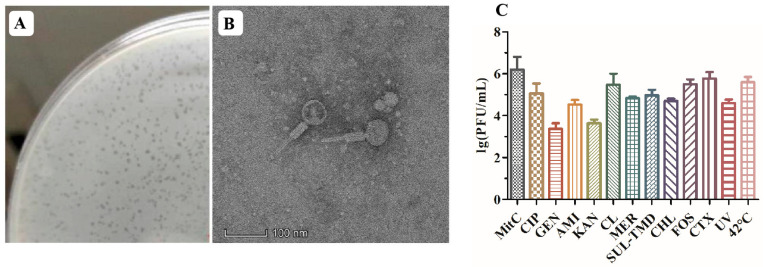
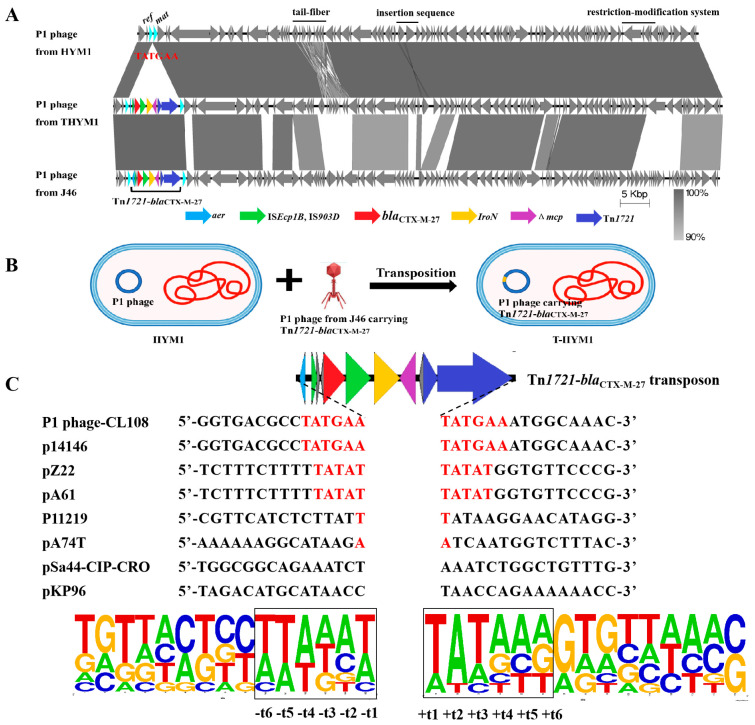
The P1 phage has garnered attention as a carrier of antibiotic resistance genes (ARGs) in Enterobacteriaceae. However, the transferability of ARGs by P1-like phages carrying ARGs, in addition to the mechanism underlying ARG acquisition, remain largely unknown. In this study, we elucidated the biological characteristics, the induction and transmission abilities, and the acquisition mechanism of the gene in the P1 phage. The P1-CTX phage exhibited distinct lytic plaques and possessed a complete head and tail structure. Additionally, the P1-CTX phage was induced successfully under various conditions, including UV exposure, heat treatment at 42 °C, and subinhibitory concentrations (sub-MICs) of antibiotics. Moreover, the P1-CTX phage could mobilize the gene into three strains of () and the following seven different serotypes of : Rissen, Derby, Kentucky, Typhimurium, Cerro, Senftenberg, and Muenster. The mechanism underlying ARG acquisition by the P1-CTX phage involved Tn transposition-mediated movement of into the and genes within its genome. To our knowledge, this is the first report documenting the dynamic processes of ARG acquisition by a phage. Furthermore, this study enriches the research on the mechanism underlying the phage acquisition of drug resistance genes and provides a basis for determining the risk of drug resistance during phage transmission.
P1噬菌体作为肠杆菌科中抗生素抗性基因(ARGs)的载体已受到关注。然而,携带ARGs的类P1噬菌体对ARGs的可转移性以及ARGs获得的潜在机制在很大程度上仍不清楚。在本研究中,我们阐明了P1噬菌体中该基因的生物学特性、诱导和传播能力以及获得机制。P1-CTX噬菌体表现出独特的噬菌斑,并具有完整的头部和尾部结构。此外,P1-CTX噬菌体在各种条件下均能成功诱导,包括紫外线照射、42℃热处理以及抗生素的亚抑菌浓度(亚MICs)。而且,P1-CTX噬菌体可将该基因转移至三株()以及以下七种不同血清型的:里森、德比、肯塔基、鼠伤寒、塞罗、森夫滕贝格和明斯特。P1-CTX噬菌体获得ARGs的潜在机制涉及Tn转座介导的进入其基因组内的和基因。据我们所知,这是第一份记录噬菌体获得ARGs动态过程的报告。此外,本研究丰富了对噬菌体获得耐药基因潜在机制的研究,并为确定噬菌体传播过程中的耐药风险提供了依据。