Tarvin Rebecca D, Coleman Jeffrey L, Donoso David A, Betancourth-Cundar Mileidy, López-Hervas Karem, Gleason Kimberly S, Sanders J Ryan, Smith Jacqueline M, Ron Santiago R, Santos Juan C, Sedio Brian E, Cannatella David C, Fitch Richard
Museum of Vertebrate Zoology and Department of Integrative Biology, University of California, Berkeley, Berkeley, CA 94720 USA.
Department of Integrative Biology and Biodiversity Collections, University of Texas at Austin, Austin, TX 78712 USA.
bioRxiv. 2024 Oct 26:2024.05.13.593697. doi: 10.1101/2024.05.13.593697.
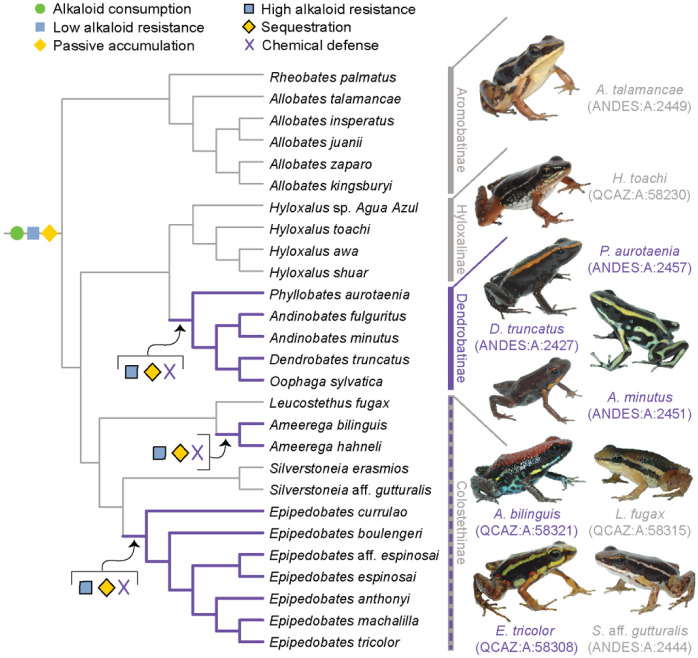
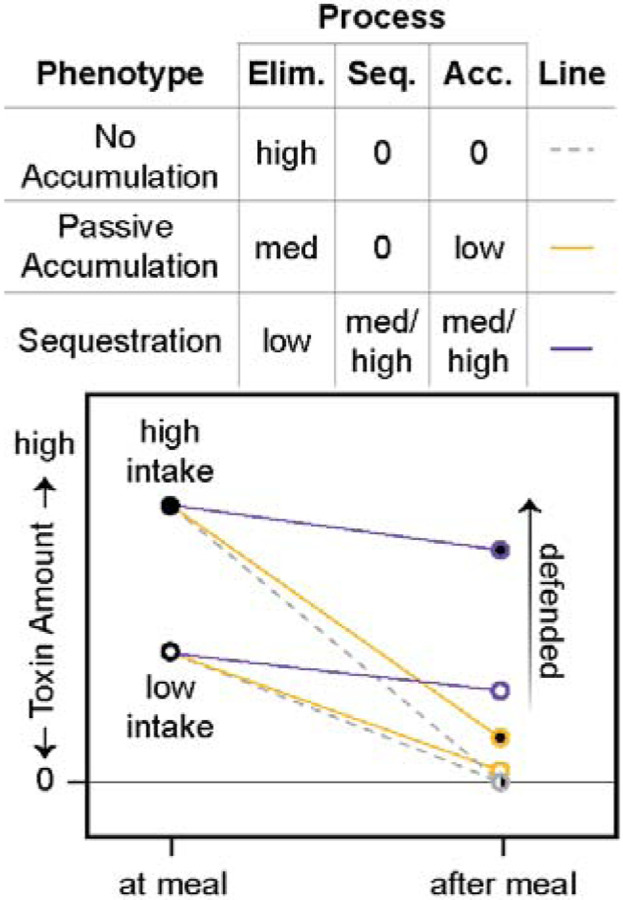
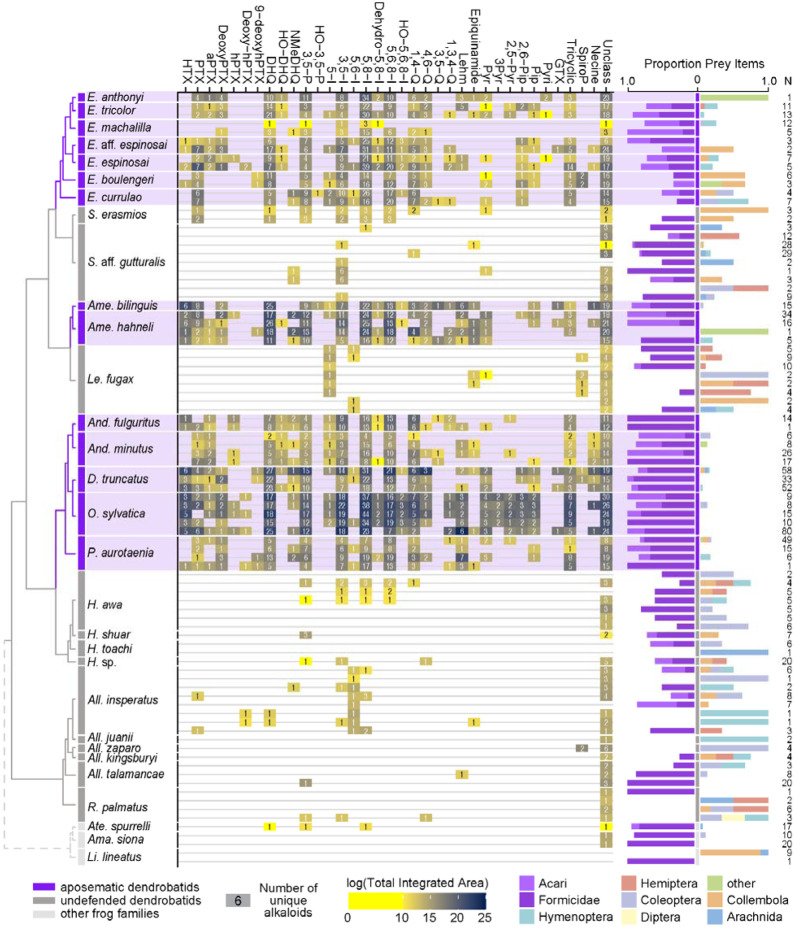
Understanding the origins of novel, complex phenotypes is a major goal in evolutionary biology. Poison frogs of the family Dendrobatidae have evolved the novel ability to acquire alkaloids from their diet for chemical defense at least three times. However, taxon sampling for alkaloids has been biased towards colorful species, without similar attention paid to inconspicuous ones that are often assumed to be undefended. As a result, our understanding of how chemical defense evolved in this group is incomplete. Here we provide new data showing that, in contrast to previous studies, species from each undefended poison frog clade have measurable yet low amounts of alkaloids. We confirm that undefended dendrobatids regularly consume mites and ants, which are known sources of alkaloids. Thus, our data suggest that diet is insufficient to explain the defended phenotype. Our data support the existence of a phenotypic intermediate between toxin consumption and sequestration - passive accumulation - that differs from sequestration in that it involves no derived forms of transport and storage mechanisms yet results in low levels of toxin accumulation. We discuss the concept of passive accumulation and its potential role in the origin of chemical defenses in poison frogs and other toxin-sequestering organisms. In light of ideas from pharmacokinetics we incorporate new and old data from poison frogs into an evolutionary model that could help explain the origins of acquired chemical defenses in animals and provide insight into the molecular processes that govern the fate of ingested toxins.
理解新奇复杂表型的起源是进化生物学的一个主要目标。箭毒蛙科的毒蛙至少三次进化出了从食物中获取生物碱用于化学防御的新奇能力。然而,生物碱的分类群采样一直偏向于色彩鲜艳的物种,而没有对通常被认为无防御能力的不显眼物种给予同样的关注。因此,我们对该类群化学防御如何进化的理解并不完整。在这里,我们提供了新的数据,表明与之前的研究相反,每个无防御能力的毒蛙分支中的物种都含有可测量但含量较低的生物碱。我们证实,无防御能力的箭毒蛙经常捕食螨虫和蚂蚁,而这些是已知的生物碱来源。因此,我们的数据表明饮食不足以解释有防御能力的表型。我们的数据支持在毒素摄取和储存之间存在一种表型中间状态——被动积累,它与储存的不同之处在于它不涉及任何衍生的运输和储存机制,但会导致低水平的毒素积累。我们讨论了被动积累的概念及其在毒蛙和其他毒素储存生物化学防御起源中的潜在作用。根据药代动力学的观点,我们将毒蛙的新旧数据纳入一个进化模型,该模型有助于解释动物后天化学防御的起源,并深入了解控制摄入毒素命运的分子过程。