Department of Biology, Stanford University, Stanford, CA, United States of America.
PLoS One. 2022 Dec 1;17(12):e0276331. doi: 10.1371/journal.pone.0276331. eCollection 2022.
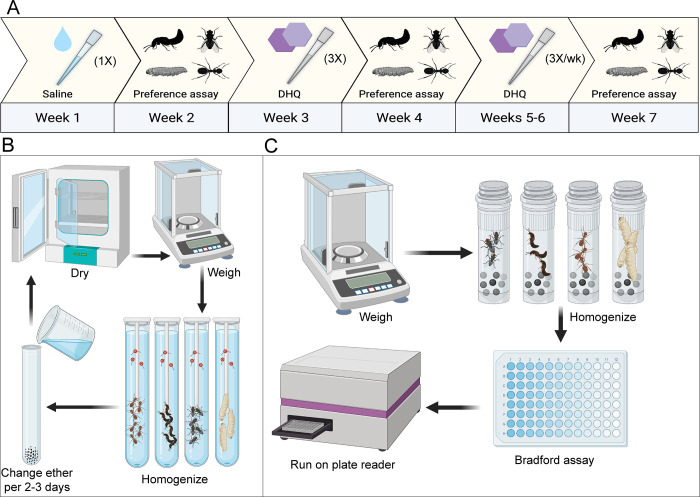
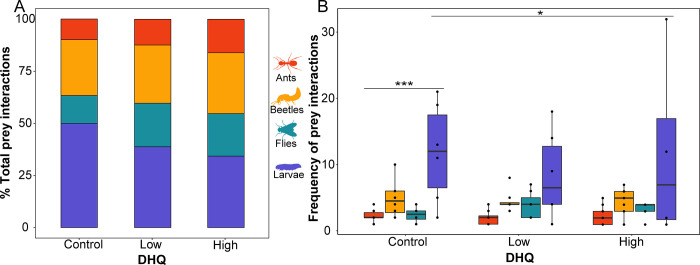
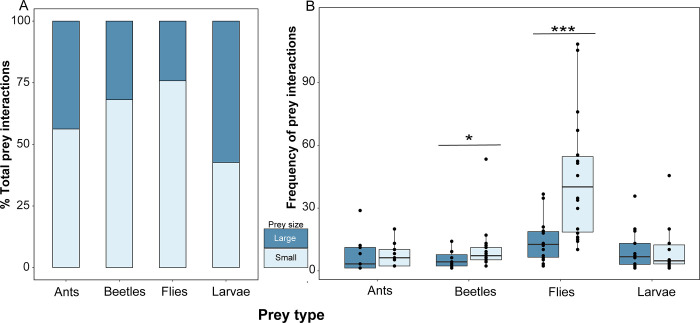
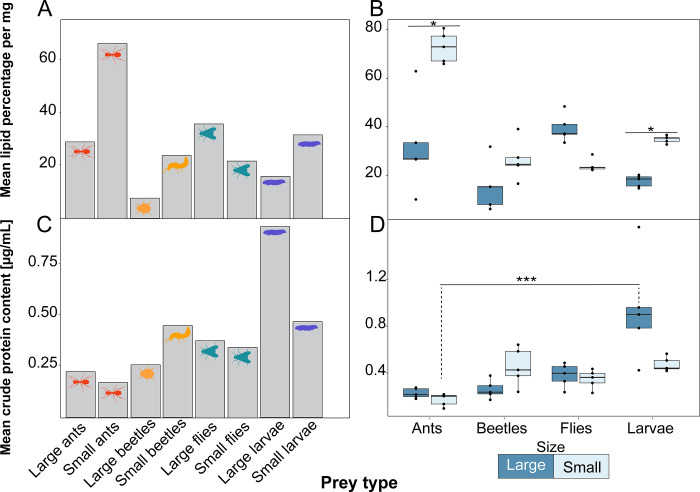
The ability to acquire chemical defenses through the diet has evolved across several major taxa. Chemically defended organisms may need to balance chemical defense acquisition and nutritional quality of prey items. However, these dietary preferences and potential trade-offs are rarely considered in the framework of diet-derived defenses. Poison frogs (Family Dendrobatidae) acquire defensive alkaloids from their arthropod diet of ants and mites, although their dietary preferences have never been investigated. We conducted prey preference assays with the Dyeing Poison frog (Dendrobates tinctorius) to test the hypothesis that alkaloid load and prey traits influence frog dietary preferences. We tested size preferences (big versus small) within each of four prey groups (ants, beetles, flies, and fly larvae) and found that frogs preferred interacting with smaller prey items of the fly and beetle groups. Frog taxonomic prey preferences were also tested as we experimentally increased their chemical defense load by feeding frogs decahydroquinoline, an alkaloid compound similar to those naturally found in their diet. Contrary to our expectations, overall preferences did not change during alkaloid consumption, as frogs across groups preferred fly larvae over other prey. Finally, we assessed the protein and lipid content of prey items and found that small ants have the highest lipid content while large fly larvae have the highest protein content. Our results suggest that consideration of toxicity and prey nutritional value are important factors in understanding the evolution of acquired chemical defenses and niche partitioning.
通过饮食获得化学防御能力是在几个主要分类群中进化而来的。具有化学防御能力的生物可能需要平衡化学防御的获取和猎物的营养质量。然而,这些饮食偏好和潜在的权衡在饮食衍生防御的框架中很少被考虑。毒蛙(Dendrobatidae 科)从它们的节肢动物食物(蚂蚁和螨虫)中获得防御性生物碱,尽管它们的饮食偏好从未被研究过。我们用染色毒蛙(Dendrobates tinctorius)进行了猎物偏好实验,以测试以下假设:生物碱负荷和猎物特征影响青蛙的饮食偏好。我们测试了四个猎物组(蚂蚁、甲虫、苍蝇和蝇幼虫)中每一组的大小偏好(大与小),发现青蛙更喜欢与较小的苍蝇和甲虫猎物互动。我们还测试了青蛙的分类猎物偏好,因为我们通过给青蛙喂食十氢化喹啉(一种与它们饮食中自然存在的生物碱化合物类似的生物碱)来实验性地增加它们的化学防御负荷。与我们的预期相反,在生物碱消耗过程中,总体偏好并没有改变,因为各组的青蛙都更喜欢蝇幼虫而不是其他猎物。最后,我们评估了猎物的蛋白质和脂质含量,发现小蚂蚁的脂质含量最高,而大蝇幼虫的蛋白质含量最高。我们的研究结果表明,考虑毒性和猎物营养价值是理解获得的化学防御和生态位分化的进化的重要因素。