Wieland-Jorna Yvonne, van Kooten Daan, Verheij Robert A, de Man Yvonne, Francke Anneke L, Oosterveld-Vlug Mariska G
Netherlands Institute for Health Services Research (Nivel), Utrecht, Postbus 1568, 3500 BN, The Netherlands.
Tranzo, School of Social Sciences and Behavioural Research, Tilburg University, Tilburg, Postbus 90153, 5000 LE, The Netherlands.
JAMIA Open. 2024 May 24;7(2):ooae044. doi: 10.1093/jamiaopen/ooae044. eCollection 2024 Jul.
Natural language processing (NLP) can enhance research on activities of daily living (ADL) by extracting structured information from unstructured electronic health records (EHRs) notes. This review aims to give insight into the state-of-the-art, usability, and performance of NLP systems to extract information on ADL from EHRs.
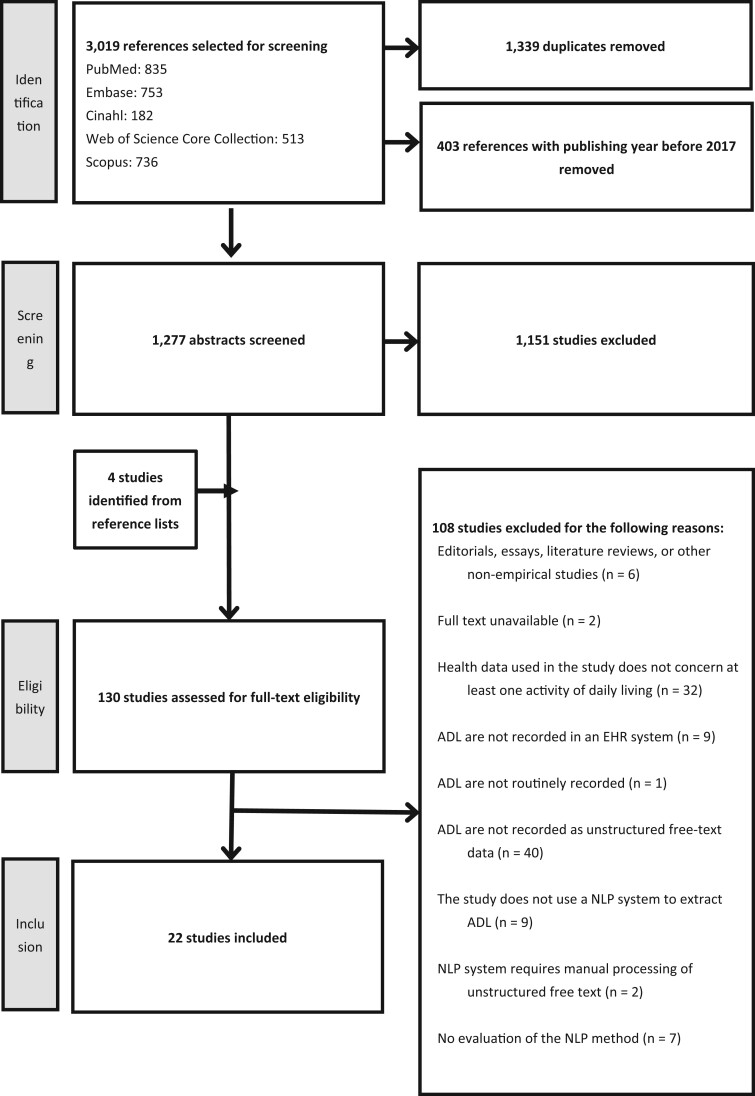
A systematic review was conducted based on searches in Pubmed, Embase, Cinahl, Web of Science, and Scopus. Studies published between 2017 and 2022 were selected based on predefined eligibility criteria.
The review identified 22 studies. Most studies (65%) used NLP for classifying unstructured EHR data on 1 or 2 ADL. Deep learning, combined with a ruled-based method or machine learning, was the approach most commonly used. NLP systems varied widely in terms of the pre-processing and algorithms. Common performance evaluation methods were cross-validation and train/test datasets, with F1, precision, and sensitivity as the most frequently reported evaluation metrics. Most studies reported relativity high overall scores on the evaluation metrics.
NLP systems are valuable for the extraction of unstructured EHR data on ADL. However, comparing the performance of NLP systems is difficult due to the diversity of the studies and challenges related to the dataset, including restricted access to EHR data, inadequate documentation, lack of granularity, and small datasets.
This systematic review indicates that NLP is promising for deriving information on ADL from unstructured EHR notes. However, what the best-performing NLP system is, depends on characteristics of the dataset, research question, and type of ADL.
自然语言处理(NLP)可通过从非结构化电子健康记录(EHR)笔记中提取结构化信息,加强对日常生活活动(ADL)的研究。本综述旨在深入了解NLP系统从EHR中提取ADL信息的最新技术水平、可用性和性能。
基于对PubMed、Embase、Cinahl、科学引文索引和Scopus的检索进行系统综述。根据预先确定的纳入标准,选取2017年至2022年间发表的研究。
该综述共纳入22项研究。大多数研究(65%)使用NLP对1项或2项ADL的非结构化EHR数据进行分类。深度学习与基于规则的方法或机器学习相结合是最常用的方法。NLP系统在预处理和算法方面差异很大。常见的性能评估方法是交叉验证和训练/测试数据集,F1值、精确度和灵敏度是最常报告的评估指标。大多数研究报告的评估指标总体得分相对较高。
NLP系统对于提取关于ADL的非结构化EHR数据很有价值。然而,由于研究的多样性以及与数据集相关的挑战,包括EHR数据访问受限、记录不充分、缺乏粒度和数据集较小等,比较NLP系统的性能很困难。
本系统综述表明,NLP有望从非结构化EHR笔记中获取ADL信息。然而,最佳性能的NLP系统取决于数据集的特征、研究问题和ADL的类型。