Chua Jeremy, Hanko Erik K R, Yiakoumetti Andrew, Stoney Ruth A, Chromy Jakub, Valdehuesa Kris Niño G, Hollywood Katherine A, Yan Cunyu, Takano Eriko, Breitling Rainer
Manchester Institute of Biotechnology, Faculty of Science and Engineering, University of Manchester, 131 Princess Street, Manchester, M1 7DN, United Kingdom.
Metab Eng Commun. 2024 May 15;18:e00237. doi: 10.1016/j.mec.2024.e00237. eCollection 2024 Jun.
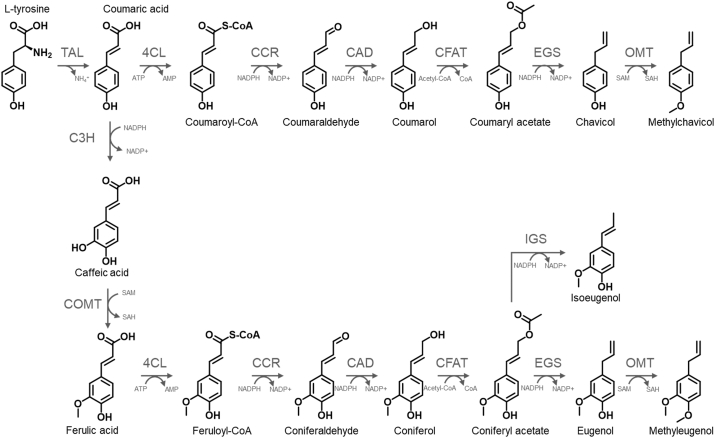
Phenylpropenes are a class of natural products that are synthesised by a vast range of plant species and hold considerable promise in the flavour and fragrance industries. Many studies have been carried out to elucidate and characterise the enzymes responsible for the production of these volatile compounds. However, there is a scarcity of studies demonstrating the production of phenylpropenes in microbial cell factories. In this study, we engineered to produce methylchavicol, methyleugenol and isoeugenol from their respective phenylacrylic acid precursors. We achieved this by extending and modifying a previously optimised heterologous pathway for the biosynthesis of chavicol and eugenol. We explored the potential of six -adenosyl l-methionine (SAM)-dependent methyltransferases to produce methylchavicol and methyleugenol from chavicol and eugenol, respectively. Additionally, we examined two isoeugenol synthases for the production of isoeugenol from coniferyl acetate. The best-performing strains in this study were able to achieve titres of 13 mg L methylchavicol, 59 mg L methyleugenol and 361 mg L isoeugenol after feeding with their appropriate phenylacrylic acid substrates. We were able to further increase the methyleugenol titre to 117 mg L by supplementation with methionine to facilitate SAM recycling. Moreover, we report the biosynthesis of methylchavicol and methyleugenol from l-tyrosine through pathways involving six and eight enzymatic steps, respectively.
苯丙烯是一类天然产物,由多种植物物种合成,在香料和香精行业具有巨大的应用前景。许多研究已经开展,以阐明和表征负责这些挥发性化合物生成的酶。然而,鲜有研究证明在微生物细胞工厂中能生产苯丙烯。在本研究中,我们进行了工程改造,使其能从各自的苯丙烯酸前体生产甲基丁香酚、甲基异丁香酚和异丁香酚。我们通过扩展和修改先前优化的用于合成丁香酚和异丁香酚的异源途径来实现这一目标。我们探究了六种依赖S-腺苷-L-甲硫氨酸(SAM)的甲基转移酶分别从丁香酚和异丁香酚生产甲基丁香酚和甲基异丁香酚的潜力。此外,我们研究了两种异丁香酚合酶从松柏基乙酸酯生产异丁香酚的能力。在本研究中,表现最佳的菌株在添加合适的苯丙烯酸底物后,能够达到13毫克/升甲基丁香酚、59毫克/升甲基异丁香酚和361毫克/升异丁香酚的产量。通过添加甲硫氨酸以促进SAM循环利用,我们能够进一步将甲基异丁香酚产量提高到117毫克/升。此外,我们分别报道了通过涉及六个和八个酶促步骤的途径从L-酪氨酸生物合成甲基丁香酚和甲基异丁香酚。