McKetta Department of Chemical Engineering, The University of Texas at Austin, Austin, TX, USA.
Institute for Cellular and Molecular Biology, The University of Texas at Austin, Austin, TX, USA.
Nat Commun. 2023 Jul 24;14(1):4448. doi: 10.1038/s41467-023-40242-9.
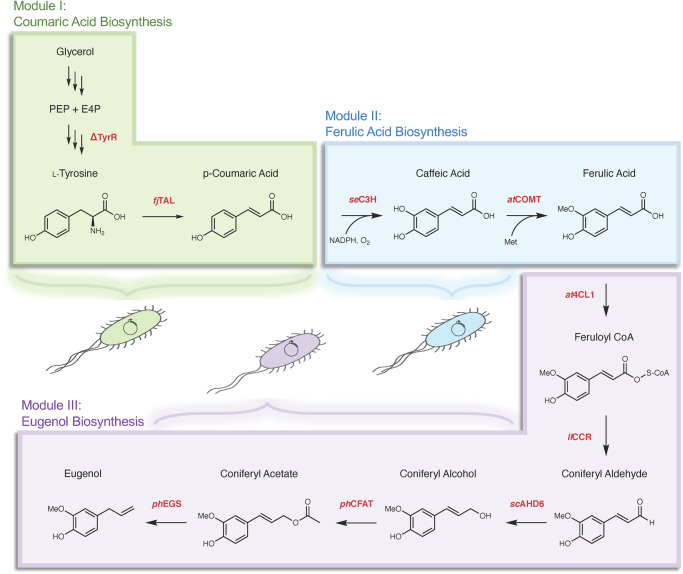
Plant-derived phenylpropanoids, in particular phenylpropenes, have diverse industrial applications ranging from flavors and fragrances to polymers and pharmaceuticals. Heterologous biosynthesis of these products has the potential to address low, seasonally dependent yields hindering ease of widespread manufacturing. However, previous efforts have been hindered by the inherent pathway promiscuity and the microbial toxicity of key pathway intermediates. Here, in this study, we establish the propensity of a tripartite microbial co-culture to overcome these limitations and demonstrate to our knowledge the first reported de novo phenylpropene production from simple sugar starting materials. After initially designing the system to accumulate eugenol, the platform modularity and downstream enzyme promiscuity was leveraged to quickly create avenues for hydroxychavicol and chavicol production. The consortia was found to be compatible with Engineered Living Material production platforms that allow for reusable, cold-chain-independent distributed manufacturing. This work lays the foundation for further deployment of modular microbial approaches to produce plant secondary metabolites.
植物衍生的苯丙烷类化合物,特别是苯丙烯类化合物,具有广泛的工业应用,从香料和香精到聚合物和药物。这些产品的异源生物合成有可能解决产量低、季节性依赖以及难以广泛生产的问题。然而,以前的工作受到固有途径混杂性和关键途径中间体的微生物毒性的阻碍。在本研究中,我们建立了三元微生物共培养物克服这些限制的倾向,并据我们所知,首次从简单糖起始原料报告了从头苯丙烯生产。在最初设计该系统以积累丁香酚后,利用该平台的模块化和下游酶的混杂性,迅速为羟基丁香酚和丁香酚的生产开辟了途径。该联合体被发现与允许可重复使用、无需冷链的分布式制造的工程活材料生产平台兼容。这项工作为进一步部署模块化微生物方法生产植物次生代谢物奠定了基础。