Ye Chaoyi, Wang Tingjun, Wang Huajun, Lian Guili, Xie Liangdi
Department of Geriatrics, The First Affiliated Hospital of Fujian Medical University, Fuzhou, China.
Fujian Hypertension Research Institute, The First Affiliated Hospital of Fujian Medical University, Fuzhou, China.
Front Psychiatry. 2024 May 10;15:1377705. doi: 10.3389/fpsyt.2024.1377705. eCollection 2024.
Calcium channel blockers (CCBs) are widely used in the clinical management of hypertension. Depression, a common comorbidity of hypertension, is an important issue in the management of hypertension. However, the impact of CCBs on depression risk remains controversial. We aim to investigate the causal effect of CCBs on depression through drug-target Mendelian randomization (MR) analysis.
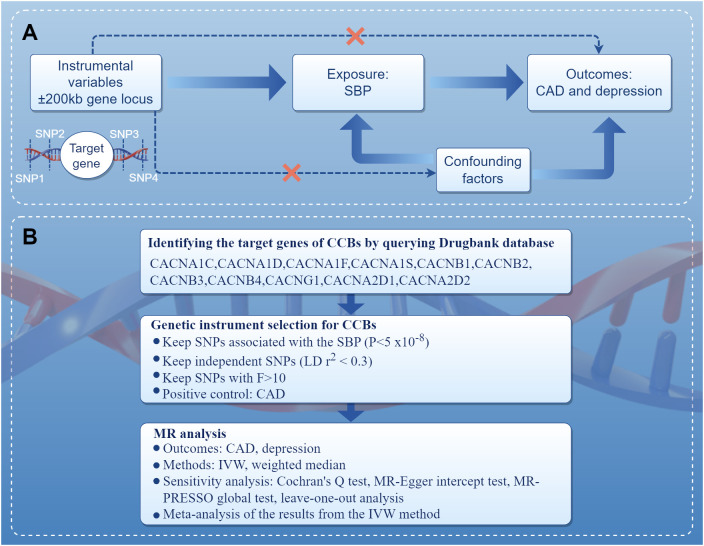
To proxy CCBs, we utilized the genetic variations located in or around drug target genes that were related to systolic blood pressure (SBP). Coronary artery disease (CAD) served as the positive control outcome. Genetic summary data of SBP, CAD, and depression were obtained from genome-wide association studies (GWAS) based on European population. Inverse variance weighted (IVW) method was applied as the main analysis to estimate the causal effect. Cochran's Q test, MR-Egger intercept, MR pleiotropy residual sum and outlier (MR-PRESSO) and leave-one-out sensitivity analysis were used to test the robustness of the results. Meta-analysis was applied to further confirm whether causal relationships existed between CCBs and depression.
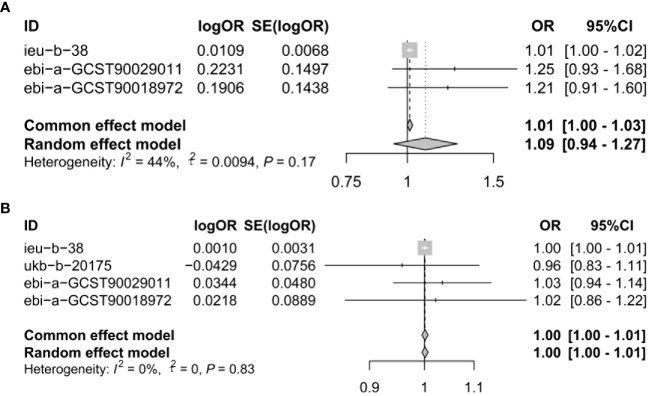
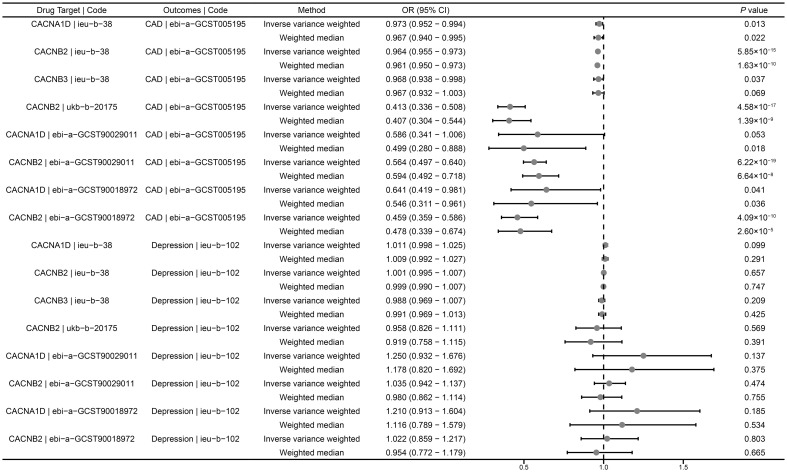
The IVW results failed to reveal any causal relationship between genetic proxies for CCBs and depression ( > 0.05). Cochran's Q test showed no evidence of heterogeneity ( > 0.05). The MR-Egger intercept test suggested no evidence of directional pleiotropy, and the MR pleiotropy residual sum and outlier (MR-PRESSO) global test for horizontal pleiotropy was also not significant ( > 0.05). Leave-one-out analysis did not reveal any genetic variant that influenced the results. In addition, the meta-analysis further confirmed the absence of a causal relationship.
The present study indicates no association of genetic proxies for CCBs with depression. Further studies are necessary to provide definitive evidence.
钙通道阻滞剂(CCB)广泛应用于高血压的临床治疗。抑郁症是高血压常见的合并症,也是高血压治疗中的一个重要问题。然而,CCB对抑郁症风险的影响仍存在争议。我们旨在通过药物靶点孟德尔随机化(MR)分析来研究CCB对抑郁症的因果效应。
为了替代CCB,我们利用了位于与收缩压(SBP)相关的药物靶点基因内或其附近的基因变异。冠状动脉疾病(CAD)作为阳性对照结局。基于欧洲人群的全基因组关联研究(GWAS)获得了SBP、CAD和抑郁症的基因汇总数据。采用逆方差加权(IVW)方法作为主要分析来估计因果效应。使用 Cochr an's Q检验、MR-Egger截距、MR多效性残差和离群值(MR-PRESSO)以及留一法敏感性分析来检验结果的稳健性。应用荟萃分析进一步确认CCB与抑郁症之间是否存在因果关系。
IVW结果未揭示CCB的基因替代物与抑郁症之间存在任何因果关系(>0.05)。 Cochr an's Q检验未显示异质性证据(>0.05)。MR-Egger截距检验未提示定向多效性证据,并且MR多效性残差和离群值(MR-PRESSO)水平多效性全局检验也不显著(>0.05)。留一法分析未发现任何影响结果的基因变异。此外,荟萃分析进一步证实不存在因果关系。
本研究表明CCB的基因替代物与抑郁症无关联。需要进一步研究以提供确凿证据。