Center for Pediatric Obesity Medicine, Department of Pediatrics, University of Minnesota Medical School, Minneapolis, MN, United States.
Division of Endocrinology, Department of Pediatrics, University of Minnesota Medical School, Minneapolis, MN, United States.
Front Endocrinol (Lausanne). 2024 May 10;15:1369270. doi: 10.3389/fendo.2024.1369270. eCollection 2024.
Obesity affects approximately 20% of U.S. youth. Anti-obesity medications (AOMs) are promising lifestyle modification adjuncts for obesity treatment, and topiramate is commonly prescribed in pediatric weight management clinics. It is important to determine "real-world" effectiveness of AOMs and, given shifts towards personalized approaches, characteristics potentially predicting better or worse response. We therefore sought to describe clinical effectiveness from topiramate plus lifestyle modification, and to determine if baseline phenotypic characteristics are associated with better or worse response.
We performed a retrospective cohort study (2012-2020) among youth (<18 years old) followed in a U.S. academic-based weight management clinic. Baseline characteristics (i.e., body mass index (BMI), liver function tests, eating-related behaviors) and outcomes (%BMI of 95 percentile (%BMIp95), BMI, percent %BMI change, weight) were determined through review of electronic health records and clinic intake survey data.
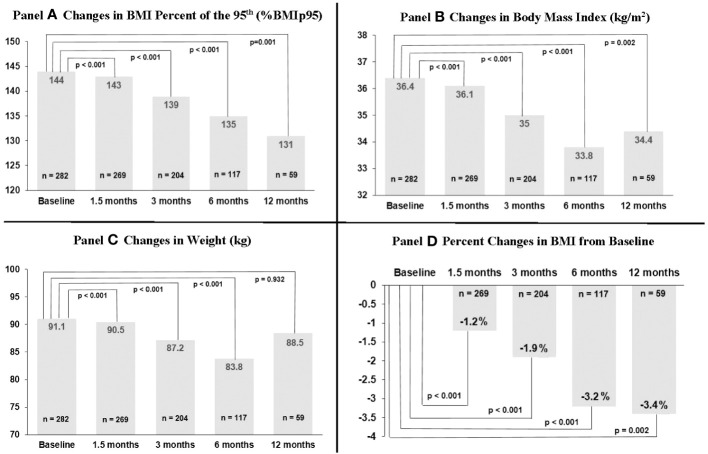
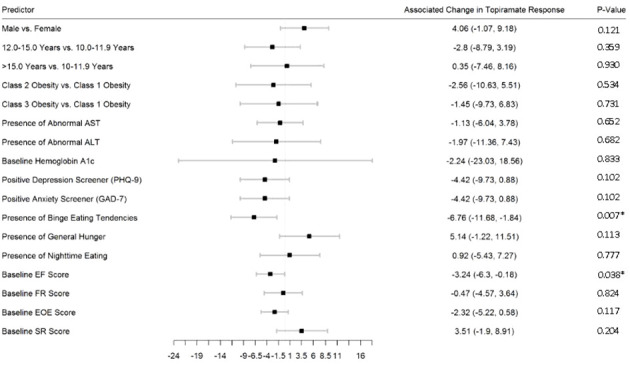
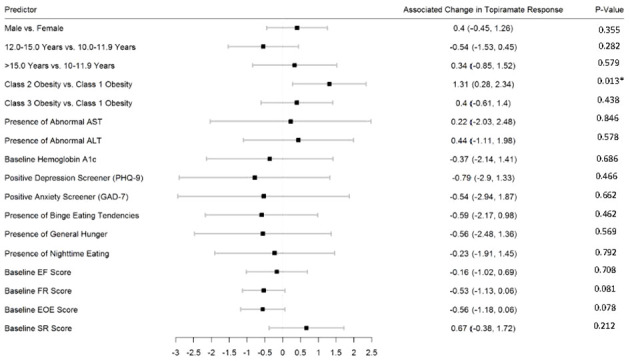
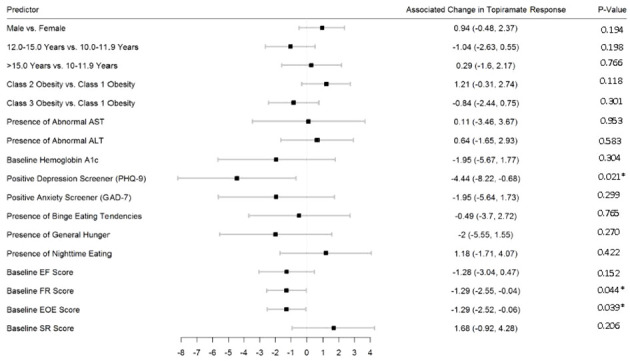
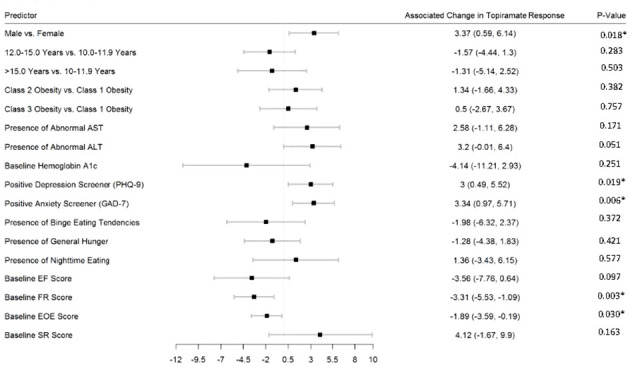
Among 282 youth prescribed topiramate plus lifestyle modifications (mean baseline age 12.7 years, %BMIp95 144%), %BMIp95 and percent BMI change were statistically significantly reduced at each time point (1.5-, 3-, 6-, and 12-month %BMIp95 reductions: -2.2, -3.9, -6.6, and -9.3 percentage points, respectively; percent BMI reduction: -1.2%, -1.9%, -3.2%, and -3.4%, respectively; all p<0.01). Considering multiple comparisons, no baseline characteristics statistically significantly predicted response at any time point.
We found that topiramate plus lifestyle modification reduced %BMIp95 and BMI among youth in a weight management clinical setting, and that no baseline characteristics evaluated were associated with response. These results should be considered preliminary given the observational nature of this study, and prospective studies are needed to further characterize clinical effectiveness and identify and confirm potential predictors of response.
肥胖影响了大约 20%的美国青少年。抗肥胖药物(AOMs)是肥胖治疗中很有前途的生活方式辅助手段,托吡酯常用于儿科体重管理诊所。重要的是要确定 AOM 的“真实世界”效果,并且鉴于向个性化方法的转变,具有预测更好或更差反应的潜在特征。因此,我们旨在描述托吡酯加生活方式改变的临床效果,并确定基线表型特征是否与更好或更差的反应相关。
我们在美国学术性体重管理诊所中进行了一项回顾性队列研究(2012-2020 年),研究对象为青少年(<18 岁)。通过审查电子健康记录和诊所摄入量调查数据,确定了基线特征(即 BMI、肝功能检查、与饮食有关的行为)和结果(%95 百分位 BMI(%BMIp95)、BMI、%BMI 变化、体重)。
在 282 名接受托吡酯加生活方式改变治疗的青少年中(平均基线年龄为 12.7 岁,%BMIp95 为 144%),在每个时间点(1.5、3、6 和 12 个月时%BMIp95 降低:-2.2、-3.9、-6.6 和-9.3 个百分点,分别;BMI 减少:-1.2%、-1.9%、-3.2%和-3.4%,均 p<0.01)。考虑到多重比较,没有基线特征在任何时间点都与反应具有统计学意义。
我们发现,在体重管理临床环境中,托吡酯加生活方式改变降低了青少年的%BMIp95 和 BMI,并且评估的任何基线特征均与反应无关。鉴于本研究的观察性质,这些结果应被视为初步结果,需要进行前瞻性研究以进一步描述临床效果,并确定和确认反应的潜在预测因素。