AlJindan Reem
Department of Microbiology, College of Medicine, Imam Abdulrahman Bin Faisal University, Dammam, Saudi Arabia.
J Family Community Med. 2024 Apr-Jun;31(2):148-152. doi: 10.4103/jfcm.jfcm_280_23. Epub 2024 Apr 15.
(. ), a forgotten pathogen that normally colonizes the upper respiratory mucosa, can be associated with severe and invasive infections. The objectives of this study were to determine the frequency of isolation of . at the microbiology laboratory in a tertiary hospital and the scope of diseases associated with it and to characterize its antimicrobial susceptibility pattern.
This cross-sectional study analyzed the retrospective data, from 2002 to 2021, on cases with laboratory-confirmed isolation of . at a tertiary care hospital. The primary outcome was to identify the scope of . infections and their antimicrobial susceptibility patterns. . isolation was done by cultivation on microbiological culture media, whereas its identification and antimicrobial susceptibility pattern were performed using either Microscan or Vitek automated systems. Data was gathered and analyzed in Excel. The percentage of resistance was calculated as the number of resistant isolates from the total isolates multiplied by 100. Similarly, the percentage of sensitivity was calculated as the number of sensitive isolates from total isolates multiplied by 100.
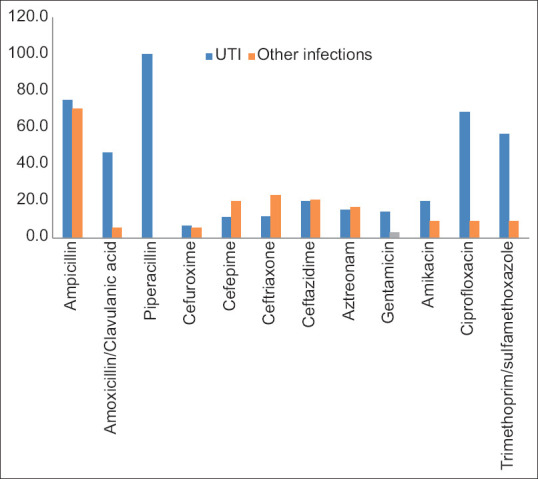
. was detected in 59 cases during the study period. . was associated with urinary tract infections (39%), nasal infections (18.6%), other respiratory tract infections including sinusitis, bronchiectasis, and pneumonia (16.9%), and wound infections (15.3%). It was also associated with invasive infections such as bacteremia (3.4%) and abscesses (3.4%). . showed susceptibility to multiple antibiotic classes, but was resistant to ampicillin, piperacillin, nalidixic acid, and nitrofurantoin. . isolates from urinary tract infections had higher antibiotic resistance percentage than isolates from other infections, particularly to amoxicillin/clavulanic acid ( = 0.007, 95% confidence interval [CI]: 1.84-375), ciprofloxacin ( < 0.0001, 95% CI: 4.6-111.2), and trimethoprim/sulfamethoxazole ( < 0.001, 95% CI: 3.1-63.6).
Our data show that . is a pathogen with a spectrum of diseases wider than expected and a unique antibiotic susceptibility pattern in urinary tract infections.
(.)是一种被遗忘的病原体,通常定殖于上呼吸道黏膜,可引发严重的侵袭性感染。本研究的目的是确定一家三级医院微生物实验室中. 的分离频率、与之相关的疾病范围,并描述其抗菌药敏模式。
这项横断面研究分析了2002年至2021年期间在一家三级护理医院实验室确诊分离出. 的病例的回顾性数据。主要结果是确定. 感染的范围及其抗菌药敏模式。. 的分离通过在微生物培养基上培养进行,而其鉴定和抗菌药敏模式则使用Microscan或Vitek自动化系统进行。数据在Excel中收集和分析。耐药百分比计算为耐药分离株数量占总分离株数量的比例乘以100。同样,敏感百分比计算为敏感分离株数量占总分离株数量的比例乘以100。
在研究期间共检测到59例. 感染病例。. 与尿路感染(39%)、鼻腔感染(18.6%)、包括鼻窦炎、支气管扩张和肺炎在内的其他呼吸道感染(16.9%)以及伤口感染(15.3%)有关。它还与侵袭性感染如菌血症(3.4%)和脓肿(3.4%)有关。. 对多种抗生素类药物敏感,但对氨苄西林、哌拉西林、萘啶酸和呋喃妥因耐药。尿路感染分离出的. 菌株的抗生素耐药百分比高于其他感染分离出的菌株,尤其是对阿莫西林/克拉维酸( = 0.007,95%置信区间[CI]:1.84 - 375)、环丙沙星( < 0.0001,95% CI:4.6 - 111.2)和甲氧苄啶/磺胺甲恶唑( < 0.001,95% CI:3.1 - 63.6)。
我们的数据表明,. 是一种病原体,其疾病谱比预期更广,在尿路感染中具有独特的抗生素药敏模式。