School of Nursing and Health, Zhengzhou University, Jianshe Dong Lu, Zhengzhou, Henan, 450000, China.
The First Affiliated Hospital of Zhengzhou University, Zhengzhou, Henan, China.
BMC Public Health. 2024 May 28;24(1):1419. doi: 10.1186/s12889-024-18634-3.
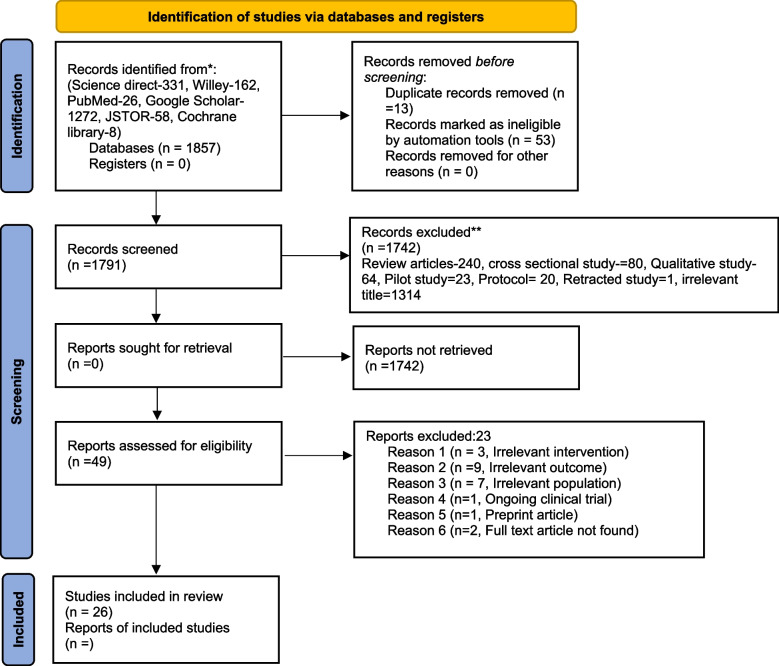
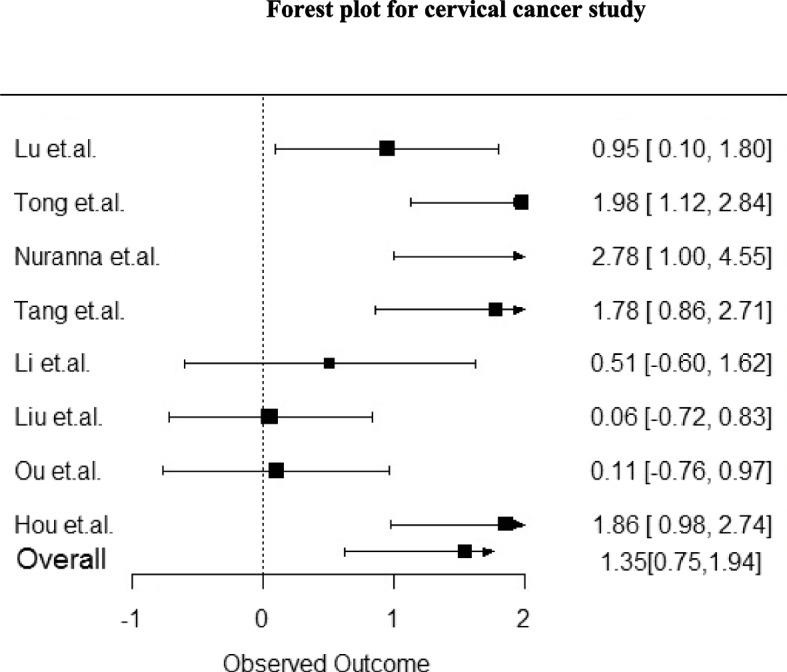
Cervical cancer patients commonly experience psychological supportive care needs, necessitating diverse interventions to enhance psychological well-being and alleviate physical symptoms. This systematic review, covering English-published articles from January 1999 to April 2023, assessed the impact of psychological supportive care interventions on anxiety and depression. Twenty-Six studies, including 11,638 patients, were analyzed, comprising randomized controlled trials; quasi-experimental, and pre-post-test designs from PubMed; Science Direct; Wiley online library; Google Scholar; Cochrane Library; and JSTOR. The extraction of data was done by two independent authors and a third independent author checked the data extraction. The Preferred Reporting Items for Systematic Reviews and Meta-Analyses (PRISMA), 2020 statement was adopted. The population, intervention, comparator, and outcomes (PICO) search strategy was applied. Effective Public Health Practice Project (EPHPP) tool was used to assess the quality of selected articles. Various interventions, such as psychological nursing, exercise, counselling, psycho-curative approaches, peer and family education, psychotherapy, and medication, were identified. Two studies incorporated homework sessions, predominantly administered by nursing staff. Self-Rating Depression Scale (SDS) and Self-Rating Anxiety Scale (SAS) were commonly used instruments. Statistical analysis revealed a significant difference in anxiety and depression scores between treatment and control groups (p < 0.005) post-intervention across all studies. A subsequent meta-analysis of eight homogeneous studies, utilizing a random-effects model, showed a moderate-to-high overall effect size (1.35, 95% CI: 0.75 to 1.94), indicating a statistically significant positive impact. Various studies exhibited variability in effect sizes ranging from low to high. While the meta-analysis included 936 participants, the forest plot visually represents individual study effect sizes and the combined effect size. Preliminary evidence supports the positive impact of psychological supportive care interventions on cervical cancer outcomes, urging further research, especially exploring long-term effects and employing rigorous study designs.
宫颈癌患者通常需要心理支持性护理,需要多种干预措施来提高心理健康水平和减轻身体症状。本系统评价涵盖了 1999 年 1 月至 2023 年 4 月期间发表的英文文献,评估了心理支持性护理干预对焦虑和抑郁的影响。共分析了 26 项研究,包括 11638 例患者,研究类型包括随机对照试验、准实验和前后测设计,数据来源于 PubMed、Science Direct、Wiley online library、Google Scholar、Cochrane Library 和 JSTOR。数据提取由两名独立作者完成,第三名独立作者检查数据提取情况。本研究采用了 2020 年 Preferred Reporting Items for Systematic Reviews and Meta-Analyses(PRISMA)声明。采用人群、干预、对照和结局(PICO)搜索策略。采用 Effective Public Health Practice Project(EPHPP)工具评估选定文章的质量。确定了各种干预措施,如心理护理、运动、咨询、心理治疗方法、同伴和家庭教育、心理治疗和药物治疗等。两项研究纳入了家庭作业课程,主要由护理人员实施。常用的评估工具包括抑郁自评量表(SDS)和焦虑自评量表(SAS)。统计分析显示,所有研究中,干预后治疗组与对照组的焦虑和抑郁评分均有显著差异(p<0.005)。随后对 8 项同质研究进行了荟萃分析,采用随机效应模型,结果显示总体效应量为中等至高度(1.35,95%置信区间:0.75 至 1.94),表明具有统计学意义的积极影响。各项研究的效应量存在从低到高的差异。虽然荟萃分析纳入了 936 名参与者,但森林图直观地显示了个别研究的效应量和合并效应量。初步证据支持心理支持性护理干预对宫颈癌结局的积极影响,需要进一步研究,特别是探索长期效果和采用严格的研究设计。