
焦化废气是京津冀地区空气中颗粒物的一个来源。
Coking exhaust contributes to airborne particulate matter in the Beijing-Tianjin-Hebei region.
作者信息
Wan Xiaoming, Zeng Weibin, Gu Gaoquan
机构信息
Institute of Geographic Sciences and Natural Resources Research Chinese Academy of Sciences, Beijing, 100101, China.
University of Chinese Academy of Sciences, Beijing, 100089, China.
出版信息
Heliyon. 2024 May 16;10(10):e31359. doi: 10.1016/j.heliyon.2024.e31359. eCollection 2024 May 30.
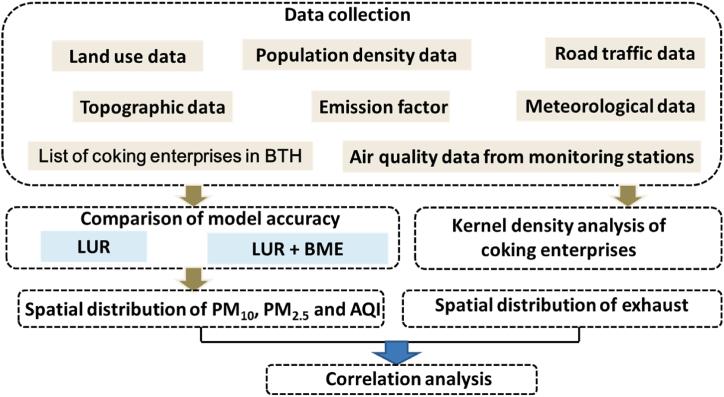
Coking was regarded as a predominant source of air pollution. Despite the adoption of more environmentally friendly equipment, whether the coking enterprises in the Beijing-Tianjin-Hebei (BTH) region are still causing regional air pollution is worthy of study, which is essential for the control of coking enterprises in this area. To improve the prediction accuracy of large-scale air pollutant distribution, the air particle distribution in the BTH region was simulated via land use regression (LUR) combined with Bayesian maximum entropy (BME); then, the distribution was correlated with the exhaust gas emitted from coking enterprises. Results indicated that the R of the "LUR + BME" method reached 0.95, higher than 0.82 using LUR alone. The air quality distribution presented a pattern of "low in the northern mountains and high in the southern plains", similar to the distribution of coking enterprises in BTH region. A significant correlation was found between exhaust emissions from coking enterprises and air quality in the BTH region, confirming the contribution of coking emissions to air pollution in this region, and the necessity to continue the strict control on coking enterprises in BTH area.
炼焦被视为空气污染的主要来源。尽管采用了更环保的设备,但京津冀地区的焦化企业是否仍在造成区域空气污染仍值得研究,这对该地区焦化企业的管控至关重要。为提高大规模空气污染物分布的预测准确性,通过土地利用回归(LUR)结合贝叶斯最大熵(BME)对京津冀地区的空气颗粒物分布进行了模拟;然后,将该分布与焦化企业排放的废气相关联。结果表明,“LUR + BME”方法的R值达到0.95,高于单独使用LUR时的0.82。空气质量分布呈现出“北山低、南平原高”的格局,与京津冀地区焦化企业的分布情况相似。研究发现,京津冀地区焦化企业的废气排放与空气质量之间存在显著相关性,证实了焦化排放对该地区空气污染的贡献,以及继续对京津冀地区焦化企业进行严格管控的必要性。



 Zotero 插件